Wednesday, December 4, 2013

CouponMom letdown

A quick note before we get to the meat of today's blog entry: A week or so ago I noticed that the search feature on this blog (that little box at the right, below the member list) seemed to have stopped working. That is, when I typed in a word that I knew could be found in one or more blog entries, I got no results. I tried messing with the settings to no effect. So yesterday, we did a little experiment: Brian tried adding the search bar to his old blog, The Modern Troll, and it didn't work there either. So as far as we can tell, this problem is occurring across Blogger and isn't limited to my site—which is kind of unnerving, considering that Blogger is owned by Google, the search engine that most of the modern world depends on. I've sent feedback to Google about it, but I don't know whether I'll get a response. In the mean time, if you want to search for a specific topic, I suggest you use the labels, which are just below the search bar. Those still work, though it may take a bit longer to find the entry you want.

And, talking of things not working right: some of you may recall that, after being skeptical for many years about the benefits of coupon use, I was won over by a website called CouponMom, which takes nearly all the work out of matching up the sales at your local stores with the coupons available in the major coupon inserts (SmartSource, Red Plum, etc.). I started making a visit to this website the first step in planning my grocery trips, using it to figure out which stores had enough good deals to make them worth visiting each week. I even featured the site in this year's Thrift Week series, which focused on the best money-saving websites.

This week, however, when I ran my regular weekly search on CouponMom, I was very disappointed. It wasn't because the list of good deals in my area was so short; there are always some weeks when the sales and coupons just don't fall into place, and that doesn't bother me. The problem was that the few deals I managed to find didn't actually work. Here's a copy of my list:

Sort by Cpn DateSort Alphabetically by ItemQty.Sale Price
Mfr Cpn.
Register Price
Per Item

Final Price
All Savings Per Item
% Saved
Pathmark

General Mills Chex Cereals (12.8-14.25 oz.) Cereals
Other Newspaper Coupons: 11-10 S
2$1.98-
=$1.48=$1.4863%

Printable coupon is for $1.00 off TWO BOXES Chex cereals for a final cost of 1.48. 10/20 coupon expires 11/30.
Shoprite

Pillsbury Flour 5 lb. bag1$0.99-
=$0.99=$0.9950%

4-Day Price Break item, price valid 12/4 - 12/7 only!
This is a good item to donate to charity.
10-27 RPTropicana Pure Premium Orange, Grapefruit or Trop50 Juice 59 oz.2$2.50-$1.00=$2.00=$2.0053%
Stop & Shop

General Mills Cereals 8.7 - 14 oz. all varieties
Other Newspaper Coupons: 11-10 S, 11-03 S2
1$2.29-
=$1.29=$1.2966%

promo: buy (4) and get $6 off instantly
Printable coupon is for $0.50 off ONE BOX Honey Nut Cheerios cereal. Final price is after printable coupon.
11-24 RPNivea Lip Care Kiss of Smoothness or Kiss of Recovery 1 ct.2$1.00-$3.00=$0.00=FREE100%

This is a good item to donate to charity.

Total Price:
$9.24Total Savings: 65%

Those two cereal deals looked intriguing, so I thought I'd check out the coupons for both and see which one would work better for us, or whether there might be some way to take advantage of both. The links to the printable coupons worked fine, but when I went to check the "other newspaper coupons," I ran into problems. The site told me I could find coupons in the November 10 SmartSource and the November 3 SmartSource 2, but when I pulled these two coupon inserts out of the file where I store them, I found no cereal coupons at all in either one. It wasn't that I'd already clipped and used them, because I would still have been able to see the spots they'd been clipped from. They'd simply never been there.

Now, it might seem like this is no problem really, because the printable coupons still work, so I could just use those. This would work at the Pathmark sale, where you only need one coupon to get two boxes of cereal for $1.48 each—but the problem with that is that the boxes are only 14.25 ounces at most, so this price would still just miss our cutoff point of 10 cents an ounce for cold cereal. And the Stop & Shop sale wouldn't work at all, because you need to buy four boxes to get the sale price, and printable coupon sites generally allow you to print only two copies of any given coupon. So there's actually no way to get the $1.29-per-box price shown on the list.

Okay, so that particular deal doesn't actually work. As I noted in my Thrift Week entry, that happens sometimes. But the other deals shown on the list should still be okay, right? Well, no, actually. For example, the orange juice deal at the ShopRite: the list says it's for any Tropicana orange or grapefruit juice, but when I dug out the coupon from the October 27 RedPlum insert, I found that it was for Trop50 only. For those of you who aren't familiar with this product, it's an orange juice blend with "50% less sugar and calories" and no artificial sweeteners. Sounds great, until you check the ingredient list and realize that all they've done is take regular orange juice and water it down. Well, for crying out loud, if I want to drink watered-down OJ, I can buy the regular stuff and add my own tap water, and that will cut the price of the juice in half—a much bigger savings than I'll get with their silly coupon. 

So of the five deals that I found in this week's CouponMom list, only three actually work—and one of those is just a straight-up sale that doesn't require the use of a coupon at all. That's an accuracy record of only 60 percent, which makes me question whether I can continue to rely on this site at all. It's still worth checking, I guess, because it does help me find the printable coupons I can use, as well as the good sale prices that don't require coupons (though I could always find those by just checking the sale fliers). But for helping me make use of my coupon inserts, I'm really not sure whether it's any use at all. I think I might be better off going back to my old system:
  1. skim the coupon inserts when they arrive;
  2. clip anything I think I might be able to use; and
  3. when I search the weekly sale fliers, check my small stash of clipped coupons to see if there are any that will stack.
It's a bit more work, but the results should be a lot more reliable.

Monday, December 2, 2013

Home-grown pie

I've been sick all week (more about that in later entries), so today's post will just be a quickie to tell you about our experiment with this year's Thanksgiving pies. Brian and I always bring the sugar to my family's Thanksgiving dinner: a big batch of cranberry sauce and two pies, one apple and one pumpkin. (This has the side effect of ensuring that all the sugar in the meal is organic, so it's less damaging to the planet, even if it's just as fattening.) But this year, we had such a bumper crop of rhubarb that Brian thought maybe we should substitute a rhubarb pie for the traditional apple. And then it occurred to him that, while we were at it, maybe we could use our home-grown butternut squash in place of the pumpkin in the other pie. I'd already seen recipes that talked about substituting other winter squashes for pumpkin, so it seemed like a reasonable idea.

We actually had about a pint of squash in the freezer, left over from the monster that we ate to celebrate the Festival of Butternut, so we didn't have to cut open any of the ones we harvested more recently. A little quick calculation showed that the amount we had stored was roughly equivalent in volume to a 15-ounce can of pumpkin, so we didn't have to adjust our recipe at all. The squash was slightly more difficult to work with, because it was a bit lumpier, but it mixed with the other ingredients just like the canned pumpkin we're used to. Once baked, it looked slightly puffier and lighter in color than our usual pumpkin pie, but still quite appetizing.

I didn't get any pictures of the two finished pies, unfortunately, but they weren't actually as impressive as they usually are. Brian was also a bit under the weather, so he decided he didn't have the energy to top the rhubarb pie with his trademark woven lattice crust, which always impresses the punters. But it turns out that a basic double-crust pie, when made by hand with real butter, gets no complaints about either its looks or its flavor. In fact, even my gluten-averse and health-centric aunt decided that Brian's piecrust was worth cheating on her usual diet for. Everyone who sampled the squash pie said that it tasted just like pumpkin, and no one had any problems with the substitution of rhubarb for apple, either. So it sounds like our established role for future Thanksgivings may involve not only baking the pies, but also growing the ingredients for them.

Sunday, November 24, 2013

Veggienomics

Thanksgiving may be late this year, but winter isn't waiting patiently to arrive. Right now, at around noon, it's 29 degrees outside, with a 30-mile-per-hour wind on top of that. From my perspective this means two things: 1) from this point forward, I'm not going to be annoyed with stores that have their Christmas decorations up already, and 2) I can pretty much declare the gardening season over at this point. Which means that this is a good time to do something I've been planning all year: tallying up the total of all our garden produce for the year and seeing how much money this hobby has actually saved us.

I've been doing my best to keep track, throughout the year, of how much we actually harvested of each crop that we grew. Granted, that wasn't always easy with items like cherry tomatoes, which tend to be priced by the pound: if you're going out and picking Sun Golds by the handful every day, it's a bit of a nuisance to have to weigh each day's pickings on the kitchen scale as soon as you get them inside (especially if there are too many of them to fit in the little measuring cup that came with the scale, so you'd have to do them in multiple batches). So in many cases, I ended up just eyeballing the day's pickings and making an educated guess. Also, it was often Brian who did the picking, and he didn't always notify me immediately about what he'd just brought in, so I sometimes ended up having to guesstimate how much had been harvested over the course of the week. So the numbers below are really just rough estimates, but as the Brits say, they'll do to be going on with.

Once I'd counted up the harvest for each crop in pounds, I had to estimate the regular cost per pound of each crop in the store. For some of them, I just checked the price at the Whole Earth Center, where all the produce is organic and much of it is locally grown; since all our garden produce is organic and as local as you can get, I figured this was a fair approximation of its market value. In some cases, however, I forgot to check on the price of a particular crop while it was in season, so for those I used this price list for produce from a food co-op in Brooklyn. That's reasonably close to us—within 50 miles, anyway—so I figured their prices should a reasonable approximation of what we'd pay in our area.

There was one crop in our garden this year that I wasn't quite sure how to count: the marigolds that we bought at the Rutgers plant sale and tucked in amongst our tomatoes. We did pick a lot of the flowers, so in theory, I could have reckoned up the cost of an equivalent volume of store-bought blooms and added that to the total. In reality, though, we never buy flowers at the store (we just pick whatever's blooming in the garden, even if it's technically a weed), so I decided that counting the store value of the marigolds would be cheating. I'm not saying the money we spent on them was wasted—they did provide a lot of nice flowers for the table, even if it's not clear that they actually did anything to repel pests on the tomato plants—but it can't be counted as a savings on our grocery bill.

So, based solely on the crops we planted and ate this year, our output was:
  • Arugula, 3 bunches (not nearly as good as last year) at $2.99 per bunch: $8.97
  • Basil, 20 bunches (I think this is actually a conservative estimate) at $1.78 per bunch: $35.60
  • Celery, 2 bunches (not a very successful experiment) at $1 a bunch: $2.00
  • Cucumbers, about 4 pounds (2 small, 2 medium, and 6 large) at $2.49 a pound: $9.96
  • Dill, 4 bunches at $2.17 a bunch: $8.68
  • Eggplant, about 10 ounces (four pathetically tiny eggplants) at $2.27 a pound: $1.42
  • Green beans, about 4 ounces (truly pitiful for 3 squares of garden space) at $2.38 a pound: $.60
  • Leeks, about 1 pound (3 small leeks, including one still out there now) at $2.18 a pound: $2.18
  • Lettuce, Boston, 9 small heads at $1.29 a head: $11.61
  • Lettuce, leaf, 6 bunches at $1.29 a bunch: $7.74
  • Parsley, 3 bunches at $1.28 a bunch: $3.84
  • Bell peppers (ripe, various colors), about 1 pound (6 smallish peppers): $5.43
  • Scallions, about 3 bunches (very rough estimate, since we tended to harvest them one or two at a time) at 87 cents a bunch: $2.61
  • Snow peas, about 2 pounds at $5.99 a pound: $11.98
  • Spinach, about 6 ounces (basically just a few stray leaves from our fall planting) at $2.17 a pound: $.81
  • Squash, butternut: 18 pounds at $1.29 a pound: $23.22
  • Tomatoes, cherry: 20 pints at $2.83 a pint: $56.60
  • Tomatoes, heirloom (a couple of Boxcar Willies and 1 large Brandywine), about 1/2 pound at $3.16 per pound: $1.58
  • Tomatoes, other (Moreton and Ramopo), about 2 pounds at $2.99 a pound: $5.98
  • Zucchini, about 14 pounds (6 medium squash, 7 large, and 3 HUGE) at $2.37 a pound: $33.18
TOTAL VALUE of all garden crops: $233.99
TOTAL SPENT on seeds, plants, and compost: $42.95
PROFIT from our gardening venture: $191.04

Looked at in the light of an investment, that's an amazing annual return. We put in $42.95 starting with our seed order back in January, and by the end of November—less than 10 months later—we had more than quintupled our money. I punched the numbers into this little online calculator I found, and it claims that our annualized return on this investment was 617.5 percent. Just for comparison, the About.com "Investing for Beginners" site reports that stocks usually earn about a 10 percent rate of return (before inflation), and bonds get maybe half of that. An ROI of over 600 percent isn't just good; it's literally incredible, in the sense that if someone promises you that kind of return, you shouldn't believe him.

Realistically, though, these figures are misleading, because the money we spent on seeds and compost isn't all we put into this garden. We also invested hours of labor into planting, watering, weeding, pest control, and picking—and the value of that time is much harder to calculate. Although I kept at least an approximate record of everything we put into and got out of the garden, I kept no records at all of how much time we spent cultivating it, so any estimate of the amount of time we put into the garden this year would be more or less a wild guess. But, for the sake of argument, let's go ahead and make a wild guess: let's say that, from April through November, we spent an average of an hour a week on gardening tasks. (That's just for the vegetable garden itself; add in the amount of time we spent on yard work altogether, and it's probably at least twice as much.) That's about 34 weeks, or 34 hours of labor. So if we look at this garden as a job, rather than an investment, then we earned a salary of $191.04 for 34 hours of work, or about $5.62 an hour—much less than minimum wage.

However, that figure doesn't really tell the whole story either. After all, we don't garden simply as a way to save money on our grocery bill; we also do it for the healthy outdoor exercise, and for the flavor of veggies that were picked literally minutes before they landed on our plates, and for the satisfaction of seeing something that we've planted and tended literally bear fruit. All of these factors are virtually impossible to put a price on. So frankly, calculating the value of our garden crops doesn't tell me whether gardening is a worthwhile activity, because we already knew that, for us, it is; we wouldn't do it otherwise. (Even if the savings on groceries are fairly impressive, if that were the only consideration, it would probably be easier to find some way to work a few more hours each year and spend the proceeds on food.)

So, in the grand scheme of things, calculating the dollar value of our garden crops doesn't actually tell us much about the value we get from gardening. However, it's much more useful for seeing, not the big picture, but the fine details—that is, figuring out which particular crops give us the best return on the money and time we invest in them. And based on the numbers above, I think it's reasonable to say that we get great value from our basil, zucchini, and butternut squash—all of which not only gave us huge yields, but also required very little work to grow. (Okay, we did need to invest a bit of effort into protecting our zucchini from squash vine borers and processing all the basil that we harvested, but in general, these crops gave us a pretty massive bang for our buck.) Our eggplant, by contrast, gave us pathetic yields even after all the effort Brian put into protecting it from squirrels. Our peppers barely broke even, since we had to purchase plants after the seedlings we started failed to germinate, and then those plants, despite their head start, barely produced anything. And our Sun Gold tomatoes, though they certainly gave us a huge dollar value for the amount we spent on the seeds, were so much work to maintain that I don't think we can possibly afford to devote this much space to them next year.

So on the whole, I think my calculations give us some useful information that we can apply when planning next year's garden. For example:
  • DO plant lots of butternut squash—maybe even more than three plants, since you can't really have too many of a squash that will keep all winter long.
  • DO continue to plant two, but only two, zucchini plants (fewer and you risk having your only plant succumb to squash borers; more and you risk having more zucchini than any sane person could eat).
  • DO continue to use the "carpet bomb" method for sowing basil, which provides massive yields with very little effort. (No room for weeds in a patch completely full of basil!) DO try using the same technique with leeks and scallions, and possibly even lettuce, in hopes of boosting our yields next year.
  • DO get the snow peas into the ground earlier, so they'll have as long a growing season as possible.
  • DON'T bother growing eggplant next year.
  • DON'T attempt again to grow the varieties of peppers, green beans, or celery that we planted this year. Look for others that offer better yields.
  • DON'T, under any circumstances, plant more than two Sun Gold tomato plants—and keep those plants isolated at the end of a row, so they can't take over the whole bed. That way we might actually manage to get some tomatoes off our other plants.

Sunday, November 17, 2013

Bushwhacked

Last year, when Brian and I splurged on a consultation with a professional landscaper, one of the questions I asked her was what would be a good choice to replace the vastly oversized foundation shrubs along the front of our house. She suggested that this would be a good place for a "pollinator garden," made up of flowering native plants that would attract beneficial insects. This sounded good to me, but I wasn't crazy about the specific plants that she suggested, which included Joe-Pye Weed, New York ironweed, goldenrod, New England Aster, boneset, mountain mint, bee balm and catmint. I looked them up and found that not only do some of them grow up to five feet tall, which would be even taller than the existing shrubs, but all of them go dormant in the winter. That is, instead of simply dying back, they dry out and sit there all winter long looking brown and shriveled. Some people apparently like this, as many sites recommend these plants for "winter interest," but to me, based on the pictures I've found online, they just look depressing.

However, while doing a little poking around online in search of possible lawn alternatives for the rest of the front yard, I happened upon the American Meadows site, which offers a variety of wildflower seed mixes specially selected to perform well in different regions of the country. Their Northeast mix  will supposedly grow in agricultural zones 2 through 7, in full or partial sun, and in any type of soil, including clay. They've been carefully chosen to provide blossoms throughout the growing season, from spring until frost, so we'd never be short of fresh flowers for the table. (The FAQ specifically notes that wildflowers are great for cutting, as they're "so prolific, the ones cut will never be missed." In fact, cutting actually extends the bloom time for annuals.) The blend includes a combination of annuals and perennials, so the annuals will bloom the first year and the perennials will take over in succeeding years. Plants range in size from 9 inches to 4 feet tall, which would put the tallest flowers right about at the bottom edge of the window, filling in the entire area below with be a mass of flowers of different heights. And they shouldn't require any special care beyond watering during dry spells.

So all in all, planting the entire area with this wildflower seed mix seemed like a much better bet than trying to handpick my own plants for the area. Before we could do that, however, we had to get rid of the two huge evergreen shrubs that were there already. (The big forsythia at the far left in the picture above had already come out earlier in the year.) Knowing that pulling these out was likely to be a fairly big undertaking, I thought it would be best to tackle it this fall, so that next year, we could get the seeds straight into the ground as soon as it was warm enough. So this weekend, with the clock ticking rapidly down to winter, we finally got on it. Where those two big shrubs once stood, there's now nothing but a clear, open space...

...and a huge mass of English ivy, which I foolishly allowed to grow unchecked because I liked the way it looked climbing over the railing. Once the shrubs were gone, it became apparent that the ivy had actually taken over pretty much the whole area that used to be underneath them.

This, presumably, will have to come out also before the wildflowers can go in, since ivy is a fairly aggressive plant that doesn't play well with others. (In Oregon, homeowners are warned about "ivy islands," areas in which ivy has smothered all the other vegetation.) Fortunately, the sources I've consulted indicate that ivy has fairly shallow roots, so it shouldn't be too difficult to pull it out and clear the bed for planting. We can probably safely leave it there to add a little touch of green through the winter and pull it out right before we plant in the spring. (However, I'll have to be vigilant about keeping an eye on it and pulling out any stray shoots that pop up next year, or it could quickly take over the bed again.)

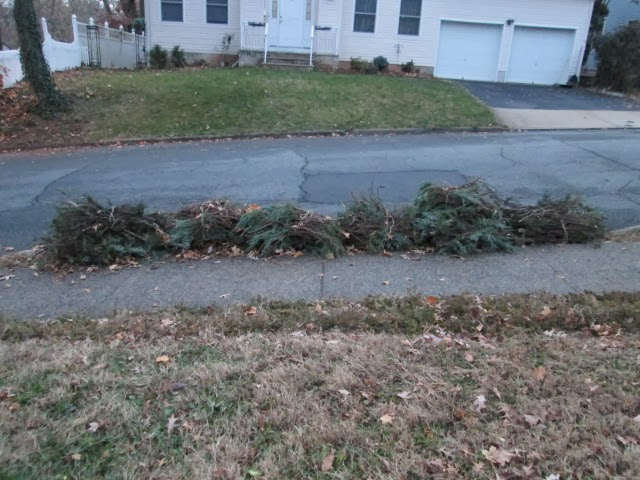
One of the most fascinating things about pulling out these two monster shrubs was that they actually seemed to increase in volume when we cut them down. Just those two shrubs produced everything you see here in this pile by the curb, plus a big trash bucket full of boughs that we set aside, on the principle of "waste not, want not," for our holiday decorations. I had already decided I'd like to do a bit more this year than just our usual single strand of white lights and evergreen trimmings around the front door, and I think this greenery with the white berries still attached will make a fetching base for some indoor arrangements.

So now we just have to order the wildflower seed and then wait until spring to plant it. A quarter pound of seed, which is the smallest amount available, will cost about ten dollars and should enough to cover this little patch ten times over. (I'm actually toying with the idea of doing a little guerrilla gardening with the leftovers in a vacant lot up the street from us, which has been sitting empty for years and would look a lot nicer as a wildflower meadow than just a mass of poorly trimmed grass.) And in the meantime, we'll actually get to enjoy the full use of our living room window throughout the winter—something we haven't had since we first moved into this house. Even now, on a November afternoon, it's amazing how much more light there is in the room than there was before.

Friday, November 8, 2013

Winter warmer-upper upgrade

A couple of years back, I posted about my alternative to the Snuggie and other sleeved blankets: a pair of $2 fleece throws from Walgreens. At the time, I was quite pleased with this frugal design, but with each succeeding winter, I grew a little less satisfied with it. Compared to the sleeved blankets I was trying to emulate, my double-blanket design was a lot harder to wear. The first problem was that the fleece "cape" didn't stay put very well while I was sitting at my computer and typing. This was fairly easy to fix: I just cut a slit in the center of the blanket that I could put my head through, so I could wear it like a poncho, as shown.

This modified design was reasonably comfy when I was settled in at my computer, but I couldn't easily get up and walk around with it on. The bottom layer (the green fleece that you can just see the bottom of in the picture) was just wrapped around my body like a bath towel, and it didn't stay put very well. After a while, I found it was too much of a nuisance, so I started wearing just the poncho—but that covered only my torso, leaving my legs as chilly as ever. Also, as you can see, it didn't really cover my arms fully.

So this year, as the cold weather settled in, I found myself shivering and grumbling at my desk once again. Brian, growing tired of my complaining, proposed getting me one of those sleeved blankets after all, but I still couldn't convince myself that it was worth the 30 bucks for a Slanket (the Snuggie is cheaper, but according to reviews, it would be overpriced at free).What I really needed, I thought, was an upgrade to my current design: a blanket that could be worn poncho-style, but would cover my entire body. This design, I suspected, would actually work better than the blankets with sleeves, because my arms could be tucked in under the body of the blanket, with all that trapped body heat, rather than isolated in the sleeves. But would it also be cheaper?

To find out, we popped into a Bed Bath & Beyond, where we found a simple fleece blanket for only $20 in a twin size. Since BB&B sends a steady stream of store coupons into my mailbox, I was able to take an additional $5 off, making the total only $16 with tax. Once I got it home, I simply folded it into quarters, cut a slit in the exact center, and voilà: a loose-fitting robe suitable for either a wizard or a Biblical prophet. It comes down nearly to my toes, and the sides cover my arms right down to my fingertips (or would, if I didn't have to push them back a bit to type). And when I sat down with it on, I felt noticeably warmer almost immediately.

The only part of me that's still cold, unfortunately, is my hands. I have no idea where it could be coming from, but I swear it feels like there's a cold draft in this room blowing right across my keyboard. Maybe the next modification to the design should be figuring out some way to cover my hands while still allowing me to type. (Actually, right now I'm touch-typing underneath a sort of tent formed by draping one of the old, smaller fleece throws over top of the keyboard, and it doesn't seem to be working too badly. But it's probably not practical for the long term.)

Looking for "the catch"

Each week, my Tip Hero newsletter names a recommended Website of the Week. Most of them aren't particularly useful for me; some are sites I already knew about, some are offer deals on products or services I don't use very often (like travel), and some are apps for a smartphone, which I don't have. However, last week's Website of the Week was a site called PriceBlink, which actually looked mind-bogglingly useful. According to the article, when you download the free PriceBlink add-on to your browser, it stays hidden most of the time; however, whenever you view a product at an online shopping site, it will search its database of other merchant sites for the same product and let you know if any of them can sell it to you cheaper. It can also automatically find and display coupons for any store you're viewing. You can even set up a Wish List of products you're planning to buy, and the site will e-mail you when it finds something at the price you want.

Sounds great, right? Sounds like something no frugal shopper could afford to be without, in fact. Which is why my immediate reaction was not to download it immediately, but instead to ask myself, "What's the catch?"

See, I doubt that the people who developed the add-on and run the site (checking all those coupon codes to keep them up to date) are doing it purely for the fun of it. So if they aren't charging anything for the service, how are they making their money? I went to the PriceBlink site and read through the "About Us" and "FAQ" sections, and neither one answered this question. This made me even more suspicious, since I thought that if they weren't saying how the site makes money, it was likely to be by doing something they don't want you to know about—like tracking the web browsing history and purchases of everyone who uses the add-on, and then selling that information to data miners. (That doesn't actually bother me if they're just tracking the aggregate behavior of all their users—that is, keeping track of how many people use various sites and purchase various products—but if they are tracking my individual behavior in a way that can be traced back to me, that's crossing the line.) But no, I checked the site's terms of use and privacy policy, and it said very clearly that the site does not gather any personally identifying information except what you choose to provide; you don't need to submit any to get the add-on to work. In fact, Lifehacker specifically promotes PriceBlink as a price-comparison engine that's "privacy conscious."

Further down, the privacy policy discusses its use of "passive data," and here I got my first hint as to how PriceBlink might be making its money; the site admitted that it allows third-party cookies to gather "information about your visits to PriceBlink and other web sites" in order to show you targeted ads. However, pretty much every site seems to do that nowadays without even telling you about it; whenever I do a report for work on, say, refrigerators, I see nothing but ads for refrigerators for the next week or so. Moreover, the privacy policy stressed that "We do not provide these third parties with any personally identifying information," so while I may see targeted ads on my computer, they won't seek me out and find me when I'm on someone else's computer—and I can always get rid of them by clearing my cookies.

I wasn't sure this was the whole story, though, so I did a Google search on "How does PriceBlink make money?" That turned out to be a dead end, though; all I got was a bunch of articles touting PriceBlink as a way to save money. So I tried asking explicitly, "What's the catch with PriceBlink?", but the only other site I could find that seemed to have asked this question was a blog called Cafe Mom, and the blogger there said that she hadn't been able to find one. However, that search did turn up a news story from last year that listed the top fifteen most-searched-for items on Cyber Monday 2012, based on data from PriceBlink. This led me to conclude that my guess was right—PriceBlink is making money from selling data. However, based on the article and the privacy policy, it sounds like they're doing so only in the aggregate, and that, as I said, I can live with.

So at this point, I figured I had nothing to lose by clicking on the "add to Chrome" button. I did twitch a little when the browser popped up a message saying that this app could "Access your data on all websites" and "Access your tabs and browsing activity," but since I'd already looked into what the site did with that data, I felt confident enough to click "Add." I spent a few minutes playing with the little toolbar, seeing how it could show me price comparisons, coupons, and even product reviews. I don't know yet how much I'll use it, but having done my homework, I know it's not doing any harm by being there.

And that, I think, is the takeaway from this story: when you're offered a great deal on anything, it always makes sense to look for the catch. In some cases, like this one, there may not be one, or it may be one that you're perfectly happy to live with. But it might not be, so it pays to ask the question before clicking "Yes." And this is doubly true with anything that's free, because you know they wouldn't be offering it to you unless they expected to make money on it somehow. Maybe the book club is offering you five books for free because in order to get them, you have to buy ten books at ridiculously inflated prices, and so all fifteen books will end up costing more than they would on Amazon.com. Or maybe that Craigslister is giving away the old couch because it's infested with mold or bedbugs, and the listing neglected to mention the fact. Needless to say, I don't think that there must always be a catch with anything that's free; I wouldn't be such an avid Freecycler if I did. But I do think that if there is a catch, you'll never find it if you don't look.

Wednesday, November 6, 2013

Squash salvage

Last night Brian decided it was time to harvest what was left of our squash, tomatoes, and peppers (well, really pepper, singular) before the frost got them. This picture doesn't show all the Sun Golds he picked (they went into the oven straightaway for another round of oven-dried tomatoes), but it's still a pretty good haul. We got five more full-sized butternut squash in addition to the five we've harvested already, plus one green pepper and more than 20 heirloom tomatoes—only one of them even slightly red, but the others can be ripened up nicely in a newspaper-lined box.
However, as you can just make out in the picture, in our haste to bring in all the squash, we broke off the stems. This is bad, because multiple sources—from nurseries to state extension offices to Organic Gardening magazine—say that squash won't keep well if the stem is removed. Breaking off the stem, sources indicate, exposes the flesh of the squash to microorganisms that cause it to rot. So when I noticed that all five of our squash had been damaged in this way, I feared that we were going to have to eat them all up in a hurry, or else figure out some way to make room for a lot of squash puree in our freezer.

Fortunately, Brian reassured me that he's picked squash this way in the past, and they still keep for several weeks at least. Maybe not all winter, but then, given how many things we like to make with butternut squash, it's unlikely they'd last that long anyway. However, he also mentioned that if I was concerned about them, it might be possible to patch the damaged ends somehow. A quick search turned up a comment on the Farmer's Almanac website saying that if the stem breaks off a pumpkin, you can disinfect the "wound" with a bleach solution and then seal it up with a dab of petroleum jelly. I didn't have these things handy, however, so instead I selected a couple of the smaller squash (the two that looked most severely damaged), wiped them down with hydrogen peroxide, and then sealed up the wound with melted wax. I had some leftover Hanukkah candles from last year, and I knew from experience that they drip like crazy, so I just lit one and held it over the damaged part of the squash, moving it from spot to spot until the entire breach in the flesh was covered. Since I used an orange candle, it doesn't even stand out that much.

We'll store the two wax-patched squash along with the three others and see whether they seem to keep any better than the ones that haven't been patched. If so, then we've learned a potentially useful trick for salvaging any squash that get damaged from future crops; if not, then as Thomas Edison said, we've discovered a way that doesn't work. But either way, we've learned to cut the stems in future, rather than pulling the squash right off the vine.