Showing posts with label waste. Show all posts

Monday, June 8, 2026

Tracking our household food waste

Every so often, I see a statistic about food waste that makes my jaw absolutely drop. It's shocking enough to hear that the world as a whole wastes about one-third of all the food it produces, to the tune of $388 billion and 2 million tons of CO2 equivalent each year. But that number is so big and abstract, it's hard to visualize how it applies to you personally. If you want a real head-spinner, check out this 2025 EPA report, which says the average family of four in the U.S. throws away around 1,025 pounds of food every year, at a cost of more than $2,900. Nearly three grand, going straight in the trash.

When I saw this number, I found it kind of hard to believe. How is it even possible to throw that much food away? Do most Americans dump all their leftovers straight in the bin instead of saving them for lunch? Are they leaving entire watermelons to rot in the fridge uneaten? 

But then I started second-guessing myself. According to a 2025 Slate article (currently available only to subscribers), 75 percent of Americans think their personal food waste is less than average, and clearly they can't all be right. Was I seriously underestimating our own household's food waste? Were we actually chucking away ten pounds of food every week without realizing it?

There was only one way to be sure. In April 2025, I started keeping track of all the food we wasted in our household, from the bad spots we removed from our strawberries to the teaspoon of coffee grounds I spilled while emptying out the old container. For an entire year, I made an entry every time any food in our house went into the bin, listing the type and amount of food, the reason we had to toss it, and where it ended up. Here is that list in full:

4/24/25: salad dressing, about 2 Tbsp, bottle popped open while being shaken. Wiped up on rag and rinsed down drain.
5/7/25: popcorn kernels, about ½ cup, knocked over container. Compost.
5/14/25: dried Biquinho peppers, about 1 tsp, grew mold. Compost.
5/27/25: coffee creamer, ¼ cup, went sour. Down the drain.
Coffee, 1 cup, ruined by sour creamer. Down the drain.
5/30/25: Strawberries, about 5 oz, bad spots removed immediately after purchase. Compost.
6/1/25: 1 batch vegan whipped cream that didn’t whip (about ½ cup coconut oil, ½ cup soy milk). Compost.
6/7/25: ½ cup coffee w/coconut milk, got too slimy to drink. Down the drain.
6/11/25: Strawberries, 3.6 oz, bad spots removed. Compost.
6/13/25: Strawberries, 2.3 oz., bad spots removed. Compost.
6/15/25: 1 tsp cocoa and 1 tsp sugar, added too much water during prep. Down the drain.
7/29/25: True Lime, 1 packet, congealed. Trash.
8/16/25: 1 cup coffee with creamer, added too much inulin. [N.b.: this is a fiber supplement I've been adding a teaspoon of to my daily coffee to help regulate my digestion.] Down the drain.
10/20/25: 1 tsp coffee grounds, spilled. Most swept up into compost, some down the drain.
11/7/25: 1 tsp sugar, spilled. Into compost.
11/9/25: ½ tsp coconut creamer, spilled. Wiped up, rinsed down drain.
11/15/25: nearly full box of corn starch, infested with bugs. Into compost.
11/23/25: about ½ cup powdered sugar, also infested. Into compost.
About 2 cups mashed potato flakes (ancient), also infested. Into compost.
About 2 cups corn grits, also infested. Into compost.
½ jar mayonnaise, 18 months past “best by” date (bought during low carb period that mercifully ended). Compost. [N.b.: this might still have been safe to use, but we decided not to take the risk.]
1/9/26: ½ cucumber, spontaneously disintegrated. Compost.
⅓ apple, cut off bad spots. Compost.
1/15/26: ⅔ apple, went mushy. Compost.
2/26/26: 12 ancient peppermint tea bags, no flavor left. Compost.
1 package brownie mix, burst open. Bagged and binned.
3/14/26: ½ c coffee creamer, went sour, down drain.
1 c coffee, ruined by sour creamer, down drain.
3/29/26: ½ plum tomato, went slimy. Into compost.
4/6/26: 2 green potatoes, into compost.
4/8/26, 1 spoiled potato, into compost.
4/10/26, 7 dates, went bad in storage. Into compost.
4/14/26: 4 homemade veggie cakes, dropped on floor, into compost.

I didn't actually weigh all the food we discarded, but based on a very rough estimate, it appears to be between 12 and 13 pounds. For the whole year. For both of us. It's still a lot more food waste than I'd like; if I'd been really on the ball, I wouldn't have let that coffee creamer go off (not once but twice) or knocked over the popcorn container or added too much water to my morning cocoa. But it's clearly much, much less than the EPA's estimate of 256 pounds per person per year.

The value of all that discarded food is a bit harder to calculate because some of the items were so old. I can determine how much we'd pay for a box of tea bags or a jar of mayonnaise today, but I have no idea how much we paid for those items when we actually bought them years ago. The best I could do was figure out roughly how much all those items would cost to replace at today's prices. That number, as closely as I can calculate, is around $20.40. Again, that's much more than I'd like, but it's a far cry from $1,456 for the two of us.

Now, it's possible the EPA's numbers are way off. The report is based on a USDA data set that the USDA itself admits may not reflect "actual loss rates." However, I've also seen a 2023 survey of actual Americans showing that the average household wastes 6.2 cups of food per week, while our household wasted roughly 22 cups in an entire year. So it seems more likely that our two-person household is an outlier, producing only (at most) 5 percent as much food waste by weight and 1 percent as much by cost as the average.

So, on the one hand, this experiment shows yet again that our ecofrugal lifestyle isn't normal, at least not by American standards. But on the other hand, it shows that reducing household food waste is a very attainable goal. Brian and I don't do anything particularly odd or extreme to avoid wasting food; we just do the straightforward, common-sense things most sources recommend. We eat up leftovers; we store food properly (produce in the produce drawer, heat-sensitive stuff toward the rear, pantry staples in closed jars); we try not to buy or prepare more food than we can reasonably eat. And if anything looks like it's getting close to the end of its shelf life, we make a point of using it right away. The only thing we do that most Americans couldn't is composting, and that's more like recycling food waste than reducing it.

In short, reducing household waste looks like a pretty simple way to cut carbon emissions. It doesn't require any up-front investment; in fact, it actually saves you money by directing more of your grocery dollars into your stomach instead of the trash bin. All that's needed, apparently, is a bit more education about how costly food waste is and how easy it is to avoid. So...consider yourselves educated.

Friday, January 23, 2026

Thrift Week 2026, Day 7: How to Recycle Plastic Bags

I'm going to wrap up this Thrift Week series with a type of waste that's particularly ubiquitous: plastic bags. Actually, here in New Jersey, they're a lot less ubiquitous than they used to be, as the state banned single-use plastic shopping bags in 2022. Now, when we go to the grocery store, we no longer need to rush to bag up our own groceries before the checker starts tossing them into a disposable bag. But plastic bags still make themselves into our home in other ways. The grocery fliers delivered weekly to our door come in a little plastic sleeve, and we occasionally have to grab disposable produce bags (which are still legal) at the grocery store. (We always have at least one reusable shopping bag with us, but if we make an impromptu stop at the store, we might not have our mesh produce bags.) We also end up with small plastic bags that once held foodstuffs like dry beans and popcorn. And occasionally something we've ordered comes in a box with a plastic liner.

Fortunately, there are plenty of ways to put these leftover bags to good use:

  • We keep several of them in our shopping bag in case we run out of mesh produce bags. They're also useful for packing up foodstuffs from bulk bins on the rare occasions we visit a store that has any. 
  • We save the little plastic sleeves that come with the grocery fliers and pass them on to my parents, who say they make ideal poop bags for walking the dogs. They're actually better than store-bought bags sold for this purpose because they're longer, so one bag can hold multiple poops.
  • I often use larger bags to hold items I'm leaving out for a Freecycle porch pickup. The bag protects the item from the weather and gives the recipient a convenient way to carry it. And using a bag marked "Freecycle" eliminates any chance that a passerby will assume an item is simply being thrown away and try to grab it.
  • Back in the days before the bag ban, we used to save plastic shopping bags to line our wastebaskets. But since we almost never accepted plastic bags, we usually didn't have enough for all the wastebaskets in the house, and we discovered that most of the time, we didn't really need them. The kitchen trash can is the only place we ever throw away anything wet or messy, and we still use store-bought bags for that.

But these flimsy little bags can't be used indefinitely. Eventually they develop holes, and then they have to be discarded. Our local supermarket used to have a bin where we could drop them off to be recycled, but it hasn't been there for years. So most of the time, damaged bags—along with other types of plastic packaging, like the envelopes that packages come in—just end up in the trash.

However, according to Earth911, that isn't the only option. Based on a quick search, it looks like there are many big-box stores in our area that collect both #2 and #4 plastic bags for recycling, including Target, Walmart, Sam's Club, and Kohl's. So we could simply stash all those unwanted plastic bags in the car and drop them in one of those store's bins the next time we're in the area, were it not for one snag: most of them don't have any sort of label on them to indicate which type of plastic they are. Right now, we have eight plastic bags that are no longer fit for service, and only one of them is labeled as #2 plastic. The rest are anybody's guess. 
 
Now, according to the websites for Target and Walmart, these stores accept all kinds of "plastic bags and films," not just specific numbers. So, in theory, we could just dump all our unwanted bags into one of their bins and let them try to sort them out. Maybe a lot of them would end up in the landfill anyway, but at least we'd be giving them every chance at getting recycled first. I guess it's worth a shot.

Thursday, January 22, 2026

Thrift Week 2026, Day 6: How to Recycle Eyeglasses

I don't like to replace my eyeglasses any more often than I have to. This is partly because of the cost, which is over $200 even if you get them at Costco and around double that from an independent optician. (Back when I had single-vision lenses, I used to order them online, which was much cheaper. But with progressive lenses, apparently, you need an in-person fitting to get them lined up right.) But also, I have a really hard time finding frames I like. For a while, the type I prefer—full frame, metal, roughly oblong in shape, and not too big—were in fashion and it was easy to find them everywhere. But nowadays, petite metal frames are out and chunky plastic ones are in, and it's almost impossible to find a pair that I think looks good on me. So when I find some I like, I try to hold on to them as long as possible.

But sooner or later, my prescription changes, and I have to get new ones. (Sadly, I can't function without glasses long enough to hand mine over and wait for them to be fitted with new lenses.) So, over time, I end up accumulating old eyeglasses with outdated prescriptions. And while it makes sense to hold on to the most recent, just slightly outdated pair as a backup in case my current ones break, it doesn't really make sense to hold on to three or four extra pairs. Yet I hate to throw something that expensive in the trash. Even if they're no use to me anymore, it seems they should still be useful for someone.

Apparently I'm not the only one who thinks so, because there are various organizations that collect old eyeglasses for reuse. Our eye doctor's office even has a collection bin right in the waiting room where we can drop our old glasses to be passed on to folks who can use them. Before we switched to this eye doctor, we used to put them in a bin hosted by the Lions Club, which has various collection sites throughout New Jersey. You can drop them off at various Lions Club buildings or in bins at participating Walmart Vision Centers. (This page has more details about the program in New Jersey.)
 
If the Lions Club locations aren't convenient for you, this blog post from Vision Center names several other donation sites. Its list includes Warby Parker, Sam's Club Optical Centers, Costco Optical, Goodwill, and the Salvation Army. I've never personally donated eyeglasses at any of these places, so I can't say how easy they are to use, or even whether they're still valid. But if any of them are on your regular route, it couldn't hurt to pop inside and ask. 

Wednesday, January 21, 2026

Thrift Week 2026, Day 5: How to Recycle Books

If there's one thing I really can't stand to throw out, it's a book. That's one reason why my bookshelves are so overstuffed, with some volumes stacked horizontally across the tops of others: to make room for them to fit properly, I'd have to get rid of something else. But there's a limit to how many books I can cram in this way, so eventually I have to bite the bullet and get rid of some.

If the books are still in readable condition, the best option is obviously to get them into the hands of someone else who can use them. Ways to do this include:
  • Passing books on to people you know. This is my personal favorite if I happen to have a specific book I know a friend or family member will enjoy. The downside is that sometimes they give the book back after reading it, and then I have to find another new home for it.
  • Selling them to a secondhand bookstore. I've only been able to do this a few times over the years, as secondhand bookstores never seem to last long in the places where I've lived. I never got much money for them—usually pennies on the dollar against the cover price—but even a dollar's worth of store credit is a nice bonus. It makes me feel better about bringing home a new book (or two or three) to fill up the space I've cleared on my bookshelf.
  • Dropping them in a Little Free Library. Our small town has more than a dozen of these, so I can always manage to find space in one of them for any book I need to cull from my collection. And it adds a spice of interest to my future walks to pass by the same Little Free Library and see if it's still there. Of course, there again, the risk is that I end up bringing home more books than I got rid of. But at least they'll be books that are new to me instead of ones I've already read and don't plan to read again.
  • Donating them to the library. Our local library holds a book sale once a year as a fundraiser. It spends a week collecting books from the locals, scoops up the best ones for its collection, and sells the rest at bargain prices—from 50 cents for small paperbacks and kids' books to $2 for most hardcovers. We often save up books we're done with in anticipation of this sale, but if it's only been a couple of months since the last one, we try to get rid of them some other way rather than hang onto them all year. Other libraries in our area don't wait for an annual sale; they sell donated books out of a mini-bookstore near the front of the building. Both these little bookstores and the annual sale are good sources of cheap reading material that will eventually become part of the book-overcrowding problem. (It's the ciiiiiircle of books...)
  • Giving them to a prison library. I've never personally tried this, but I hear tell that prison libraries are always eager to add to their collections and may even take books other libraries won't accept, like old textbooks. The American Library Association has some info about organizations that can help you get your books into the hands of folks inside.
This is only a sampling of the possible places to donate books. The Local Book Donations site has a tool to search for organizations in your area that will take them. And of course, there are always the old standbys, Freecycle, Buy Nothing, and Trash Nothing.
 
All this is fine for usable books, but what about the ones that are completely falling apart? Well, in many  towns, including ours, the pages can go directly in the paper recycling bin as long as you remove the cover first. If you're not sure about it, you can check with your local waste/recycling/public works department. If your town doesn't accept them, you can always search trusty old Earth911 for paper recycling sites in your area.
 
However, a more entertaining option is to take those old pages and use them for craft projects. There are all kinds of things you can make with paper, including origamipaper mâché, beads, flowers, and decoupage. Heck, with enough pages and enough polyurethane, you could probably cover an entire floor the way we did in our downstairs room. For books that can no longer serve their true purpose as reading material, a second life as a bouquet of paper roses seems like a less tragic fate than the recycling bin.And if you're not of a crafty bent yourself, you can offer up the book pages to friends, or strangers on Freecycle, who are.

Tuesday, January 20, 2026

Thrift Week 2026, Day 4: How to Recycle Razors and Razor Blades

About four years ago, I gave up on cartridge razors and switched to a safety razor. After some unsuccessful experiments with a cheap one from Target, I bit the bullet and invested in a Twig from Leaf Shave. It cost quite a lot up front, but I'm hoping it will be a lifelong investment, unlike the various cartridge razors I've owned and been forced to discard after a few years of use—either because they broke or because they went off the market and it was no longer possible to buy replacement heads for them. Since it takes single-edged razor blades (which you can make by breaking standard double-edged blades in half), and since my frugal shaving hacks give me at least a month of use out of each blade, it's costing me less than 2 cents per shave. And when those blades finally wear out, all I have to discard is a tiny strip of metal, rather than a whole chunk of plastic.
 
However, I'd rather not discard even that much if I don't have to. So, ever since I made the switch to a safety razor, I've been saving the used blades in an empty candy tin, planning to take them to a scrap metal recycler when the tin got full. The one I initially found in Edison appears to have gone out of business, but a new search for "scrap metal" on Earth911 steered me toward a place in New Brunswick that might be able to take them. However, since the site says only that it takes metal scraps and doesn't specifically mention razor blades, I'm a bit concerned that they wouldn't take them. It seems like they should be able to take the entire steel tin full of blades and treat it as a single lump of metal, but maybe it doesn't work that way.
 
So I'm now thinking it might be a safer bet to recycle my blades through the Gillette recycling program. It takes blades and razors from all brands, and you can drop them off at any public collection site. According to the map on the website, there's one in Princeton that we could easily swing by before dance practice, so we wouldn't even have to make a special trip. Better still, this site takes not just blades but complete razors as well, so I could also use it to get rid of the unused cartridges and the orphaned handle from my last two failed cartridge razors, as well. I'd been thinking it was dumb of me to keep holding onto them "just in case," but now it's actually paid off!

Monday, January 19, 2026

Thrift Week 2026, Day 3: How to Recycle Batteries

As regular readers will know, I'm not a particularly tech-oriented person. I'm a late adopter who only replaces her computer every ten years or so and didn't even own a smartphone until 2018. So I was quite surprised the first time I calculated just how many devices we had that ran on batteries. There were literally dozens—some with their own built-in rechargeable batteries, some with single-use alkaline batteries. Even when batteries aren't included, they're very much required.

In the years since, we've swapped out most of those alkaline batteries for either rechargeable ones or longer-lasting lithium batteries. (We still have a few partially discharged ones lurking in a drawer, waiting for us to eke the last little bit of charge out of them.) Both of these, particularly the rechargeables, are a big improvement on the alkaline ones. They produce a lot less waste and cost less over their lifespan. But sadly, no battery lasts forever. Eventually, like their disposable cousins, they'll need to be tossed.

Fortunately, when their time finally comes, there are plenty of places to recycle them. Our local Department of Public Works takes them, as do many Home Depot and Lowe's stores. But the old-fashioned alkaline batteries pose a bigger challenge. Our local DPW no longer accepts these, telling us we should simply toss them in the trash. But this doesn't sit well with me. Although modern alkaline batteries contain a lot less mercury than they used to, they still have some, along with other metals like manganese and zinc that go to waste when they're discarded. Environmentally conscious areas, like California and most of Europe, don't allow them into household trash, and I don't want to allow them in mine if I can help it. 
 
The Earth911 Recycling Search isn't all that helpful in this particular area. Most of the places it lists in my area for recycling alkaline batteries are municipal programs that are only open to residents. I've had better luck with a couple of sites specifically devoted to battery recycling: Battery Network and Call2Recycle. As far as I can tell, both these sites use the same search tool, which you can customize to find recycling locations near you for multiple types of batteries: rechargeable, single-use, cell phone batteries, and even specialty kinds like e-bike batteries. In our area, there are several Staples that accept single-use batteries, including one that's quite easy to swing by on our weekly trip down to Princeton. It takes only a few minutes to drop them off, and we can even earn reward points for them.
 
So, if you live near a Staples store, or if you pass by one on your regular route, you can dispose of all your depleted batteries there—both rechargeable and disposable—at one fell swoop. If that's not an option and your only choice is the trash, then take the precaution of putting tape over their terminals before tossing them. (Actually, it's a good idea to do this even while they're sitting in the drawer so you don't risk a short-circuit if the terminals come into contact.) 
 
Of course, the best long-term solution would be to switch to rechargeable batteries for everything, so you'd never need to dispose of single-use ones at all. But with most rechargeable batteries still available only in AA and AAA sizes, it may be a while before that's practical.

Sunday, January 18, 2026

Thrift Week 2026, Day 2: How to Recycle Electronics

One category of waste that's particularly tricky to recycle is electronics. Electronic waste, or e-waste, includes old phones, computers, and pretty much anything else containing circuits, which these days can mean anything from light bulbs to refrigerators. It's a huge category, over 60 tons a year worldwide, and it poses an even thornier problem than textiles. If worse comes to worst, those old jeans can go into the landfill, where they won't cause any more pollution than anything else in the landfill with them. But old phones and computers contain all sorts of nasty components, such as dioxins, mercury, and lead, which you definitely don't want getting into the environment. At the same time, they contain lots of valuable metals and minerals, such as gold, copper, and lithium, which you definitely don't want to go to waste. That makes recycling them both very difficult and very important.

Because e-waste is also hazardous waste, most places have specific rules about recycling it. In our town, for instance, we're supposed to take it down to the Department of Public Works. This is what we do with any device that's no longer usable, like the old VCR and tape deck we discarded earlier this month. (If your town doesn't have an official collection site, you can drop off most kinds of electronic gizmos at your local Best Buy or Staples store. Check Earth911 for locations near you.) But, just like with clothing, it's much better to keep an object that's still usable in use if possible. 

The most recent case in point for us was my old smartphone. When I replaced it in 2022, it was technically still working; it had just become so unreliable that it was impractical to use. (Not only did the battery drain really fast, even after I'd replaced it with a new one, but it would randomly shut down without warning.) It might have been possible to fix it, but it wasn't within my extremely modest abilities. So, rather than simply take it to the recycling shed, I did a quick search and found an organization called 911 Cell Phone Bank. They take old cell phones, repair or recycle them, and donate them to victims of domestic violence and human trafficking. If my old phone was fixable, they could probably fix it; if not, it would be recycled. So, worst-case scenario, it would be the same as if I'd taken it to the DPW; best-case scenario, I'd not only keep it out of the waste stream but help out someone who really needed it.

Donating my phone through this program was quite straightforward. First I wiped it by going into Settings and doing a factory reset. Then I went to the website, clicked the Donate Phones button, and selected 10 Devices or Less and Print Shipping Label. There was one minor snag when the label didn't print properly, so I had to submit my information a second time and have the label emailed to me as a PDF. But eventually I got it printed out, packed up the phone and the spare battery that hadn't done it much good, slapped on the label, and dropped it off at the post office. Easy peasy.

Computers are a bit trickier to dispose of than phones, mainly because they're bigger. However, they're also more valuable, so if you have a computer that's still usable, you can almost certainly find a new home for it. If it's a reasonably new one, you might even be able to get a little cash for it on Craigslist. We've never sold an old machine this way, but we recently bought one: Brian's new laptop, which will replace his work laptop when he retires this year. (Like his work computer, it's a Lenovo ThinkPad, which gets high marks for repairability, and buying it secondhand will make it even more sustainable. It's far from state of the art, but it's more than adequate for jobs like email and streaming TV shows, and it was only $200.)

But even if your computer is ancient and creaky, you can probably find someone willing to take it on Freecycle (or Buy Nothing or Trash Nothing). I've never Freecycled one of my own old computers, since I tend to keep them until they're effectively unusable, but I've successfully found homes for two old machines that had belonged to my parents. I forget exactly how old they were, but I know neither one was any spring chicken, and I still got multiple offers for each of them within 24 hours.

And if your computer is so old that, like mine, it's barely working at all, you may still be able to find a home for it through Computers4People. Like 911 Cell Phone Bank, they accept both working and nonworking machines. After wiping the data, they refurbish the ones that can be salvaged and donate them to people in need; everything else gets recycled. It's not quite as simple to use, because you can't just pop the device in the mail, but you can drop it off at any of over 10,000 FedEx and Walgreens stores across North America. Most sites only accept laptops, tablets, and smartphones, but there are few that take desktop machines and peripherals.
 
One important caveat: before getting rid of a computer or a phone, make sure to transfer all the files you need from it, then scrub the hard drive to remove all your personal data. PCMag offers guidelines on how to do this with both computers and phones. But if your device is well and truly bricked and you can't get onto the drive at all, don't worry; both 911 Cell Phone Bank and Computers4People promise to clear all data off donated devices before passing them on to new users.

Saturday, January 17, 2026

Thrift Week 2026: How to Recycle All the Things (starting with textiles)

I've been writing this blog for over 16 years now (counting from January 2010, when I first decided to give my old blog an ecofrugal theme). In those 16 years, I've published over 1,600 posts. And the most popular of them all, by a huge margin, was a 2014 post on how to recycle whipped cream cans. In the 12 years since I posted it, it's received roughly 31,000 views—blowing away its nearest competitor, my post on building a raspberry trellis, with a mere 5,100 views. Over 160 people have viewed it just in the past week. Evidently, how to recycle hard-to-recycle objects is a topic that interests many, many people.

Hence, this year's Thrift Week is going to be all about that topic. I've already said pretty much all that needs to be said on the topic of whipped cream cans, but there are loads of other recycling challenges that I've explored over the years, and this will be my chance to share what I've learned. I've written about this subject before, most notably in my 2013 post "How to recycle everything (if you can)," but a lot of the info in that post is now outdated. This week's series will expand on that material and bring everything up to date. And I'm kicking it all off with one particular category of theoretically-recyclables that's given me considerable trouble over the years: textiles.

When you look for information on textile recycling, most of what you'll find is advice on clothing donation. And obviously, if you need to get rid of clothes in usable condition, this is the best thing to do with them. There are tons of places that will take old clothes, from local thrift shops to veterans' organizations. I personally just gave a big box of worn but still serviceable garments to the United War Vets Council, which emails me every so often to see if I have anything to donate. You can also give old clothes away on Freecycle (or its close cousins, the Buy Nothing Project and Trash Nothing) or offer them to your friends at a clothing swap. You might even be able to make a little money reselling them at a consignment shop (in store or online) or at a yard sale. In short, there's no shortage of ways to find a new home for wearable garments.

But if you're a frugal person like most readers of this blog, you tend to wear your clothes until you've worn them out. An old pair of jeans with thighs so threadbare you can't even patch them is clearly no longer wearable, yet it may still have plenty of good fabric left on it that could be put to use. Yet most of the sites listed under "textile recycling" won't actually take them. They're not really planning to recycle your garments; they're planning to resell or donate them, so they'll only accept clothes in good condition. And the few that do accept clothes for actual recycling may require you to cover the shipping costs, which can be considerable. Terracycle's prepaid Zero Waste Boxes, for instance, cost between $160 and $379. 

In my area, there are only two places I know of that genuinely recycle textiles. The one I rely on most is Helpsy. It accepts all types of fabric goods, donates the stuff that's still usable, and downcycles the rest into insulation, stuffing, or rags for industrial use. Only about 5 percent of it needs to be thrown out. Unfortunately, this organization operates only in the northeastern U.S., and even within that area, the number of its bins seems to be dwindling. The last time I tried to make a dropoff, both the bin I had been using in Princeton and the one closest to me in New Brunswick had mysteriously vanished. Fortunately, I was still able to find one, but it keeps getting more difficult. (Which is why I currently have a small collection of old socks, tights, and one battered potholder that's been sitting in the bedroom for several months, waiting until I can get it to a usable recycling bin.)

If Helpsy ever disappears completely, I can always fall back on the garment collection program at H&M. The store has bins where you can drop off clean, used garments from any brand, which get sent to its "partners" overseas to be sorted. The usable items are resold, the unusable ones get downcycled, and a small fraction of the material gets fully recycled into new textiles. This isn't an ideal solution for me because the nearest H&M store is in a mall we never otherwise visit (the traffic is awful), and because of the additional carbon costs of shipping the garments halfway around the world. But it's better than nothing.

If neither of these organizations works for you, you might be able to find a better one through Earth911. This handy site has a tool to help you find recycling facilities near you for just about anything, including clothing. Unfortunately, its suggestions aren't always helpful. Many of the textile recycling programs it lists near me either (a) only accept items in good condition, (b) only accept specific items, such as sneakers or bras, or (c) are only available to residents of a particular town. But it's at least worth a check.

Whenever possible, though, we prefer to take the recycling of our clothes into our own hands. Those old trousers too worn to hold a patch usually get tucked away in my scrap fabric bin so I can cut them up to make patches for other garments. If the bin is too full to hold the entire garment, I at least keep the pockets, which make handy ready-made patches for holes in the knees of Brian's jeans. Similarly, when his T-shirts and socks get too worn out to be darned, we rip them up and turn them into cleaning rags. And little scraps too small to get used for anything, if they're made of natural materials, can go into the compost bin, where they'll eventually break down into useful fertilizer for our garden. Now that's truly cradle-to-cradle recycling.

Monday, July 28, 2025

Recyclable =/= sustainable

Late last year, I subscribed to the One5C newsletter, which drops tidbits of climate news and tips for lowering my carbon footprint in my email inbox twice a week. Some of this info is useful, but occasionally the editors make silly mistakes about things that would have been easy to check. One recent newsletter called "natural gas" a misleading term invented by fossil fuel companies "to confuse consumers" when it's actually been used since the 1820s to refer to methane gas that's naturally occurring, as opposed to synthetic. (Consumers may indeed be confused because they mistakenly assume "natural" means "wholesome," but that doesn't mean the term itself is inaccurate.) Another touted a proposed law it said would require schools to provide nondairy milk "for any child that wants it—no note required," when the bill in question actually would require students to provide a note identifying the "disability" that prevents them from drinking cow's milk. And a third recommended bidets on the grounds that they save water, a claim I debunked last year.

Having run across problems like these before, I was a bit wary of One5C's recommendation for Ball's new aluminum party cups. I didn't doubt the editors were technically right in claiming that these aluminum cups are "infinitely recyclable," while "Classic red Solo cups...are #6 plastic, which few facilities recycle." But I wasn't prepared to assume this automatically made the aluminum ones the more ecofrugal choice. After all, the widely demonized single-use plastic bag actually does a lot less damage to the environment than a single-use paper bag or even an organic cotton tote bag. How could I be sure these new aluminum cups were really the most sustainable choice—both economically and environmentally?

To tackle these questions, I started out by shopping around in the "disposable tableware" section on Target.com. There I found several alternatives, some marketed as green and some not. First, as a baseline, I looked at the 18-ounce red Solo cups the One5C editors alluded to. These cost $8.99 for 72, or 12.5 cents each. Target also has its own brand of plastic cups that cost only $5.89 for 72, or 8.2 cents each. Both brands are made of polystyrene (#6 plastic), which isn't typically recyclable, just as One5C claims.

One product marketed as a greener alternative is Repurpose compostable cups. These clear plastic cups hold 12.2 ounces and cost $7.99 for 20 (40 cents each). That's more than three times the cost of the Solo cup and nearly five times the cost of the store brand in exchange for a questionable environmental benefit. The bioplastic these cups are made from has a lower carbon footprint than petroleum-based plastic, but it also uses more land, produces more pollution, and depletes the ozone layer more. Even the cups' claim to be "compostable" is dubious; bioplastics will break down in a commercial composting facility, but not in a home compost bin.

Compared to the Repurpose cups, the new Ball aluminum cups seem at first glance like a more legitimately sustainable alternative. Unlike most plastics, aluminum really can be recycled indefinitely, and aluminum recycling really does save significant resources and energy. Unfortunately, the cups themselves are not recycled; they're made from virgin aluminum, which has a significantly higher environmental footprint. In fact, a life-cycle analysis by Upstream found that these single-use aluminum cups are much worse for the environment than plastic ones, using 47% more energy and producing 86% more emissions. They also have by far the largest footprint in terms of cost. At $5.29 for 10, each cup costs 52.9 cents, more than four times as much as that "classic red Solo cup" and more than six times as much as the store brand.

Clearly, there's no good reason to recommend the Ball aluminum cups over traditional plastic ones. It only took me a few minutes of research to figure that out, and I'm a bit annoyed at the editors of One5C for not doing even that minimal amount of due diligence before recommending them. But what annoys me much more is that they're recommending a single-use product at all. Surely we all know by now that the slogan "reduce, reuse, recycle" puts recycle last for a reason, and that there's almost always more environmental benefit to reducing and reusing when you can.

And in this particular case, there's a very obvious reusable alternative that doesn't cost a cent. If you're having a gathering at your home, using your own cups and glasses costs nothing and creates no waste, aside from a little bit of water and energy for washing. In fact, I went to a potluck this weekend, and the host did exactly that. She served the meal with reusable glasses, reusable plates, and metal utensils, all of which worked much better than flimsy disposable equivalents.

And if you don't have enough glasses for that many guests? Well, if you plan on throwing parties often, it could be worth investing in a dozen 16-ounce mason jars, sold elsewhere on the Target website for $13.49, or $1.12 each. They'd be a better deal than the Ball aluminum cups after just three uses. Even compared to the cheapest plastic ones, they'd pay for themselves after 14 uses. They can accommodate both hot drinks and cold ones. And while the Upstream life-cycle analysis didn't look specifically at glass cups, a separate one by the UN's Life Cycle Initiative found that they're one of the greenest alternatives in just about every situation.

The moral of the story? It's not simply that reuse trumps recycling, although that is the case more often than not. It's that it's worth doing your homework rather than just assuming a product is ecofrugal, or even eco-conscious, just because it's recyclable. If there's an existing life cycle analysis out there, it will only take you a few minutes to find it, and it could save you from a costly mistake—for you and for the earth.

Saturday, May 17, 2025

The gift of less stuff

We're in the middle of a busy couple of months. Between events with Citizens' Climate Lobby (CCL), Morris dance performances, and stuff we're doing with family and friends, we don't have a single free weekend until June. And some weekends, including this one, are crammed full of events on both days. Today, I was "tabling" (staffing a table at a street fair) for CCL in the afternoon, and we're going to the opening of our local outdoor movie series tonight; tomorrow, we have a Morris performance down in South Jersey during the day and a CCL get-together in exactly the opposite direction in the evening. With all that going on, this hour before dinner is about the only time I've got to update my blog, so you're only getting a quickie post this week.

One of the things that kept us busy last weekend was Mother's Day. My mom is a difficult person to buy gifts for, because her house is so full already that she doesn't need any more stuff. On the contrary, she's always saying she wants to get rid of the stuff she has. So, last year, I had a brainwave: I offered, as my Mother's Day gift to her, to come to her house and spend the day helping her clean out one room of her choice. I didn't suggest this because she had any heavy boxes to move, nor because I thought I could do a better job than she could deciding what to throw away, what to keep, and where to put it. The main advantage of having me there all day was that it would force her to sit down and do the work of going through things, instead of wanting to do it and never finding the time. And it seemed to work pretty well. She chose her office, and by the end of the day we'd cleared away all the piles of paper in there, removed some old things of mine that had been sitting in that room since it was my bedroom, and put all her computer equipment in places where she could easily find it.

Since that was such a success, I decided to give her the same "gift" this year. This time around, she decided to get a bit more ambitious and tackle the sun porch, which is a repository of all kinds of miscellany: decades-old toys, plants and garden supplies, old sporting equipment, a big bookshelf full of board games and puzzles, and a huge stack of my old notebooks from high school and college. Mom seemed to think we could go through this stuff quickly and maybe have time to move on to another room, but I suspected we wouldn't even make a dent in the contents of the the porch itself. 

It turns out the answer was somewhere in the middle. We didn't clean out the whole porch, but we did get through a lot more of it than I expected. I spent a large portion of the day going through my old notebooks, pulling out the few things I wanted to keep (mostly stories and poems that I didn't have digital copies of), then breaking down the notebooks themselves so the contents could be recycled. I discarded so much paper that I had to split it between two separate bins so they wouldn't be too heavy for my dad to haul to the curb. But I also found time to review the contents of several bins and shelves with my mom. She opted to keep a lot more of the games and puzzles than I would have in her place, but we still set aside quite a lot of them to give away. We also cleared out things from the bins I'd had no idea were in there: a couple of giant "magic bubble wands," several old tennis rackets, a baseball bat and a few balls, multiple Frisbees, an old model airplane kit, and even an old jump rope of mine that I hadn't seen in decades.

All that stuff went downstairs into the storage room, where it will sit until Hopewell holds its next town-wide yard sale. My parents aren't planning to host an official sale, but they'll haul out a folding table, set it up on the lawn, and put out all their unwanted items with a big sign saying that everything (barring the table itself) is free. They hope that the yard-sale shoppers, always eager for a bargain, will snap up most of it, leaving them with only a few items to either Freecycle or discard.

All in all, I'd say this was a pretty ecofrugal present. It was something my mom actually wanted, and it cost nothing and used no natural resources to produce. Better still, it helped get all this unwanted stuff out of the house and, hopefully, into the homes of people who can use it—people who might otherwise have spent their own money, and the planet's resources, on new products. In fact, it worked so well I'm thinking of offering the same gift to my dad for Father's Day next month. (That will result in one more rather full weekend in June, but at least it will be only one weekend out of an otherwise quiet month.)

Sunday, April 6, 2025

108 handkerchiefs

My in-laws are moving. Their new, one-level house will be a lot easier for them to get around in, and it's conveniently close to Brian's brother, so he can visit them regularly and give them a hand with household tasks. However, it also has a lot less space, which means a lot of the stuff in their current house needs to go somewhere else. One item his mom unearthed recently was a whole bag full of dainty handkerchiefs that had belonged to his grandmother and great-grandmother. They were all quite old and mostly quite fancy—embroidered, patterned, lace-trimmed, all sorts—but they hadn't been used in decades and she had no idea what to do with them. So, hating to see them go to waste, I offered to take them off her hands.

This weekend, the hankies arrived, care of Brian's sister and her family, who were stopping by for a visit as part of a trip to New York. (Obligatory brag: they're going to see their daughter perform with her college orchestra at Carnegie Hall.) There were a lot more of them than I'd expected, and they'd all acquired a musty smell from their long years in storage. It was clear they'd all need to be washed before I could put them to use. 

Since our washer is a front-loader, which is gentler on clothes than the old agitator models, I wasn't worried about running these old and delicate pieces through it. (We needed to do a load of sheets anyway, so it didn't even use any extra water.) However, I hesitated to entrust them to the tumble dryer, and today's weather was too wet for outdoor drying. We filled every inch of both our indoor drying racks, along with the towel rack in the downstairs bathroom, and still that wasn't enough room for all of them. Brian had to string a couple of clotheslines from the laundry room ceiling to accommodate the rest. 

As we hung them, we counted them out. We initially thought there were 105, but that total got amended to 108 after we discovered that three of them had hitched rides on our bedsheets and gone through the dryer after all. (Fortunately, they appeared to have suffered no damage.) Which led to a new question: where were we going to put them all? Our current collection of roughly a dozen plain cotton handkerchiefs lives in Brian's underwear drawer, but there was never going to be room in there for this lot.

Then a thought occurred to me. Brian and I almost exclusively use handkerchiefs ourselves, but we do have one box of disposable tissues in the house for guests. Since it's seldom used, we store it on top of the fridge under a whimsical trompe-l'oeil cover. What if we replaced the tissues in that box with a stack of these fancy hankies instead? Then, whenever guests asked for a tissue, we could offer them a nice, reusable alternative. We'd just need a separate container, like a basket, to collect the used ones for later laundering. Being able to discard the hanky immediately after use, just like a disposable tissue, might be enough to overcome any tendency to see the reusable nose rags as gross or unsanitary. We'd also need to arrange the handkerchiefs in the box so that every time one was pulled, a new one would pop up in its place, just like with tissues. Or, alternatively, we could use an open-topped container for the clean hankies and the box with the narrow aperture for storing the used ones, as shown in this Instructable.

When I put this idea to Brian, he suggested taking it a step further: offer the hankies to guests and let them keep them if they liked. Of course, doing this would whittle down our collection over time, but considering that we've been working on the same box of disposable tissues for somewhere between two and six years, those 108 handkerchiefs should last a pretty long time. And we might even make a few converts to the culture of reuse along the way.

Sunday, June 16, 2024

Quick updates

On this blog, I tend to focus on what's new and different in our ecofrugal life. This makes sense, but it has a downside: you hear the beginnings of a lot of stories without hearing the endings. I tell you that I've tried a new homemade conditioner, but I don't think to tell you that it turned out not to work all that well with everyday use. I tell you that we've added a strawberry bed to our garden, but I don't remember to follow up and tell you whether we got any actual strawberries out of it. 

So for this week's blog entry, instead of telling you what's new, I'm going to fill you in on the latest updates to some older stories. I'll start with the most recent stories and work my way backwards, so we're going from the smallest updates to the biggest ones.

Update #1: Potato plants

Last summer, when we got our new rain barrel, I mentioned that Brian was planning to use the old one to grow potatoes. We'd tried before to grow them in five-gallon buckets, but the results were disappointing. Brian thought that a bigger vessel, with plenty of room for the stems and tubers to form, might give us a better crop.

It's too early to say yet what our harvest will look like, but the plants themselves are flourishing in their new home. The stems have already reached the top of the barrel and are loaded with lush green foliage. They just recently flowered, as well. Brian snipped off the flowers because apparently you get more potato production that way, but I got a picture of them first. The trimmed-off blooms are now in the bud vase in our kitchen, so we've already gotten some benefit out of the plants regardless of how the potato crop turns out.

Update #2: Garden paths

Over the years we've had our garden, we've struggled to find a suitable covering for the paths between the beds. I thought I'd hit on the perfect solution with the leftover stone dust from our patio project, but within a year, weeds (and a few stray vegetable plants) were forcing their way through it. So, last winter, I decided to try a new approach: covering the paths with leaves. Using all the leaves we raked up in our own yard, as well as a bag or two of our neighbor's that we scavenged from the curb, we managed to cover all the paths a couple of inches deep.

This approach has been a moderate success. The blanket of leaves hasn't managed to suppress weeds entirely, but we're getting far fewer of them, and the ones that do pop up are easier to remove because they're rooted in loose, leafy soil rather than solid clay. (I'm only bothering to do this with the tall weeds, like crabgrass and dandelions. Ground-hugging weeds like barren strawberries, I figure, can just get walked on. If they pop up in the garden beds themselves, I'll yank them, but otherwise, they can stay where they are.) And since the leaves cost us nothing, we can simply keep replenishing them year after year.

Update #3: Strawberry bed

Last year was our first attempt at growing strawberries. Our new seed supplier offered seeds for the small Alpine variety, and we decided on a whim to add a packet to our order. The plants grew faster than we expected, and we actually managed to get a small handful of fruit off them that first year. But this year, they have really come into their own. The plants are flourishing, and we have already harvested 6 cups of tiny red and white fruits. (They're supposed to be red and yellow, but it's a very pale yellow. Alongside our honeyberries, which ripen around the same time, they make a very patriotic-looking fruit salad.) 

These little berries aren't as plump and juicy as regular strawberries. Their flavor is more concentrated, with a sort of floral undertone to it. They also don't keep nearly as well, which explains why you don't tend to see them in stores. We have to eat them up within a day or two of picking or they turn into mush. This means we can't use really use them in recipes, since we only get a cup or so of berries with each picking, and we can't save them up to get enough for a fruit crisp or a batch of jam. But eating them fresh every day (by themselves or in salads) is certainly no hardship.

So, all in all, I'd consider this experiment a success. The question now is, how long can we keep it going? According to the seed packet, these plants will only remain productive for about two years. But other sources on Alpine strawberries recommend dividing the plants "every four or five years" to keep production high and prevent overcrowding. That suggests that we should be able to expect them to last another couple of years at least. I guess we'll keep an eye on them next spring, and if it looks like they're not coming up, we can pick up a few strawberry plants of the more conventional type to replace them.

Update #4: Homemade deodorant

Over the years, I've tried various alternatives to commercial deodorant in an attempt to avoid both animal testing and excess packaging. Plain baking soda, vinegar, rubbing alcohol, and peroxide didn't work very well; milk of magnesia did but turned out to have an undesirable laxative side effect. The best of the bunch was alcohol-based hand sanitizer; it wasn't strong enough to keep me fresh as a daisy on hot summer days, but it was good enough for light activity in mild weather. 

However, this sanitizer deodorant had a few drawbacks. It still produced some plastic waste; the bottle was recyclable, but the pump top wasn't. Also, annoyingly, the pump was never able to extract all the sanitizer from the bottle, and it also made it impossible to turn the bottle upside down to get the last drops. And it became difficult to obtain during the pandemic, though I was able to get by with a homemade version made from rubbing alcohol and aloe vera gel.

So when I came across a recipe for another homemade deodorant with just three ingredients—one part baking soda, two parts cornstarch, and three parts coconut oil—I thought it was worth a try. True, straight baking soda hadn't worked that well for me, but neither had straight rubbing alcohol, yet the alcohol-based gel worked fine. In any case, it wouldn't cost much to mix up a small batch and test it out.

Well, as it turns out, this baking soda mixture works at least as well as the hand sanitizer. Like the sanitizer, it doesn't always last all day, but it's no big deal to reapply it. It also produces no plastic waste whatsoever, and it's easy to get every last drop of it out of the container. And it's cheap—less than 25 cents for that initial batch (6 tablespoons total), which has already kept me going for a few weeks and is nowhere near running out. Can't get much more ecofrugal than that!

Update #5: Patio furniture

Back in 2013, we furnished our DIY patio with a cheap patio set from IKEA. At $120 for a table and four chairs, it was a much better deal than anything available at Home Depot or Lowe's, where outdoor furniture sets started at around $500. We refinished it once in 2014, but after that we decided to just live with the weathered look.

After 11 years of use, though, the furniture was starting to have problems with more than just its appearance. The pieces had become rickety, wobbling noticeably when we sat down, and tightening the bolts didn't solve the problem. We finally concluded that we were going to need a replacement.

The obvious place to look for one was Craigslist, which we now prefer to IKEA for home furnishings. But there was a snag: unlike IKEA furniture, pieces on Craigslist come fully assembled. How would we fit a whole patio set into our little Honda Fit?

The answer: we didn't. We already knew we'd have to rent a truck at some point to haul home the lumber for our laundry room renovation (which, yes, is still in progress) and for another project that Brian wants to do outdoors (more on that one in a future post). So, once we'd booked the truck for that, we took advantage of the opportunity to haul home a $135 patio set from Craigslist as well. We were still able to get the truck back by the end of the day, so the rental fee was the same; all it cost us was a little extra for gas.

Our new patio set is superior in almost every way to our old one. The glass-topped table is larger and includes a center hole where we can add a patio umbrella, should we ever feel the need for one. The chairs, with their woven plastic seats, are quite comfortable even with no added cushions. And both table and chairs are made of materials that should stand up better to the elements than our old wooden pieces. The previous owner had already kept them outdoors for several summers, and the table during the winters as well, and they're all still in good shape. So, given the same treatment, this new set should serve us for many years to come.

Monday, May 6, 2024

More ecofrugal episodes

Once again, we've been having some ups and downs in our ecofrugal life this week. Rather than recount these ecofrugal episodes in chronological order, I think I'll arrange them from most disappointing to most satisfying. That way I'll be able to end the post on a nice positive note. 

Thus, we'll start at the bottom, with:

Ecofrugal Episode 1: The Earth Fair Washout

I spent most of this afternoon "tabling"—that is, setting up a table and talking to people—for Citizens' Climate Lobby at a street fair in town. Unfortunately, the event was a bit of a washout—literally. The weather was chilly and wet, progressing from clouds and drizzle in the morning to steady, soaking rain in the afternoon. Fortunately we had a canopy to keep us dry while we were actually at the table, but we got pretty wet whenever we ventured away from it. By the time we finished putting away all our gear at the end of the event—including the canopy itself—we were all pretty well soaked.

Furthermore, there were fewer people to talk to than there would usually be, since many people were sensibly staying home and keeping dry. All in all, we had about 30 conversations over the course of four hours—five if you count the time we spent setting up and putting away all our gear—and only a few of those could be considered enthusiastic. It's not a lot to show for the amount of effort we put in. 

On top of that, we had to put up with a lot of other annoyances unrelated to the weather. The organizers of the Earth Fair put our booth into a slot right next to the music stage, so we couldn't converse at normal volumes. The parking lot they told us to use for unloading our gear was completely filled up five minutes before the time they told us to arrive, and we weren't allowed to use the nearby bank parking lot—not even for the few minutes required to unload—because it was reserved for an EV car show. (Fortunately, we'd already unloaded our car by the time they told us this; otherwise we would have had to find a parking spot on the street and then haul all our gear several blocks to the site.) Given how much hassle we went to for such a small benefit, I'm inclined to think it's not even worth signing up for this event next year.

Ecofrugal Episode 2: The Case of the Compacted Soil

Yesterday was our big spring planting day in the garden. We put in seeds for twelve squares of beans, four of cucumbers, six of basil, and two of herbs, and we transplanted eight tomato seedlings and four peppers. This proved to be a much harder job than I expected—literally. I'd expected to just poke some holes in the dirt and put the seeds in, but the soil was so dense and compacted that I could barely get the blade of a trowel into it, much less my fingers. I had to spend several minutes hacking at the soil in each square to break up the clods of clay before I could put the seeds into it.

This is both puzzling and frustrating, because we've had these raised garden beds for about fifteen years at this point, and we've spent that whole time following the advice in all our garden books about building healthy soil. We double-dug the beds when we first built them, turning over all the soil twice to break it up, and we haven't tilled it or walked on it since then. We add compost to it every year during spring planting and mulch the beds with leaves in the winter. And we've never once used any sort of harsh synthetic fertilizer or pesticide. By now, our soil ought to be so rich and soft we could plunge our hands right into it, not packed so hard we can barely dig in it.

Based on all the sources I've consulted, the best explanation I can find is that we're not adding enough organic matter to the beds. Our little home compost bin only provides enough compost to add a thin layer—less than one inch—to each of the beds each year, and we should be piling on at least a couple of inches. Bagged compost isn't an ideal solution either, since we would need to buy several bags and then test every one of them to make sure the contents weren't herbicide-laden "killer compost" that would kill our plants. If any of the bags failed the test, we'd have to buy new ones and test them too, repeating the process until we got only clean results. But that would seriously delay our planting schedule, so to avoid the problem, we'd have to buy a lot more compost than we thought we needed—at least twice as much—in the hope that at least one bag in two would be usable. 

Probably the best solution is to go to the Belle Mead Co-Op every year and load up with half a yard of bulk leaf mold. We haven't been using this stuff regularly because we learned that it's not actually a great source of soil nutrients, but it should be effective as an amendment to loosen up the soil, hold moisture, and attract earthworms. The only problem with this plan is that we can't do this at the same time we buy mulch because there isn't room in our car, or our garden shed, for both at once. So probably we should either buy a load of mulch every spring and a load of leaf mold every fall or vice versa.

Ecofrugal Episode 3: The Case of the Disappearing Eggs

One of the things that made Lidl an instant hit with Brian and me was its prices on Certified Humane (CH) eggs. We used to buy these at H-Mart, where sale prices ranged from $2 to $4 per dozen. But at Lidl, we consistently found them for $2.40 a dozen. Even during the pandemic, when most food prices soared, this price held steady. We did encounter occasional shortages, during which we'd go in and find the CH-egg shelf empty, but we figured these were due to temporary blockages in the supply chain. The eggs were always back a week or so later, so we didn't worry too much about it.

But in the past month or two, Lidl's CH eggs seem to have disappeared entirely. The case where they live is still there, with the price on it marked at $2.40 a dozen, but every time we show up, it's empty. Brian guessed this could mean that the store's delivery cycle has changed, so that the eggs now arrive on Friday morning, and consequently they're always gone when we show up on Thursday evening. (We found a little support for this theory last week, when we showed up a little earlier on Thursday and found exactly one carton of eggs in the case, with one of them smashed. Clearly it hadn't been sitting there all week, so it was most likely the last one left, passed over on account of the damage.) But given how full our schedule is this spring, we haven't found an opportunity to go to Lidl at some other time and check.

For a while, this problem left us stranded without a good source of CH eggs. The $8 per dozen at the farmers' market was much too rich for our blood; we hunted around at other local food stores, but none of them—not even our once-trusty H-Mart—could do much better than $5 per dozen. (Trader Joe's, we discovered, didn't carry them at all; it had only "cage free" eggs, a much wimpier standard.) And then it occurred to us to check the refrigerated case at Rite Aid, which carries a small selection of dairy products. To our astonishment, not only did the store carry CH eggs, they were only $3.20 per dozen—about 35 percent less than their nearest competitor.

We don't know how a drugstore chain, of all places, manages to offer humanely farmed eggs at better prices than any local supermarket. But we're pleased to have a new source of eggs so close to home. We'll still keep checking the Lidl when we visit to see if our cheaper eggs have returned, but we won't need to rearrange our whole shopping schedule in the hopes of catching them there.

Ecofrugal Episode 4: A Reusable Replacement

My favorite way to brew coffee, hands-down, is the Aeropress. It's much faster than a drip machine, uses much less ground coffee to brew the same volume, and produces excellent coffee from fairly cheap beans. It's also much easier to clean than the French press so beloved by coffee snobs. All the grounds get compacted into a dense little puck that you can shoot directly out into the compost bin, so all you have to do is rinse off the plunger. 

The Aeropress has only two downsides. First, it takes a lot of effort to depress the plunger; I often have to put my full weight on it for a minute or so before it finally sinks. And second, it's not completely zero-waste. The paper filters it uses are fairly tiny and cost only a couple of cents each, and they can go straight into the compost bin with the coffee grounds, so the waste it produces is fairly minimal. But still, I have thought from time to time that it would be still more ecofrugal to replace those paper filters with a resusable one.

So, when I noticed that I was running low on paper filters, I decided this was my chance to give it a try. This was an easier decision to make since the paper filters had gone up in price, from $6 for a pack of 350 to between $8 and $10, not counting shipping. By contrast, a set of two reusable metal filters from a site called Mason Jar Lifestyle was only $10 ($14 with shipping). The price was barely any higher, and I'd have two filters to experiment with and see which I preferred. And if it turned out they were both unacceptable, I'd still have time to switch back to the paper ones.

Having now tried both filters, I can say they have both advantages and disadvantages compared to the paper ones. Most obviously, they're more ecofrugal; they produce no waste and should last for years, making them much cheaper on a per-cup basis. They also let more air through than the paper ones, which reduces the amount of muscle needed to depress the plunger. This is particularly noticeable with the perforated metal disk rather than the fine mesh one.

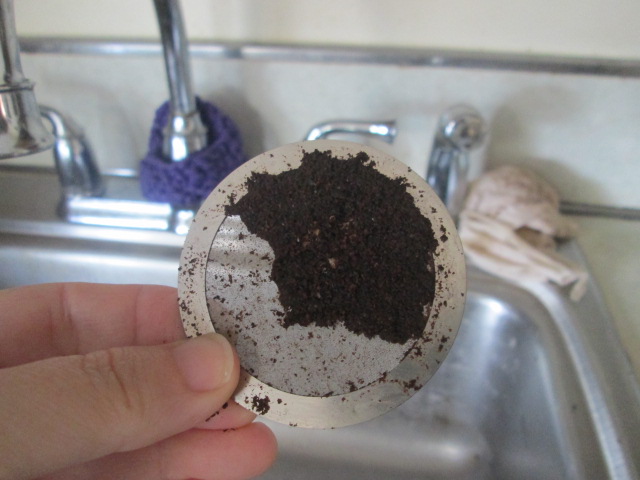
One downside of these metal filters is that they allow more sediment into the coffee than the paper  ones. However, this isn't a huge problem, particularly with the fine-mesh disk. A much bigger drawback is the extra cleanup work. Removing the filter from the press before knocking the grounds out into the bin doesn't sound like that much added hassle, and it wouldn't be if the filter came away cleanly. But no matter how carefully I pry it off (after running cold water over it so it's cool enough to touch), at least half the coffee grounds end up stuck to the filter rather than the press. And unlike the grounds stuck to the plunger itself, they don't come off cleanly. If I simply rinsed them off the filter, I'd be washing several grams of coffee grounds down the drain with every cup of coffee I brew, and I think it wouldn't be long before our plumbing objected to that. I've tried scraping the grounds off the filter onto the plunger before emptying it, but that never works neatly. Some grounds stay stuck to the filter no matter what I do, and some get all over my hands, so they have to be washed too.

I consulted Reddit on this subject and found two suggestions for dealing with this problem. Some users say that sliding the metal filter off sideways rather than lifting it off removes most of the grounds. Others say pulling the plunger back slightly and then inverting the press and letting it rest (without unscrewing the cap first) allows the grounds to drop back onto the plunger and away from the filter, leaving it mostly clean. I'll give both methods a try, and if either one works, then I'll be able to say definitively that the mesh filter is superior to the paper ones. 

[UPDATE, 5/5/24: I have now tried both methods of cleaning the metal filter. Neither one is perfect, but the first is much better than the second. When I invert the plunger and let it rest before removing the cap, the grounds do not fall away from the filter; they remain stuck to it at the top. When I remove the cap, some of the grounds fall off onto the top of the plunger, but at least half remain on the filter:

By contrast, when I rinse the plunger, unscrew the cap, and slide off the filter, it leaves only a thin film of coffee grounds behind. A quick spray with the faucet hose is enough to get them off. And I'm not concerned that the amount of coffee washing down the drain will clog it up.


I've also discovered another advantage of the metal filter: it fits more securely than the paper ones. With those, I always had to take care that the filter was exactly centered in the cap before screwing it on. If it wasn't, it would slip to the side and let some of the grounds through into my cup of coffee. I'd have to strain it a second time before I could drink it. 

So, in addition to saving me money and eliminating waste, this metal mesh filter has eliminated the two biggest problems with my Aeropress: the stuck-plunger problem and the slipping-filter problem. The additional step of rinsing the filter is a small price to pay for that.]

[FURTHER UPDATE, 9/13/24: I've now figured out that the best method of all for cleaning the filter is to combine the two suggestions. After rinsing the press and unscrewing the filter basket, I pull the plunger back slightly so the metal filter is flush with the bottom of the tube before sliding it off. This takes only a few seconds and leaves almost nothing stuck to the filter.]

Ecofrugal Episode 5: A Pressing Concern

A couple of weeks ago, I mentioned that I had ordered us a new (or more accurately, new-to-us) garlic press to replace our old Oxo one that broke. After a little research, we decided to go with the Joseph Joseph Garlic Rocker, which got consistently solid reviews from cooking sites. A new one costs $15 at Amazon, but since we don't do Amazon, we bought a secondhand one from eBay for $14 ($17 with shipping).

It has since arrived, and after testing it out several times, Brian reports that it's better in almost every way than its predecessor. It takes a couple of passes over a garlic clove to mince it as finely as the old one, but on the plus side, it does mince the entire clove rather than extruding part of it and turning the rest into a sort of squashed blob. It's easier to clean than the old press and takes up less room in the drawer. And since it's a solid piece of metal with no moving parts, we can be confident it won't simply fall apart like the previous one.

This espisode makes me inclined to add a seventh principle to my Ecofrugal Manifesto: Buy It to Last. (You could call this a subset of my sixth principle—Mend It, Don't End It—but I think it's different enough to deserve a principle of its own.) If you have to buy something new, buy something that's built to last as long as possible. Look for sturdy materials and construction, check reviews for complaints about durability, and minimize the number of moving parts that can break. And, other things being equal, opt for mechanical rather than electronic controls whenever possible. Electronics of all kinds usually cost more to repair than to replace—if it's possible to replace them at all.