Showing posts with label Thrift week. Show all posts

Friday, January 23, 2026

Thrift Week 2026, Day 7: How to Recycle Plastic Bags

I'm going to wrap up this Thrift Week series with a type of waste that's particularly ubiquitous: plastic bags. Actually, here in New Jersey, they're a lot less ubiquitous than they used to be, as the state banned single-use plastic shopping bags in 2022. Now, when we go to the grocery store, we no longer need to rush to bag up our own groceries before the checker starts tossing them into a disposable bag. But plastic bags still make themselves into our home in other ways. The grocery fliers delivered weekly to our door come in a little plastic sleeve, and we occasionally have to grab disposable produce bags (which are still legal) at the grocery store. (We always have at least one reusable shopping bag with us, but if we make an impromptu stop at the store, we might not have our mesh produce bags.) We also end up with small plastic bags that once held foodstuffs like dry beans and popcorn. And occasionally something we've ordered comes in a box with a plastic liner.

Fortunately, there are plenty of ways to put these leftover bags to good use:

  • We keep several of them in our shopping bag in case we run out of mesh produce bags. They're also useful for packing up foodstuffs from bulk bins on the rare occasions we visit a store that has any. 
  • We save the little plastic sleeves that come with the grocery fliers and pass them on to my parents, who say they make ideal poop bags for walking the dogs. They're actually better than store-bought bags sold for this purpose because they're longer, so one bag can hold multiple poops.
  • I often use larger bags to hold items I'm leaving out for a Freecycle porch pickup. The bag protects the item from the weather and gives the recipient a convenient way to carry it. And using a bag marked "Freecycle" eliminates any chance that a passerby will assume an item is simply being thrown away and try to grab it.
  • Back in the days before the bag ban, we used to save plastic shopping bags to line our wastebaskets. But since we almost never accepted plastic bags, we usually didn't have enough for all the wastebaskets in the house, and we discovered that most of the time, we didn't really need them. The kitchen trash can is the only place we ever throw away anything wet or messy, and we still use store-bought bags for that.

But these flimsy little bags can't be used indefinitely. Eventually they develop holes, and then they have to be discarded. Our local supermarket used to have a bin where we could drop them off to be recycled, but it hasn't been there for years. So most of the time, damaged bags—along with other types of plastic packaging, like the envelopes that packages come in—just end up in the trash.

However, according to Earth911, that isn't the only option. Based on a quick search, it looks like there are many big-box stores in our area that collect both #2 and #4 plastic bags for recycling, including Target, Walmart, Sam's Club, and Kohl's. So we could simply stash all those unwanted plastic bags in the car and drop them in one of those store's bins the next time we're in the area, were it not for one snag: most of them don't have any sort of label on them to indicate which type of plastic they are. Right now, we have eight plastic bags that are no longer fit for service, and only one of them is labeled as #2 plastic. The rest are anybody's guess. 
 
Now, according to the websites for Target and Walmart, these stores accept all kinds of "plastic bags and films," not just specific numbers. So, in theory, we could just dump all our unwanted bags into one of their bins and let them try to sort them out. Maybe a lot of them would end up in the landfill anyway, but at least we'd be giving them every chance at getting recycled first. I guess it's worth a shot.

Thursday, January 22, 2026

Thrift Week 2026, Day 6: How to Recycle Eyeglasses

I don't like to replace my eyeglasses any more often than I have to. This is partly because of the cost, which is over $200 even if you get them at Costco and around double that from an independent optician. (Back when I had single-vision lenses, I used to order them online, which was much cheaper. But with progressive lenses, apparently, you need an in-person fitting to get them lined up right.) But also, I have a really hard time finding frames I like. For a while, the type I prefer—full frame, metal, roughly oblong in shape, and not too big—were in fashion and it was easy to find them everywhere. But nowadays, petite metal frames are out and chunky plastic ones are in, and it's almost impossible to find a pair that I think looks good on me. So when I find some I like, I try to hold on to them as long as possible.

But sooner or later, my prescription changes, and I have to get new ones. (Sadly, I can't function without glasses long enough to hand mine over and wait for them to be fitted with new lenses.) So, over time, I end up accumulating old eyeglasses with outdated prescriptions. And while it makes sense to hold on to the most recent, just slightly outdated pair as a backup in case my current ones break, it doesn't really make sense to hold on to three or four extra pairs. Yet I hate to throw something that expensive in the trash. Even if they're no use to me anymore, it seems they should still be useful for someone.

Apparently I'm not the only one who thinks so, because there are various organizations that collect old eyeglasses for reuse. Our eye doctor's office even has a collection bin right in the waiting room where we can drop our old glasses to be passed on to folks who can use them. Before we switched to this eye doctor, we used to put them in a bin hosted by the Lions Club, which has various collection sites throughout New Jersey. You can drop them off at various Lions Club buildings or in bins at participating Walmart Vision Centers. (This page has more details about the program in New Jersey.)
 
If the Lions Club locations aren't convenient for you, this blog post from Vision Center names several other donation sites. Its list includes Warby Parker, Sam's Club Optical Centers, Costco Optical, Goodwill, and the Salvation Army. I've never personally donated eyeglasses at any of these places, so I can't say how easy they are to use, or even whether they're still valid. But if any of them are on your regular route, it couldn't hurt to pop inside and ask. 

Wednesday, January 21, 2026

Thrift Week 2026, Day 5: How to Recycle Books

If there's one thing I really can't stand to throw out, it's a book. That's one reason why my bookshelves are so overstuffed, with some volumes stacked horizontally across the tops of others: to make room for them to fit properly, I'd have to get rid of something else. But there's a limit to how many books I can cram in this way, so eventually I have to bite the bullet and get rid of some.

If the books are still in readable condition, the best option is obviously to get them into the hands of someone else who can use them. Ways to do this include:
  • Passing books on to people you know. This is my personal favorite if I happen to have a specific book I know a friend or family member will enjoy. The downside is that sometimes they give the book back after reading it, and then I have to find another new home for it.
  • Selling them to a secondhand bookstore. I've only been able to do this a few times over the years, as secondhand bookstores never seem to last long in the places where I've lived. I never got much money for them—usually pennies on the dollar against the cover price—but even a dollar's worth of store credit is a nice bonus. It makes me feel better about bringing home a new book (or two or three) to fill up the space I've cleared on my bookshelf.
  • Dropping them in a Little Free Library. Our small town has more than a dozen of these, so I can always manage to find space in one of them for any book I need to cull from my collection. And it adds a spice of interest to my future walks to pass by the same Little Free Library and see if it's still there. Of course, there again, the risk is that I end up bringing home more books than I got rid of. But at least they'll be books that are new to me instead of ones I've already read and don't plan to read again.
  • Donating them to the library. Our local library holds a book sale once a year as a fundraiser. It spends a week collecting books from the locals, scoops up the best ones for its collection, and sells the rest at bargain prices—from 50 cents for small paperbacks and kids' books to $2 for most hardcovers. We often save up books we're done with in anticipation of this sale, but if it's only been a couple of months since the last one, we try to get rid of them some other way rather than hang onto them all year. Other libraries in our area don't wait for an annual sale; they sell donated books out of a mini-bookstore near the front of the building. Both these little bookstores and the annual sale are good sources of cheap reading material that will eventually become part of the book-overcrowding problem. (It's the ciiiiiircle of books...)
  • Giving them to a prison library. I've never personally tried this, but I hear tell that prison libraries are always eager to add to their collections and may even take books other libraries won't accept, like old textbooks. The American Library Association has some info about organizations that can help you get your books into the hands of folks inside.
This is only a sampling of the possible places to donate books. The Local Book Donations site has a tool to search for organizations in your area that will take them. And of course, there are always the old standbys, Freecycle, Buy Nothing, and Trash Nothing.
 
All this is fine for usable books, but what about the ones that are completely falling apart? Well, in many  towns, including ours, the pages can go directly in the paper recycling bin as long as you remove the cover first. If you're not sure about it, you can check with your local waste/recycling/public works department. If your town doesn't accept them, you can always search trusty old Earth911 for paper recycling sites in your area.
 
However, a more entertaining option is to take those old pages and use them for craft projects. There are all kinds of things you can make with paper, including origamipaper mâché, beads, flowers, and decoupage. Heck, with enough pages and enough polyurethane, you could probably cover an entire floor the way we did in our downstairs room. For books that can no longer serve their true purpose as reading material, a second life as a bouquet of paper roses seems like a less tragic fate than the recycling bin.And if you're not of a crafty bent yourself, you can offer up the book pages to friends, or strangers on Freecycle, who are.

Tuesday, January 20, 2026

Thrift Week 2026, Day 4: How to Recycle Razors and Razor Blades

About four years ago, I gave up on cartridge razors and switched to a safety razor. After some unsuccessful experiments with a cheap one from Target, I bit the bullet and invested in a Twig from Leaf Shave. It cost quite a lot up front, but I'm hoping it will be a lifelong investment, unlike the various cartridge razors I've owned and been forced to discard after a few years of use—either because they broke or because they went off the market and it was no longer possible to buy replacement heads for them. Since it takes single-edged razor blades (which you can make by breaking standard double-edged blades in half), and since my frugal shaving hacks give me at least a month of use out of each blade, it's costing me less than 2 cents per shave. And when those blades finally wear out, all I have to discard is a tiny strip of metal, rather than a whole chunk of plastic.
 
However, I'd rather not discard even that much if I don't have to. So, ever since I made the switch to a safety razor, I've been saving the used blades in an empty candy tin, planning to take them to a scrap metal recycler when the tin got full. The one I initially found in Edison appears to have gone out of business, but a new search for "scrap metal" on Earth911 steered me toward a place in New Brunswick that might be able to take them. However, since the site says only that it takes metal scraps and doesn't specifically mention razor blades, I'm a bit concerned that they wouldn't take them. It seems like they should be able to take the entire steel tin full of blades and treat it as a single lump of metal, but maybe it doesn't work that way.
 
So I'm now thinking it might be a safer bet to recycle my blades through the Gillette recycling program. It takes blades and razors from all brands, and you can drop them off at any public collection site. According to the map on the website, there's one in Princeton that we could easily swing by before dance practice, so we wouldn't even have to make a special trip. Better still, this site takes not just blades but complete razors as well, so I could also use it to get rid of the unused cartridges and the orphaned handle from my last two failed cartridge razors, as well. I'd been thinking it was dumb of me to keep holding onto them "just in case," but now it's actually paid off!

Monday, January 19, 2026

Thrift Week 2026, Day 3: How to Recycle Batteries

As regular readers will know, I'm not a particularly tech-oriented person. I'm a late adopter who only replaces her computer every ten years or so and didn't even own a smartphone until 2018. So I was quite surprised the first time I calculated just how many devices we had that ran on batteries. There were literally dozens—some with their own built-in rechargeable batteries, some with single-use alkaline batteries. Even when batteries aren't included, they're very much required.

In the years since, we've swapped out most of those alkaline batteries for either rechargeable ones or longer-lasting lithium batteries. (We still have a few partially discharged ones lurking in a drawer, waiting for us to eke the last little bit of charge out of them.) Both of these, particularly the rechargeables, are a big improvement on the alkaline ones. They produce a lot less waste and cost less over their lifespan. But sadly, no battery lasts forever. Eventually, like their disposable cousins, they'll need to be tossed.

Fortunately, when their time finally comes, there are plenty of places to recycle them. Our local Department of Public Works takes them, as do many Home Depot and Lowe's stores. But the old-fashioned alkaline batteries pose a bigger challenge. Our local DPW no longer accepts these, telling us we should simply toss them in the trash. But this doesn't sit well with me. Although modern alkaline batteries contain a lot less mercury than they used to, they still have some, along with other metals like manganese and zinc that go to waste when they're discarded. Environmentally conscious areas, like California and most of Europe, don't allow them into household trash, and I don't want to allow them in mine if I can help it. 
 
The Earth911 Recycling Search isn't all that helpful in this particular area. Most of the places it lists in my area for recycling alkaline batteries are municipal programs that are only open to residents. I've had better luck with a couple of sites specifically devoted to battery recycling: Battery Network and Call2Recycle. As far as I can tell, both these sites use the same search tool, which you can customize to find recycling locations near you for multiple types of batteries: rechargeable, single-use, cell phone batteries, and even specialty kinds like e-bike batteries. In our area, there are several Staples that accept single-use batteries, including one that's quite easy to swing by on our weekly trip down to Princeton. It takes only a few minutes to drop them off, and we can even earn reward points for them.
 
So, if you live near a Staples store, or if you pass by one on your regular route, you can dispose of all your depleted batteries there—both rechargeable and disposable—at one fell swoop. If that's not an option and your only choice is the trash, then take the precaution of putting tape over their terminals before tossing them. (Actually, it's a good idea to do this even while they're sitting in the drawer so you don't risk a short-circuit if the terminals come into contact.) 
 
Of course, the best long-term solution would be to switch to rechargeable batteries for everything, so you'd never need to dispose of single-use ones at all. But with most rechargeable batteries still available only in AA and AAA sizes, it may be a while before that's practical.

Sunday, January 18, 2026

Thrift Week 2026, Day 2: How to Recycle Electronics

One category of waste that's particularly tricky to recycle is electronics. Electronic waste, or e-waste, includes old phones, computers, and pretty much anything else containing circuits, which these days can mean anything from light bulbs to refrigerators. It's a huge category, over 60 tons a year worldwide, and it poses an even thornier problem than textiles. If worse comes to worst, those old jeans can go into the landfill, where they won't cause any more pollution than anything else in the landfill with them. But old phones and computers contain all sorts of nasty components, such as dioxins, mercury, and lead, which you definitely don't want getting into the environment. At the same time, they contain lots of valuable metals and minerals, such as gold, copper, and lithium, which you definitely don't want to go to waste. That makes recycling them both very difficult and very important.

Because e-waste is also hazardous waste, most places have specific rules about recycling it. In our town, for instance, we're supposed to take it down to the Department of Public Works. This is what we do with any device that's no longer usable, like the old VCR and tape deck we discarded earlier this month. (If your town doesn't have an official collection site, you can drop off most kinds of electronic gizmos at your local Best Buy or Staples store. Check Earth911 for locations near you.) But, just like with clothing, it's much better to keep an object that's still usable in use if possible. 

The most recent case in point for us was my old smartphone. When I replaced it in 2022, it was technically still working; it had just become so unreliable that it was impractical to use. (Not only did the battery drain really fast, even after I'd replaced it with a new one, but it would randomly shut down without warning.) It might have been possible to fix it, but it wasn't within my extremely modest abilities. So, rather than simply take it to the recycling shed, I did a quick search and found an organization called 911 Cell Phone Bank. They take old cell phones, repair or recycle them, and donate them to victims of domestic violence and human trafficking. If my old phone was fixable, they could probably fix it; if not, it would be recycled. So, worst-case scenario, it would be the same as if I'd taken it to the DPW; best-case scenario, I'd not only keep it out of the waste stream but help out someone who really needed it.

Donating my phone through this program was quite straightforward. First I wiped it by going into Settings and doing a factory reset. Then I went to the website, clicked the Donate Phones button, and selected 10 Devices or Less and Print Shipping Label. There was one minor snag when the label didn't print properly, so I had to submit my information a second time and have the label emailed to me as a PDF. But eventually I got it printed out, packed up the phone and the spare battery that hadn't done it much good, slapped on the label, and dropped it off at the post office. Easy peasy.

Computers are a bit trickier to dispose of than phones, mainly because they're bigger. However, they're also more valuable, so if you have a computer that's still usable, you can almost certainly find a new home for it. If it's a reasonably new one, you might even be able to get a little cash for it on Craigslist. We've never sold an old machine this way, but we recently bought one: Brian's new laptop, which will replace his work laptop when he retires this year. (Like his work computer, it's a Lenovo ThinkPad, which gets high marks for repairability, and buying it secondhand will make it even more sustainable. It's far from state of the art, but it's more than adequate for jobs like email and streaming TV shows, and it was only $200.)

But even if your computer is ancient and creaky, you can probably find someone willing to take it on Freecycle (or Buy Nothing or Trash Nothing). I've never Freecycled one of my own old computers, since I tend to keep them until they're effectively unusable, but I've successfully found homes for two old machines that had belonged to my parents. I forget exactly how old they were, but I know neither one was any spring chicken, and I still got multiple offers for each of them within 24 hours.

And if your computer is so old that, like mine, it's barely working at all, you may still be able to find a home for it through Computers4People. Like 911 Cell Phone Bank, they accept both working and nonworking machines. After wiping the data, they refurbish the ones that can be salvaged and donate them to people in need; everything else gets recycled. It's not quite as simple to use, because you can't just pop the device in the mail, but you can drop it off at any of over 10,000 FedEx and Walgreens stores across North America. Most sites only accept laptops, tablets, and smartphones, but there are few that take desktop machines and peripherals.
 
One important caveat: before getting rid of a computer or a phone, make sure to transfer all the files you need from it, then scrub the hard drive to remove all your personal data. PCMag offers guidelines on how to do this with both computers and phones. But if your device is well and truly bricked and you can't get onto the drive at all, don't worry; both 911 Cell Phone Bank and Computers4People promise to clear all data off donated devices before passing them on to new users.

Saturday, January 17, 2026

Thrift Week 2026: How to Recycle All the Things (starting with textiles)

I've been writing this blog for over 16 years now (counting from January 2010, when I first decided to give my old blog an ecofrugal theme). In those 16 years, I've published over 1,600 posts. And the most popular of them all, by a huge margin, was a 2014 post on how to recycle whipped cream cans. In the 12 years since I posted it, it's received roughly 31,000 views—blowing away its nearest competitor, my post on building a raspberry trellis, with a mere 5,100 views. Over 160 people have viewed it just in the past week. Evidently, how to recycle hard-to-recycle objects is a topic that interests many, many people.

Hence, this year's Thrift Week is going to be all about that topic. I've already said pretty much all that needs to be said on the topic of whipped cream cans, but there are loads of other recycling challenges that I've explored over the years, and this will be my chance to share what I've learned. I've written about this subject before, most notably in my 2013 post "How to recycle everything (if you can)," but a lot of the info in that post is now outdated. This week's series will expand on that material and bring everything up to date. And I'm kicking it all off with one particular category of theoretically-recyclables that's given me considerable trouble over the years: textiles.

When you look for information on textile recycling, most of what you'll find is advice on clothing donation. And obviously, if you need to get rid of clothes in usable condition, this is the best thing to do with them. There are tons of places that will take old clothes, from local thrift shops to veterans' organizations. I personally just gave a big box of worn but still serviceable garments to the United War Vets Council, which emails me every so often to see if I have anything to donate. You can also give old clothes away on Freecycle (or its close cousins, the Buy Nothing Project and Trash Nothing) or offer them to your friends at a clothing swap. You might even be able to make a little money reselling them at a consignment shop (in store or online) or at a yard sale. In short, there's no shortage of ways to find a new home for wearable garments.

But if you're a frugal person like most readers of this blog, you tend to wear your clothes until you've worn them out. An old pair of jeans with thighs so threadbare you can't even patch them is clearly no longer wearable, yet it may still have plenty of good fabric left on it that could be put to use. Yet most of the sites listed under "textile recycling" won't actually take them. They're not really planning to recycle your garments; they're planning to resell or donate them, so they'll only accept clothes in good condition. And the few that do accept clothes for actual recycling may require you to cover the shipping costs, which can be considerable. Terracycle's prepaid Zero Waste Boxes, for instance, cost between $160 and $379. 

In my area, there are only two places I know of that genuinely recycle textiles. The one I rely on most is Helpsy. It accepts all types of fabric goods, donates the stuff that's still usable, and downcycles the rest into insulation, stuffing, or rags for industrial use. Only about 5 percent of it needs to be thrown out. Unfortunately, this organization operates only in the northeastern U.S., and even within that area, the number of its bins seems to be dwindling. The last time I tried to make a dropoff, both the bin I had been using in Princeton and the one closest to me in New Brunswick had mysteriously vanished. Fortunately, I was still able to find one, but it keeps getting more difficult. (Which is why I currently have a small collection of old socks, tights, and one battered potholder that's been sitting in the bedroom for several months, waiting until I can get it to a usable recycling bin.)

If Helpsy ever disappears completely, I can always fall back on the garment collection program at H&M. The store has bins where you can drop off clean, used garments from any brand, which get sent to its "partners" overseas to be sorted. The usable items are resold, the unusable ones get downcycled, and a small fraction of the material gets fully recycled into new textiles. This isn't an ideal solution for me because the nearest H&M store is in a mall we never otherwise visit (the traffic is awful), and because of the additional carbon costs of shipping the garments halfway around the world. But it's better than nothing.

If neither of these organizations works for you, you might be able to find a better one through Earth911. This handy site has a tool to help you find recycling facilities near you for just about anything, including clothing. Unfortunately, its suggestions aren't always helpful. Many of the textile recycling programs it lists near me either (a) only accept items in good condition, (b) only accept specific items, such as sneakers or bras, or (c) are only available to residents of a particular town. But it's at least worth a check.

Whenever possible, though, we prefer to take the recycling of our clothes into our own hands. Those old trousers too worn to hold a patch usually get tucked away in my scrap fabric bin so I can cut them up to make patches for other garments. If the bin is too full to hold the entire garment, I at least keep the pockets, which make handy ready-made patches for holes in the knees of Brian's jeans. Similarly, when his T-shirts and socks get too worn out to be darned, we rip them up and turn them into cleaning rags. And little scraps too small to get used for anything, if they're made of natural materials, can go into the compost bin, where they'll eventually break down into useful fertilizer for our garden. Now that's truly cradle-to-cradle recycling.

Thursday, January 23, 2025

Thrift Week 2025, Day 7: Giving

So far this Thrift Week, I've only looked at the money that the wealthy spend on themselves. But they also spend a non-trivial portion of their income on others. According to the latest Consumer Expenditures Survey, Americans earning over $200,000 per year devote more money to "cash contributions" than those with lower incomes—both in absolute dollar terms and as a percentage of their income. But the gap isn't as big as you might expect. The top income group devotes an average of 3.7% of its budget to charitable donations, as compared to 3.1% for Americans overall. Even the poorest Americans, those earning under $15,000 per year, manage to give away 1.5% of that.

If happiness economists are to be believed, wealthy Americans are making a sound investment when they give to charity, and probably missing a trick by not devoting a bigger share of their spending to this purpose. Multiple studies have shown that spending money on others gives people a bigger happiness boost than spending it on themselves. Wealthy people, who presumably have all the necessities of life already, stand to get more satisfaction out of their money by giving it away than by spending it on luxuries. And for those who aren't rich, giving money away is one of the easiest ways to feel like you are. Just the gesture of giving something, even if it's only a dollar to a sidewalk beggar, reminds you that you're better off than a lot of other people in the world. 

Even if your budget is so tight that you can't manage to squeeze that extra dollar out of it, there are other ways to indulge in what Louisa May Alcott called "the luxury of charity." You can: 

  • Shop through charity portals that donate a small percentage of your purchase.
  • Use a credit card that does the same thing.
  • Raise money for a cause on GoFundMe.
  • Donate food, clothing, or other household goods.
  • Donate your time by volunteering.
  • Donate blood (an especially valuable way to give right now if you live in New Jersey or New York, where blood banks are currently experiencing severe shortages).

Thus, I'm closing out this Thrift Week with a Treat for Today that's a treat both for me and for others: a donation to support SciShow, one of my favorite educational channels on YouTube. Hank Green, one of the channel's hosts (and, in my opinion, a total hottie), recently posted on Bluesky that to make accurate content, they rely on donations from one out of every 10,000 people who watches. So, to reward that special one percent of one percent, they are offering a deal: for a donation of $25, you get a postcard autographed by all the show's hosts containing art, facts, and a QR code linking to "one of four exclusive videos from me discussing my favorite frog facts." And for a donation of $60, you get all four postcards with all four frog videos. Such a deal!

Sure, that $60 is significantly more than I've spent on any of my previous birthday treats. But last year I donated $54 and got only one postcard, and all it had on it was a thank-you message with Hank's signature. So four whole postcards complete with frog videos for a mere $60 seems like a good value to me.

Oh, and I made an appointment to give blood next Tuesday. So even when Thrift Week is over, I can continue to treat myself—both with the warm glow of giving and with free cookies.

Wednesday, January 22, 2025

Thrift Week 2025, Day 6: Fragrance

Back on Day 3, I named Dom Perignon as a classic example of a luxury good, costing about $330 for a 750-mL bottle. But on a milliliter-for-milliliter basis, that stuff doesn't hold a candle to high-end fragrance. A 2023 article in (once again) Town & Country magazine lists a dozen perfumes that cost hundreds or even thousands of dollars per ounce. The most expensive scent on the list, Haute Luxe by Roja Dove, costs $3,500 for a 3.4-ounce (97-mL) bottle. That's $36 per milliliter—82 times as much as France's most iconic bubbly.

According to T&C, these pricey perfumes are "worth every cent." While the editors concede that "your signature scent doesn't need to cost an arm and a leg," they also claim that an "ultra-luxury fragrance" offers benefits a more "attainable" one can't, such as:

  • The "finest ingredients in the world" that went into it.
  • The skills of the "master perfumer" who created it.
  • The design and "natural materials" of the the bottle.
  • A "one-of-a-kind scent" that most people won't have.

All that sounds impressive, but really, a fragrance only has to do one thing: make you smell good. If it doesn't do that, then the luxurious ingredients, the fancy bottle, and the efforts of the master perfumer are simply wasted. And, conversely, if you can get a much cheaper scent that smells just as good to you, then the lack of fancy ingredients and "craftsmanship" matters not one whit. The proof of the perfume is in the sniffing.

So, if you want to "find your signature scent" without spending a bundle on it, where do you look? Well, you could disregard T&C's guide in favor of this one from Cosmopolitan, which recommends the best "affordable fragrances that smell luxe." But its definition of "affordable" is up to $70, which is still a bit much to risk on a scent you don't actually know you'll like. So if you want a chance to try before you buy, you could pick up a few test vials from Microperfumes, which sells tiny samples (just 0.75 mL) of different fragrances for as little as $3 apiece. Or, if you already know what fragrance you like but you don't like the price tag, you can search for a knockoff version at a site like Perfume Parlor. With a quick search there, I found a duplicate of that $36-per-milliliter Haute Luxe that costs only 56 cents per milliliter (with a 2-mL test vial available for just $4). 

Or, if you want a truly "one of a kind scent" that no one else is wearing, you can do what I do and make your own. My signature scent is a blend of three essential oils—sandalwood, vanilla, and cinnamon—mixed with a carrier oil in a little roller bottle. Last summer, the tiny bottles of essential oil that I bought back in 2020 finally started to run low, so I restocked with some bigger bottles from an online supplier: 2 ounces of sandalwood for $4, 1 ounce of vanilla for $6, and half an ounce of cinnamon that looked like an unbeatable value at just $1. Unfortunately, when I cracked it open, I realized why it was so cheap: it had a weird, acrid smell that was nothing at all like cinnamon. Thus, for the past few months, I've been making my perfume with just sandalwood and vanilla—all about those base notes, with no middle or top.

So, as my Treat for Today, I ventured out in the brisk January air to go to the local Rite Aid and drop $9 plus tax on a new bottle of cinnamon essential oil. (As Rite Aid is going through a bankruptcy right now, its shelves are looking a little picked over, but fortunately this particular essential oil is still well stocked.) It's a 1-ounce bottle, so at the rate I use it, I'll still have half of it left when my new bottles of vanilla and sandalwood oil run out. (At that point, I'll have to decide if I want to replace the sandalwood oil, which I've recently learned comes from a rare and over-harvested plant, with something more sustainable—like, ironically, a synthetic fragrance oil.)

Tuesday, January 21, 2025

Thrift Week 2025, Day 5: Beauty

Another way the very rich are different from you and me: They don't age as visibly. Partly, of course, this is because they can afford more nutritious food (see Day 2) and better health care. But also, they can invest in luxury skin care, spa treatments such as facials, "tweakments" such as Botox and fillers, and even plastic surgery. All that stuff decidedly doesn't come cheap. According to Real Self, a site that reviews beauty treatments, you can expect to pay an average of:

  • $35 for a prescription skin-care product containing Retin-A (tretinoin), which can gradually brighten your skin and improve elasticity if you use it regularly for at least 4 to 6 weeks
  • $208 for a HydraFacial, which reduces the appearance of fine lines for 1 to 3 months
  • $535 for a syringe of Botox, which can smooth away wrinkles for 3 to 4 months
  • $1,112 for a "vampire facial," which uses tiny needles to inject your skin with platelet-rich plasma pulled from your own blood, smoothing away skin damage over the course of multiple treatments and lasting 9 to 18 months
  • $3,229 for a "liquid facelift" that combines Botox with dermal fillers, improving wrinkles and moderately lifting sagging skin for up to 2 years
  • $16,690 for a full facelift—the most expensive option, but the only one that will last 10 years or more

None of these, obviously, will fit into a tight budget. Even the $35 topical treatment, with its modest effects, will run you $420 a year if you restock monthly. The rest, if you keep them up regularly, will most likely cost a grand or more per year. 

The most economical approach to beauty, obviously, would be to decide to love yourself wrinkles and all. But I'll admit that's not easy. Throughout my late forties, I found myself growing more and more dissatisfied with the face in the mirror, which didn't look like the way I thought of myself. I kept browsing the list of pricey treatments on Real Self, but I could never convince myself that any of them would be worth the money.

Finally, on my 50th birthday, I decided to spring for something that looked like it could give me just a little bit of a boost. I invested $150 (on sale) in a mini microcurrent device that claimed it could "significantly improve skin firmness & elasticity" in just a few minutes a day. The evidence for the effectiveness of microcurrent wasn't terribly strong, but I'd seen a few studies suggesting it could have at least a small benefit, and even if it didn't help at all, I wouldn't be out as much money as I would for a pricey professional treatment. I did a little research first to make sure that it would work without the expensive serums the company sells to go with it and found that a homemade conductive gel made from aloe vera gel with a bit of ordinary table salt could get the job done.

So did it work? Well, you can judge for yourself. Here's the "before" picture I took of my face in January 2023 (shot in the bathroom mirror because I'm hopeless at selfies):

And here's the one I took in May, after a few months of using the device nearly every day.

It's not a dramatic difference, to be sure, but many of the before-and-afters on Real Self are just as subtle, and for treatments that cost considerably more.

Another beauty booster I considered was collagen supplements. Once again, there were some studies suggesting that taking them regularly could improve skin texture and elasticity. But there were two problems: first, most brands contain bovine collagen, which isn't vegetarian-friendly, and second, even a relatively inexpensive brand like Vital Proteins costs around $1.25 a dose—over $450 a year if you take it daily. (You can get "marine collagen" made from fish instead, which would work with my flexitarian diet, but it's even more expensive.) Searching for a vegan alternative, I happened on some research about the benefits of aloe sterols found in plain old aloe vera gel. I found an aloe vera supplement that cost only pennies a dose and started taking that daily. Once again, the effects are subtle at best, but it certainly isn't doing me any harm, and it could potentially have benefits for my blood sugar as well. So, for such a low cost, I see no real downside to keeping it up.

The latest addition to my low-budget beauty routine is my Treat for Today: a little bottle of plant-derived squalane oil. This stuff is derived from squalene, a natural oil produced by your skin, and Cleveland Clinic reports it's good for hydration and can "slow the signs of aging." This little bottle from The Ordinary cost me only $10, and a little of it goes a long way; just five or six drops is sufficient to moisturize my entire face and neck. I use it in the evening, after using the microcurrent device and before applying my rosacea meds, and I don't need any additional moisturizer on top of that. It hasn't miraculously firmed up my skin, but it does leave it nice and soft, and for less than ten cents a dose, it adds an affordable touch of luxury to my evening routine.

Do I truly have the skin of a rich person? Almost certainly not. But is my budget beauty routine keeping me in pretty good shape for 52? Almost certainly yes. I mean, hey, Cameron Diaz and Jennifer Garner are my age, and they don't look that much better without makeup than I do.

Monday, January 20, 2025

Thrift Week 2025, Day 4: Clothing

When you picture a rich person, how are they dressed? Designer labels from head to toe? According to the Washington Post (gift link), Town & Country magazine, and the Style Theory channel on YouTube, that's a bit wide of the mark. There certainly are well-to-do folks who dress that way, but the really rich tend to go for "quiet luxury." Their clothing doesn't bear any obvious brand labels; in the words of O. Henry, it "properly proclaim[s] its value by substance alone and not by meretricious ornamentation." You'd have to look at it very closely to notice the details that make it so expensive: the luxe fabrics, the impeccable stitching, and crucially, the flawless fit. They often have garments altered, made to measure, or even custom made to fit them exactly.

So how do you get this look for less? The Style Theory video suggests starting with off-the-rack garments from mid-tier brands like Banana Republic or J. Crew, then getting them tailored for "an additional $20 or so" to give you that custom-fit look. But several comments on that video argue for my preferred approach: starting out with thrifted garments. In the first place, secondhand clothes from those same medium-priced brands will cost less than new ones; in the second place, they'll most likely be better made, as all but the highest of high-end clothing lines have cut back on quality in recent years to churn out clothing faster and more cheaply. You can take those secondhand clothes to the tailor and end up with a custom-fitted garment for the same price as you'd have paid for a lower-quality new garment straight off the rack. (This is also a handy strategy for those of us who have trouble getting a decent fit in new clothing. Rather than hunting all over for that elusive pair of pants that fits over the hips without gapping at the waist, we can just buy one that fits in the seat and have it taken in to close the gap.)


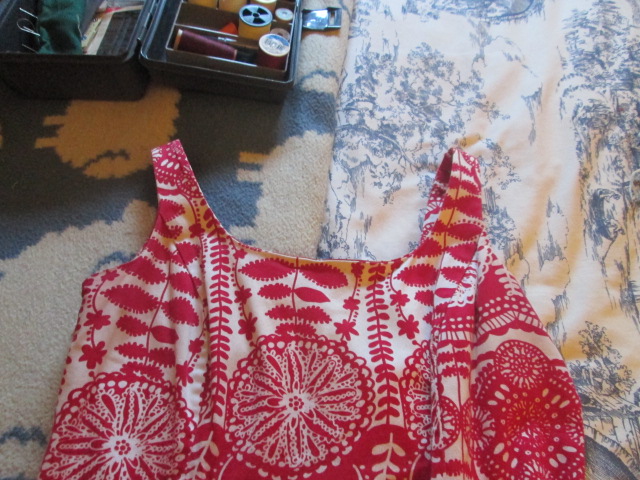
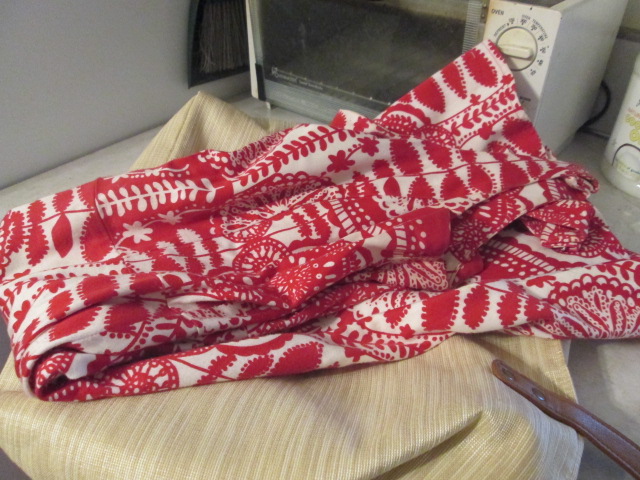
Now, while this thrift-shop-plus-tailoring approach costs a lot less than buying high-end brands to start with, that doesn't mean it's cheap. As I recently discovered, high-quality secondhand garments can actually cost significantly more than new ones from cheaper brands (though they may give you more quality for your dollar). Also, depending on what you want done, tailoring can cost quite a lot more than the $20 benchmark quoted in the Style Theory video. I was originally planning to have my Treat for Today be taking an item to the tailor: a red sundress I'd bought for $19 on eBay that was too big in the shoulders. I'd managed to make it wearable by pinning up the straps and loosely basting them into place, but the excess fabric made an awkward lump that I had to hide under a jacket. I figured for around $30 more, I could have the straps professionally adjusted and get myself a perfectly fitted dress for under $50 total. But when I got the dress to the tailor shop, they informed me that this simple alteration would actually cost $50 all by itself. (I also inquired about the cost of adding pockets to the dress, and that would have raised the price tag to $100.)

At that price, I wasn't sure this alteration would really qualify as an affordable luxury. So, before springing for it, I brought the dress back home and did a little investigation to see how hard it would be to shorten the straps myself. When I found a YouTube video showing a method that didn't require a sewing machine and looked well within my modest abilities as a seamstress, I decided to take the plunge. 

First, I turned the dress inside out, put it on, pinned the straps up to the right length, and stitched them in place. Then, I added an extra step not shown in the video: I turned the dress right side out again and tried it on to make absolutely sure I had the shoulders adjusted correctly. I knew once I took the next step—cutting the fabric—there would be no going back, so I followed the old carpenter's rule: measure twice, cut once.

Then I took the dress back off and, with some trepidation, made the fateful cut. I stitched the fragments of fabric down as shown in the video, then did the same on the other side. And when I turned it back right-side out and put it on again, lo and behold, it fit! With my rudimentary sewing skills, about a quarter's worth of thread, and about half an hour of work, I'd managed to make a perfectly respectable job of an alteration that would have cost $50 to have done professionally. My work may not look quite as neat as the tailor's would have, but you'd have to look quite closely at the straps to notice it, and how likely is anyone to do that?

So this is my actual Treat for Today: an elegant summer dress that fits me perfectly and only cost me $19 plus half an hour of work. In fact, I'm so encouraged by this success that I might just take a crack at adding those pockets myself, too. But that looks like a job that requires the use of the sewing machine, so I'll probably want to practice my machine skills a bit first. (And yes, I realize the dress looks a bit silly worn with a winter hat and long johns, but give me a break, it's January.)

Sunday, January 19, 2025

Thrift Week 2025, Day 3: Drink

It was perhaps a bit misleading for me to call the theme of this year's Thrift Week "Champagne tastes on a beer budget," because actually, I'm not that big a fan of bubbly. I'm happy to drink a toast in it to celebrate someone's wedding or graduation, but it's not a drink I'd choose for myself. I prefer alcoholic beverages (and, for that matter, nonalcoholic ones) with a bit of sweetness to them, like a nice tawny port.

However, a high-end tawny port doesn't exactly come cheap either. Some of the top-rated tawny ports at Vivino sell for over $300 a bottle, rivaling the price of Dom Perignon. So while it's not literally a champagne taste, it's one that could be equally pricey to indulge.

Fortunately, it doesn't have to be. The tawny Brian and I like best, Hardy's Whiskers Blake, sells for as little as $14 a bottle. It's not technically a port since it's not made in Portugal, but as far as I'm concerned, its dark, velvety flavor leaves nothing to be desired. Wine Spectator, which awards it an impressive 94 points out of 100, describes it as "Succulent and smooth...tremendously complex...layered with caramel, walnut, coffee, almond and orange peel flavors, long, elegant and spicy in the mouth." The highest-priced tawny on that same site, a 40-year-old Taylor Fladgate that costs $210, gets only 90 points, so I think we're missing nothing by choosing this bargain bottle.

The only problem with Whiskers Blake is that it's a little hard to find. The only store anywhere near us that carries it is in Somerville, half an hour's drive from here—a bit far to go just for a bottle of wine, particularly in weather like we're having this weekend. So instead, my Treat for Today is a tipple we picked up on our last trip to Trader Joe's: Joe-Joe's Peppermint Wine Cocktail. It's a sweet, creamy drink with a strong peppermint flavor. The bottle cost only $8.99, and a little of it goes a long way. Because it's so strong, I tend to sip it slowly, so I can easily nurse a couple of ounces over the course of an hour or two while curled up on the couch watching Critical Role or Taskmaster. And a dollop added to a cup of hot cocoa, along with a puff of coconut whipped cream, turns an everyday sip into an indulgent treat.

By the way, if your tastes actually do run toward Champagne, don't worry: there are budget-priced picks for you too. Sparkling wines from outside the Champagne region, such as Prosecco, Cava, or Cremant, are much cheaper than the real thing and just as fizzy and fabulous. Check out Gear Patrol and Reverse Wine Snob for recommendations costing as little as $8 a bottle.

Saturday, January 18, 2025

Thrift Week 2025, Day 2: Food

When you ask people to name a luxury good, many of them will probably think of traditional rich-people foods like caviar or lobster. And thirty years ago, this would indeed have been an accurate reflection of a multi-millionaire's diet. According to a 2018 story in Quartz, the 1991 Lifestyles of the Rich and Famous Cookbook featured these two luxury foods right on the cover, alongside such other delicacies as chocolate-dipped strawberries and capital-C Champagne in crystal goblets. But in the years since, the article notes, the lifestyles of the wealthy—including their food choices—have changed dramatically. Today, rich-people food is all about "wellness": cold-pressed juices, organic produce, "fermented lamb and local lichens" served at a high-end restaurant on a remote Scottish island.

Healthy whole foods like these are indeed more expensive than processed foods, especially if you're looking for local and organic produce and the green halo associated with it. (As it turns out, this halo is mostly illusory; local and organic foods have roughly the same carbon footprint as conventionally grown ones. Some reputedly earth-friendly foods, like grass-fed beef, are actually significantly worse than their cheaper equivalents.) But the cost doesn't have to be prohibitive—particularly for those lucky enough to live near a Lidl store

Over the course of our two most recent visits to Lidl, we picked up ten pounds of mandarin oranges, a cauliflower, half a pound of Brussels sprouts, three bell peppers, a pound of mushrooms, two eggplants, an avocado, a head of broccoli, a bunch of scallions, a bag of red onions, and an English cucumber, all for a grand total of $25.86. That works out to $12.93 per week—slightly less than the $13.06 per week the average low-income household (under $15,000 per year) spent on fresh fruits and veggies in 2023. (To be fair, we also bought some produce from other stores, but our total food spending was still less than half the limit set by the USDA's Thrifty Food plan.) And if you're looking for more traditional luxury foods, like caviar, Lidl carries those too—at prices that, while a bit steep, won't break the bank.

Which brings me to my Treat for Today: a half-pound of smoked salmon, purchased on our most recent Lidl trip for $8.39. Admittedly, anything that costs $16.78 a pound is still an extravagance, but as extravagances go, it's a pretty affordable one. Served on Brian's home-baked no-knead bread with sliced cucumber, accompanied by a salad of red leaf lettuce with walnuts, dried cranberries, and our favorite honey-garlic balsamic vinaigrette, it's a meal that wouldn't look out of place in the pages of a modern Lifestyles of the Rich and Famous Cookbook. And you don't have to be either rich or famous to enjoy it.

Friday, January 17, 2025

Thrift Week 2025: Champagne tastes on a beer budget

One of the biggest challenges of writing about frugality is that so many people associate the word with phrases like "tightening your belt" or "doing without." In other words, deprivation. Even people who are trying to promote a frugal lifestyle sometimes fall into this trap. Scroll through the underconsumption core videos on TikTok (quickly, before the ban goes into effect), and you'll see people showing off their broken phone cases or trash-picked dishware, provoking cries of outrage in the comment section. This kind of content may play well with folks who are already fully on board with the idea, but it doesn't make a frugal lifestyle look appealing to those who enjoy their little luxuries and don't want to give them up.

That's why I've decided to make this year's Thrift Week all about ways to live the life of a rich person on a modest budget. Each day, I'll look at one particular category of luxury spending, then explore ways to enjoy the same kind of luxury while spending much less. And I'll put my money where my mouth is by treating myself to one of the cheap luxuries on my list each day—giving myself a whole week's worth of birthday presents in the process.

One thing that rich people definitely spend money on is entertainment. The latest Consumer Expenditures Survey shows that as folks move up the income scale, they spend larger sums on entertainment—not just in dollar terms, but as a percentage of their total spending. That makes sense, since it's a non-essential expense that folks on tight budgets would be likely to cut back on. And lots of really high-end entertainment experiences, like tickets to the Super Bowl or a Taylor Swift concert, cost thousands of dollars—an expense only the well-to-do can afford to shoulder on a regular basis.

Now, according to happiness economists, this is a sound decision. Their studies show that spending a given amount of money on an experience generally produces more happiness than spending a comparable sum on material goods. Which is all well and good, but I haven't seen any studies that suggest that the more you spend on a specific experience, the more you enjoy it. Yes, a Swiftie will probably get more happiness out of paying $4,000 to go see Taylor with her mom than she would out of spending the same sum on a diamond necklace. But will she get four hundred times as much happiness out of buying those tickets as she would from paying $10 for a one-month Disney+ subscription and having a watch party with her friends? 

Based on our experience going to our first big stadium show, I kind of doubt it. We spent a total of $241 on that show, including transportation and food, and still found it to be, at best, only marginally more enjoyable than watching at home for free. Granted, we could have paid a lot more than that, and maybe if we'd shelled out $500 for VIP tickets and another $200 for parking and concessions we would have enjoyed the show more. But then again, maybe not. A lot of the things that made the show frustrating—the venue's bag policy, the long lines, the late drive home—wouldn't have been any better no matter how much we'd spent.

By contrast, we can go to the Troubadour concert series on any given Friday night and see a good show—possibly even a great one—for only $15. And that's exactly what my Treat for Today was: a $15 ticket to see Cheryl Wheeler at the Troubadour. (Brian didn't buy a ticket, but he volunteered to bake, so he got his admission for the cost of a $3 pan of home-baked brownies. On top of that, by volunteering tonight, he earned a "tick" that he can use to get in free for a future show. Most of the time, when we go to the Troubadour, Brian bakes and then uses one of his previously earned "ticks" for me, so we both get to see the show for that same $3 worth of brownie ingredients—a truly unbeatable deal. But we knew tonight's show was likely to be a sellout, so I had to pony up for a real ticket to be sure of getting a seat.) Cheryl was a trip as always, and the opener, Kenny White, turned out to be an unexpected treat who would have been worth the price of admission all by himself.

Granted, this particular entertainment bargain only works if you happen to be a folk music fan living in New Jersey. (And if you are in that category, you should definitely take advantage of it.) But the Troubadour is just one of many smaller, lesser-known venues across the country that are putting on terrific shows at reasonable prices, often featuring artists you've never heard of but should have. Try looking for listings of events in your local paper, if you still have one, or on your city or county website. Check out nearby colleges and even high schools. Check your local library. You may be surprised at how many live shows you can attend for cheap, or even free. They may not be as exciting as Taylor, but they deliver a lot more bang per buck.

Tuesday, January 23, 2024

Thrift Week 2024, Day 7: My sewing kit

The last item in this Thrift Week series is probably the one that's given me the biggest bang for my buck. But it's also the hardest to calculate the exact impact of, so I'm going to have to guesstimate.

The item in question is my trusty sewing kit. I don't remember exactly when I bought this, but it was somewhere between ten and twenty years ago at a local estate sale. It included a full set of basic sewing supplies: needles of various sizes, straight pins, safety pins, a pincushion, a box of odd buttons, a pair of fabric scissors, and dozens of spools of thread in assorted colors. The entire box cost me a quarter.

In the years since, I have used these supplies more times than I can count. I have replaced buttons on shirts and pants, mended holes in sweaters, sewn patches on jeans, and darned countless socks. I've made Brian a belt pouch and a hat to wear to Renaissance fairs, using only scrap materials. I've made several oversized garments wearable by shortening pant legs and taking in waistbands with either elastic, hooks, or simple stitching. I've even repaired a damaged pair of shoes with a few well-placed stitches. And I did nearly all of it with only the supplies that came with this 25-cent box. (I've bought a few notions like buttons and elastic, and a year or so ago I finally had to spend $4 on one new spool of thread to replace a color that I'd used up. But most of those repairs were covered by my initial 25 cents' worth of materials.)

So how much has this purchase actually saved me? It's impossible to say exactly, because I haven't kept track of every single item I've repaired with this sewing kit and how much it would have cost to replace. But let's take a wild stab and guess that I've repaired at least one garment every month, on average, in the years since I bought this sewing kit. Let's also assume that I've had it for fifteen years, making a total of 180 repairs during that time period. And let's finally suppose that those garments would have cost, on average, $5 each to replace. (Some of them, like socks, would undoubtedly have cost less, but others, like Brian's heavy wool cardigan that I mended just this week, would have cost significantly more.) That works out to $900 in savings, which means that my 25-cent sewing kit has paid for itself 3,600 times over.

Of course, this estimate could be wildly inaccurate. But even if it's off by a factor of ten and this sewing kit has only saved me $90 over the years, that's still a really impressive return on such a tiny investment.

Monday, January 22, 2024

Thrift Week 2024, Day 6: Glad Rags

Today's item is one I've already covered in a previous Thrift Week series: my Glad Rags, a set of reusable feminine napkins. In that post, I observed that the average American woman spends $7 a month, or $84 per year, on "sanitary products," known to the less squeamish as tampons and pads. Meanwhile, I have now successfully made it all the way to menopause with just half a dozen cloth pads that probably cost me around $50 in total. (A comparable set of the same brand purchased today would cost around $110, but there are also numerous other brands available now from stores like Walmart for as little as $10.)

I bought my first set of three cotton Glad Rags some time around 1996 or 1997, and within a year or two I was using them almost exclusively (eked out by a few disposables for travel or tampons for swimming). To make the math simple, let's say that I used them for exactly 25 years. At $7 a month, that means they saved me a total of $2,100 for a one-time cost of $50. That's a hell of a return on such a small investment.

The only problem I've ever had with these is what to do with them now that I no longer need them. I can't quite bring myself to dump them in textile recycling, since most of them are still in usable condition even after 25 years of use. But I hesitate to list them on Freecycle because I think even people who wouldn't be squeamish about reusable pads—and I suspect many women would be—would draw the line at using secondhand ones.

Sunday, January 21, 2024

Thrift Week 2024, Day 5: A $30 lock on a $15 bike

To put this Thrift Week post in context, I need to provide a little background. This is a story I never got around to discussing on the blog when it happened, partly because it was a bit embarrassing for us. I told you about how, when Brian's old junker of a bike finally bit the dust in 2012, we bought him a nice, new bicycle to replace it. It cost us $400, but we thought it was a good investment, since he expected to be using it for many years to come. Here's the part you didn't hear: within a year after we bought it, that nice, new bicycle was stolen from the bike rack at his workplace. 

The reason this is embarrassing for us is that it's possible we could have prevented it. At the time we bought the new bike, we didn't invest in a new lock for it, because Brian was pretty confident that the old, heavy chain he was using was sturdy enough to prevent theft. But he was thinking in terms of casual theft, and the thieves who actually came for his bike were professionals. They drove up in a big, black van, parked it in such a way that it blocked the view of the bike rack from security cameras, and then systematically removed all the bicycles from the rack and drove off with them. As far as I know, none of them were ever recovered. His beautiful new ride probably ended up being stripped down for parts. And since its value was less than our insurance deductible, there was no way to recover any of what we'd spent on it.

Well, after that, we weren't about to spend a lot of money on another nice, new bike. Instead, I searched Craigslist and found a seller in Princeton offering not one, but two bicycles in rideable condition for $30. We drove down, checked them out, paid in cash, managed to get both bicycles into the back of our little Honda Fit, and brought them home, giving Brian one bike for everyday use and a spare for parts. (We've since acquired yet another one from Freecycle, which explains why there are three bikes—or more precisely, two and a half—crammed into our back room.)

After that, we had to replace all the equipment that had been on the old bike when it was stolen—including the lock that had so dramatically failed to protect it. So we went back to the same shop where we'd bought the previous bike and invested $30 in a top-of-the-line Kryptonite lock—a purchase that, if we'd made it sooner, might have been enough to deter the thieves and save Brian's old bike. (Professional thieves can get through one of those too, with the right tools, but it takes time, and they might have decided it wasn't worth it.) Thus, Brian's current ride is protected by a lock that cost roughly twice as much as the bike itself. This gives him two layers of protection: a lock that's hard for even professional thieves to get through, and a bike so cheap that it's not really worth the effort. 

This $60 set of equipment—riding bike, spare bike, and lock—is a major money-saver. Each time Brian rides his bike to work or to the grocery stores, he saves money on gas, as well as and wear and tear on our car. One way to estimate the total savings is to use the IRS's mileage reimbursement figure, which is currently 67 cents per mile. Brian's daily commute to work is about four miles each way, and he makes the trip an average of twice a week (roughly four times a week in the summer, about once a week in the winter, and varying amounts in between) for 50 weeks a year. That's a total of 100 eight-mile round trips, or 800 miles, and he probably makes another six-mile round trip to the grocery store every two weeks or so, adding about another 150 miles. That makes 950 miles at 67 cents per mile, for a total of $636.50 in savings every single year.

To be fair, this number is probably a serious overestimate. In the first place, the IRS's mileage reimbursement is based on the average vehicle, and ours is much smaller than average. In the second place, Brian no longer drives to work on most of the days he doesn't ride the bike. The pandemic established that his job could reasonably be done from home, so now he's only required to go into the office once a week. The rest of the time, he only goes in to work on days when he can reasonably ride there. So he's probably only saving himself around 40 trips to the office (the one day a week he would otherwise have to drive, assuming weather permits him to make the trip by bike 80 percent of the time). But according to the government's fuel economy calculator, the gas alone for that trip costs him about 80 cents each way, or 20 cents per mile. So even if Brian is only avoiding 470 miles of driving per year, that's still a savings of at least $94 per year on a one-time investment of $60 nearly 12 years ago. I'd say it has clearly paid for itself many times over in fuel savings alone—not even counting what it could be saving us on medical bills by helping Brian stay in better shape at 53 than he was 30 years ago.