Sunday, October 27, 2024

Recipe of the Month: Roasted Stuff

As I noted last week, these past couple of weeks have been insanely busy for us. Between medical appointments, home maintenance, and special events like last weekend's game fest and this weekend's trip to the Renaissance Faire, I wasn't sure when we'd manage to squeeze in a Recipe of the Month for October. But as always, Brian came to the rescue. He looked at what we had on hand—some broccoli in the fridge, canned beans in the pantry, some leeks and butternut squash harvested from the garden—and decided to toss it all together and roast it. We'd already tried roasting all these ingredients separately and knew they cooked up well that way, so it was just a question of how well they worked together.

The answer turned out to be "pretty well." The sweet squash, starchy white beans, and crispy, flavorful leeks all complemented each other nicely, and the soy curl "bacon" Brian threw in added a salty note and made the dish more substantial. The only element that wasn't quite on pitch was the broccoli. Its flavor was okay, but its fibrous texture didn't mesh well with the other textures in the dish. We think it would probably work better with a different vegetable, such as Brussels sprouts, cauliflower, or even cabbage. All of these roast well and would probably play nicely with the other ingredients.

All in all, we considered this recipe good enough to write down, but we're treating it as a work in progress. For lack of a better idea, we're calling it:

ROASTED STUFF

Peel and dice 1 lb. butternut squash. Toss it with 1/4 tsp. salt and 2 Tbsp. canola oil. Roast at 400F for 15 minutes.

Chop up 5-6 oz. broccoli (one small head) and one medium leek. Drain and rinse two 15-ounce cans cannellini beans. Add these to the squash, along with 1/4 tsp. salt and 1 Tbsp. canola oil, and toss to combine. Roast another 15 minutes.

Prepare the Soy Curl bacon. In a medium bowl, combine 2 Tbsp. water, 2 Tbsp. soy sauce, 1 tsp. nutritional yeast, 1 tsp. Dijon mustard, 1 tsp. maple syrup, and 1/4 tsp. Liquid Smoke. Microwave the mixture 20 to 30 seconds. Soak 1 to 1.5 oz. Soy Curls in this mixture for 10 to 15 minutes, then toss with 1 tsp. canola oil to coat. Add the curls to the mixture in the roasting pan and roast another 20 minutes.

If you decide to try making this, consider replacing the broccoli with an equivalent amount of cauliflower or one of the other veggies I named. Then let me know how it turns out.

Sunday, October 20, 2024

More kicks for free

It's been a very busy weekend for us. Luckily, it wasn't work or other obligations tying up our time, just a bunch of different for-fun activities that all happened to fall on the same couple of days. And, more luckily still, they were all free.

We started off the weekend with the International Games Day event at the Piscataway library, just a few miles up the road. Brian was quite familiar with this library, since it's within easy walking distance from  his office; he has often spent his lunch break strolling there, checking out the graphic novels, and walking back to work. He's also occasionally stopped by on his bike on the way to or from work. But he'd never driven there before, and the trip was complicated by the fact that there was a Rutgers football game scheduled for the same afternoon. Since this invariably snarls up traffic everywhere near the stadium for hours before and after the game, he planned an alternate route that skirted around the edges of campus rather than taking us right past the stadium. Even from this path, a mile or more from the stadium, all the campus parking lots we could see were packed with tailgaters, but luckily they hadn't discovered (or at least hadn't filled up) the library lot.

At the library, there was one large room devoted entirely to board games from around the world, each with one person in charge of teaching the game to newbies. The selections included kiddie games like Chutes and Ladders (India) and Candy Land (USA); board-game classics like Hanabi (France) and Wingspan (USA); and role-playing games like For the Queen (Canada) and Blood on the Clocktower (Australia). There were also separate areas devoted to traditional games, including chess (India), checkers (Iraq), and skittles (Ireland). We spent some time chatting with a pal from a local board-gaming group, who was there to teach Hanabi, and with the designers of a game called Shaolin, which is based entirely on the works of Wu-Tang Clan. Passing on this since we both know next to nothing about the group, Brian elected to play Wingspan instead, while I joined a game of For the Queen led by another board-gaming buddy of ours. I also tried Carom, an Indian game a bit like pool played with flat discs, and skittles, a pub game in which you try to knock down little bowling pins with a spinning wooden top. I never felt like I had much control over it, but when I showed it to Brian after he'd finished his Wingspan game, he recalled having played it years before, most likely at his grandparents' house. Apparently he hadn't lost his touch with it, since he gave it two attempts and scored over 600 both times.

In between games, I checked out the library's maker space, which features a variety of tools such as a 3D printer, thermal transfer machines, and sewing machines. The host there told me they sometimes have scheduled events, but you can also email them to schedule a one-on-one appointment for your own pet project. She offered me a choice of freebies from previous crafting events; I settled on a button reading, "So many books, so little time." I also spent a bit of time browsing the library's mini bookstore, which included a small selection of both kid and adult books for a dollar or less. Luckily, I didn't find any new books to add to our towering to-read piles, but I selected one item to add to our holiday gift exchange and a nice assortment of greeting cards to be deployed on future birthdays, all for just $1.20.

All that occupied a good chunk of the afternoon, so we headed home for an early dinner (taking an even more circuitous route on the way back to avoid the football crowds) before heading back out to check out R.O.T.-Tober Fest, a Halloween event being put on by the RAC-on-tour bookmobile. The owner of the RAC-on-Tour, Alex Dawson, is an English professor at Rutgers who believes in promoting weirdness of all kinds, and this event was no exception. We browsed the flea market and artists' booths, caught the end of a performance by "Bruce Frankensteen" (a local busker with multiple personas), watched a sideshow performer called The Reverend Thom Odd contort himself through a series of tennis rackets, and heard a reading of a spooky story by one of Dawson's students before heading home.

And that was just on Saturday. Today, after we had a late breakfast and Brian made a call to his parents, we headed out a third time to a native plant giveaway run by our local eco-group, Sustainable Highland Park. We've received free native plants from this organization before, including bee balm and hyssop, but this time we were looking specifically for something we could put in our new planters. We filled these in initially with a mixture of plants bought on clearance at the Belle Mead Co-Op: four salvias, two heucheras, two English ivies, and four begonias. Of these, we knew we'd need to replace at least the begonias in the spring, since they're annuals; as for the rest, we figured we'd see how they did and replace them if necessary.

The results were middling. The two salvias in the rear planter have absolutely thrived, but the two in the front planter—with identical soil and water levels—grew weak and spindly. Both heucheras are doing okay, but they look a bit dry and papery. The two ivy plants thrived initially, putting out long tendrils that hung over the backs of the planters, but just this past week something (presumably a deer) came along and ate a bunch of their leaves, making them look a bit lopsided. As for the begonias, they've all been repeatedly munched right down to the dirt line, and one of them has gone entirely missing.

After consulting with the folks from Sustainable Highland Park and debating the merits of the various native plants they had on offer, we settled on a narrowleaf mountainmint (Pycnanthemum tenuifolium). Being part of the mint family, it's a tough little plant that's hard to kill, and its shallow root system makes it suitable for container growing. Brian dug up the stubs of the begonias from the front planter and put the new mountainmint in their place, where it will have a month or so to get settled in before winter arrives. As for the remains of the begonias, he brought them in and put them in pots. If any of them manage to put out new growth, we can give them away or add them to Brian's workplace plant collection. (They shouldn't stay around our house, since they're toxic to cats.)

So that was our busy weekend, sandwiched in the middle of two equally busy weeks. Between volunteer activities, game nights, musical events, and other appointments, we've had something going on almost every day last week, and we'll have the same next week. After that we'll be able to slow down to maybe one thing every other day, and by mid-November we might actually get a few days in a row to catch our breath before plunging headlong into the holiday season.

Sunday, October 13, 2024

A stitch in time

When Brian's jeans wear out, it's usually the knees that go first. This is a fairly easy area to repair: I simply sew on one of my pocket patches, salvaged from an older pair of jeans. This simple fix enables him to get another year or two of use out of them before they wear out completely.

With my own pants, however, it's a different story. The area most likely to get holes is the inside of the thighs, a much harder spot to repair. The best method I've come up with is to sew a patch over the inside, but it usually doesn't take too long before I wear through the patch as well. (Just this week, a patch I put in my black jeans last spring blew out completely, forcing me to consign the entire pair to the rag bin.)

Clearly, it would be much better if I could find some way to prevent, rather than repair, holes in this area. So when I noticed that my grey corduroys had developed two bald patches on the inner thighs where all the ribs had worn off, I wondered, could I reinforce the fabric there before holes developed? Would the same honeycomb darning technique I'd used on my old wool socks work over this much larger area?

I didn't know the answer, but I figured I didn't have much to lose by trying. If I did nothing, the pants surely wouldn't last the winter, so even if my attempt was a complete failure, I wouldn't be taking much off their lifetime. I went through my stash of embroidery floss, selected a nice bright turquoise that I thought would contrast well with the grey, and proceeded to stitch. 

Not surprisingly, repairing this large worn area was a much bigger job than darning the socks had been. The painted rock I use as a darning egg was much smaller than the area I needed to patch, so I slipped a hardcover book inside the leg of the pants and tucked the fabric under that. I threaded my needle with the longest length of floss I could manage, but it still was only enough to complete three rows of stitches, covering only a fraction of the bald patch. I had to thread it several more times before I was done, using up nearly an entire skein of floss.

I realized at this point that I'd made a tactical error in choosing the turquoise floss. I knew the assortment I'd bought at Michael's contained two skeins of every color, but apparently this was an extra I'd picked up somewhere else, and I didn't have an exact match for it. To do the other side, I had to choose another skein of a slightly different blue. I'll just have to hope that no one ever sees both repaired sides at once and notices the mismatch.

All told, the whole process took a couple of hours, spread out over two or three days. To most people, that may seem like an awfully big investment of time to save a pair of pants that cost me less than $10 at a thrift shop. But considering how hard it is for me to find new pants that fit, if this prolongs the cords' lifespan by at least a year, it will save me many frustrating hours of shopping to replace them. And if it doesn't, I'll know not to bother with it next time.

Sunday, October 6, 2024

If at first you don't succeed, try something else

In the words of my favorite wizard, Harry Dresden, if you have one problem, all you have is a problem. But if you have two problems, you may also have an opportunity, because one problem can sometimes provide a solution to the other. A case in point: two failed crops in our garden.

I've already told you about how our attempt to grow potatoes in our old rain barrel was an abject failure, producing only a literal handful of potatoes. But that wasn't the only crop that gave us a very disappointing harvest this year. Of the 30 cloves of garlic we put in the ground last fall, only six grew into garlic heads—and pretty small ones at that, with only four to five good-sized cloves each. As with the potatoes, the total weight of the harvest was probably less than the amount we planted.

Frustrated by this failure, I checked out an article in Mother Earth News on garlic growing, looking for some pointers that might improve our results next year. And the one piece of advice that jumped out at me was, "Plant in crumbly, light soil that drains well and that is high in organic matter." Our rich, heavy clay soil does not, by any stretch of the imagination, fit that definition—which might explain why even in a good year, our garlic harvest comes to only around 25 small heads. 

However. we did happen to have some soil sitting around that fit the description perfectly: the mix of bagged topsoil and aged manure in which we'd attempted to grow the potatoes. Brian had originally intended to dump this out into the garden beds to add more organic matter to the soil, which has grown compacted over the years. But after reading the Mother Earth News article, we thought, well, why not try repurposing the potato barrel as a garlic barrel? Growing garlic in a container would also prevent groundhogs romping through the crop and crushing all the scapes, so it could remedy two problems at once.

The Mother Earth News article recommended planting garlic cloves 2 to 4 inches deep, 4 to 6 inches apart, in rows 12 inches apart. Trying to figure out how to adapt this spacing to a round barrel about two feet in diameter, I looked up "grow garlic in containers" and found an article in The Spruce that said putting them "at least 3 inches apart" would be sufficient. Working my way around the edge of the barrel and spiraling into the middle, I was able to fit in a total of 20 cloves. Since the soil was so light, I didn't bother digging holes for them; I just pushed them in with my fingers until they were about 2 inches deep.

The Mother Earth News article recommended mulching the garlic with "several inches of leaves or straw" to protect it from the winter cold. We don't have enough leaves in our yard yet to cover it that deep, but I added one layer, and I'll continue adding more as fall progresses. I left the lid off the barrel to let rain in; if we don't get much rain, I'll water by hand to "keep the soil moist but not soggy," as The Spruce recommends. In the spring, we'll pull the leaves off and give the barrel an extra top-dressing of compost. And in the fall, we'll see if this container-grown garlic yields a better crop than what we planted in the ground this year. One thing we know for sure: it can't be much worse.

Sunday, September 29, 2024

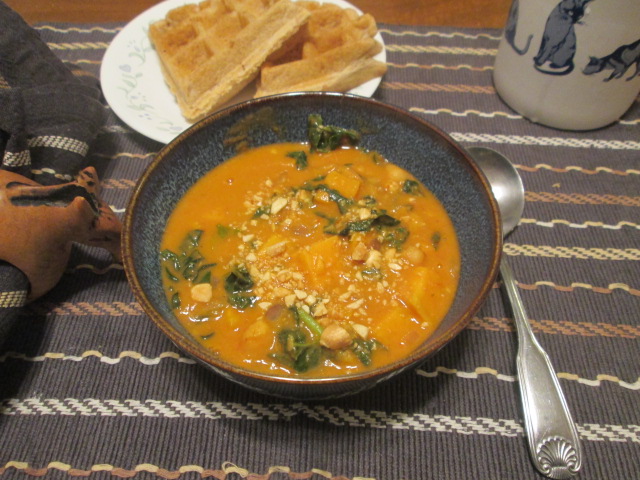
Recipe of the Month: African Peanut Stew

All week, I've been nervously watching the last days of September running out without a single good idea for a new Recipe of the Month. Fortunately, Brian came to my rescue. After a quick search for "high protein vegan recipe," he tracked down something that didn't look (at first glance, at least) like anything we'd tried before: this African Peanut Stew from The Plant-Based School. He picked up most of the necessary ingredients (sweet potatoes, onion, crushed tomatoes) on our weekly Lidl run and grabbed a bunch of fresh spinach at the new SuperFresh in town, and he was ready to cook.

Brian made only a couple of minor modifications to this recipe. Knowing that I don't like things too spicy, he dialed back the red pepper flakes from 1/2 to 1/4 teaspoon and the 1/8 teaspoon of black pepper to just a pinch. He cooked everything else just as directed, and it was pretty straightforward. Not lightning-fast, since it takes half an hour on the stove (or in this case, the new induction burner) to get the sweet potatoes tender, but it didn't require a lot of baby-sitting. The only real work was the ten minutes of chopping, grating, and sauteing before tossing everything in the pot.

Then there was the matter of garnishes. The recipe recommended topping each bowl with "a small handful of crushed, toasted, unsalted peanuts, a generous squeeze of lime juice, and some pickled red onions." Brian wasn't entirely convinced the lime juice would work with the rest of the dish, so rather than waste a fresh lime on it, he just got out the bottle of lime juice and set that on the side. (As it turned out, his instincts were good: neither of us felt that the stew would benefit from this addition.) But he did chop and toast some peanuts and whip up a small batch of the Quick Pickled Red Onions from the same recipe site: sliced red onion steeped for half an hour in a mixture of vinegar, lemon juice, salt, sugar, and red pepper. Since I'm not a huge fan of onions (and they don't love me, either), I skipped this garnish, but Brian tried it and found that it did indeed go well with the stew. However, he didn't think it added so much that he would go to the effort of making it again.

The stew, on the other hand, was something we both deemed worthy of being added to our recipe rotation. It's healthy, vegan, and easy to make, and it doesn't call for any expensive or hard-to find ingredients. And it offers a complex, satisfying mixture of flavors and textures, with chick peas, tender chunks of sweet potato, and chewy strands of spinach in a flavorful broth blended from tomatoes, onions, garlic, ginger, cumin, pepper, and peanut butter. This combination sounds quite unusual, but I realized after a few mouthfuls that it wasn't so different from another dish Brian is very fond of: the tahini-spiked Garlic, Chick-pea and Spinach Soup from Linda Frazer's Vegetariana. However, that recipe isn't vegan (it calls for heavy cream), so this one fits better into our current diet.

The one thing we might do differently next time we make this dish is to plan ahead and make sure we have a suitable bread to serve with it. The recipe suggests either naan or pita bread, but all we had on hand was a loaf of Brian's sturdy whole-wheat bread and some whole-wheat tortillas. So instead, we accompanied the meal with some waffles left over from that morning's breakfast. They were made with whole-wheat flour too, but their lighter texture made them a closer approximation to what the Plant-Based Schoolteachers had in mind.

Sunday, September 22, 2024

Gardeners' Holidays 2024: Harvest Home

Usually, the crop we're most excited about in September is the tomatoes. And they are doing pretty well this year; to date, we've harvested 9 big Pineapples, 61 Premios, 66 San Marzanos, and 490 little Sun Golds. But all summer rolled into fall, we found ourselves focusing more on a new crop: the potatoes Brian planted this spring in our old rain barrel. The plants, which were green and healthy at midsummer, began turning yellow and dry in August, and Brian figured he'd harvest them once the foliage was completely gone. But a little quick research showed that they're actually ready to harvest a couple of weeks after they start yellowing. In short, they were now as ready as they were going to get, and we might as well go for it.

After scooping all the mulch off the top of the plant and setting it aside, Brian began digging into the dirt itself, transferring it into an empty trash can as he went. And just a few inches in, he saw the first little tuber peeping out of the dirt. Unfortunately, it was green on top, meaning it probably wouldn't be safe to eat. (The green itself comes from chlorophyll, but it's a sign that the spud may also contain high levels of solanine, which is poisonous.) But we took it as a sign that there was probably plenty more where that came from.

Sadly, this was not the case. As he kept digging deeper and deeper into the barrel, he found almost no further spuds. Brian burrowed right down to the layer of rocks he'd put in the bottom of the barrel for drainage and unearthed only a scanty handful of potatoes—far less than we'd harvested from our 5-gallon buckets in 2020. The total weight of spuds we produced was probably less than that of the seed potatoes we put in.

So what had we done wrong? Why had such lush, healthy green potato vines produced so few usable tubers? We put this question to the Internet, which told us that the most likely culprit was over-fertilization—particularly the over-application of nitrogen at the time the potato vines were in flower. But that didn't make sense, since the only fertilizer we'd added to the potato barrel was a single bag of aged manure that we mixed in at planting time. Other possible explanations—poor soil, insufficient sunlight, too little water—also didn't fit the data. The plants had gone into rich, crumbly soil; we'd given them plenty of water; and their patio location provided a good 6 to 8 hours of daily sunlight. And the plants themselves looked healthy and vigorous, with no signs of disease or pest infestation.

But after a few dead ends like this, I hit on a site called Growing Produce. The author said her neighbor had a situation exactly like ours: his potato plants "looked great all summer, with vigorous and healthy tops," but produced "only a few small tubers." She immediately diagnosed the problem: His spuds were grown in containers, which "can yield poor results when high daytime temperatures warm the soil." The high temperatures "promote leaf growth at the expense of tubers," resulting in lush plants that are scarce o' tatties. According to the article, "The optimal temperature for tuber growth is said to be about 59°F, while for leaf it’s about 75°F." And according to my home energy use spreadsheet (yes, of course I track our home energy use on a spreadsheet. Are you really surprised?), the average daily temperature throughout June, July, and August of this year was consistently over 75—much more conducive to healthy leaves than abundant spuds.

In short, this potato-barrel experiment was probably doomed from the start. We might conceivably have better results growing potatoes in the ground where the soil would stay cooler, perhaps in the sloped part of the yard where they'd have a big thermal mass to protect them. But we'd have to plant them early, and there's still a chance that too much heat or too much rain would ruin the crop. We might give it one more try just for the hell of it, but we won't be getting our hopes up.


Fortunately, we have other crops in the garden that definitely won't be letting us down. Along with our trusty tomatoes, there are plenty of green beans, peppers, and, surprisingly, zucchini. Normally these summer plants are entirely played out by the time fall comes around, but this year they're still growing, spilling over the edges of the beds and into the paths, and producing healthy squash. And if we still want potatoes, our new local supermarket (which just opened this weekend, about 18 months after the old one shut down) has them on sale for just 30 cents a pound.

Sunday, September 15, 2024

Yard-sale haul 2024

Most years, when we head out to shop Highland Park's annual yard-sale weekend, we aren't looking for anything specific. Our goal is simply to score the most interesting, fun, and/or useful items for the lowest total sum of money. These days we tend to pass over the sales that focus on kids' toys, since we no longer have any children under 10 in our lives, but we always brake for books, board games, adult clothing, or tools that we don't currently have.

This year, however, we did have a particular quarry in mind. Over the past two years, our Christmas gift exchanges have been such a big hit with the niblings on Brian's side of the family that we knew we wanted to do another one this year. But, since we've already done gift exchanges featuring books and board games, we didn't want to repeat either of those themes. So we decided that the theme for this year's exchange would be simply "interesting objects"—something we knew we had a good chance of finding during yard-sale weekend. So, along with seeking out items for ourselves, we were keeping our eyes peeled for any whimsical items that might show up on our neighbors' sale tables. And, as luck would have it, we found some, which is why I won't be too specific in describing or displaying all our finds in this blog entry.

We knew when we set out on Saturday morning that we wouldn't be able to shop for more than a couple of hours at a stretch. I had my monthly Citizens' Climate Lobby meeting at 11:45, and I had to be home by 11:30 to tune in over Zoom. (Normally I go in person, but I wasn't willing to sacrifice an additional hour out of my yard-sale time for the drive.) This turned out to be a blessing in disguise, since what seemed at first like perfect weather for a yard sale—bright, clear, and warm—became uncomfortably hot after two hours of traipsing around. 

But we couldn't bring ourselves to head home any earlier than we had to, because the sales were thick on the ground and we were finding lots of good stuff. As we worked our way westward along the south side of town, we accumulated three potential gift items, three books for ourselves, a pair of pants for Brian, a turtleneck for me, and a tall stack of plastic flowerpots, all for a total of just $10. By the time we headed home, all three of the shopping bags we'd brought with us were bulging.

After my meeting and a bite of lunch, we went once more into the breach. This time, we worked our way west along the north side before heading down to the farmers' market parking lot, where we knew there would be a large collection of sales, as well as entertainment from some local bands. Unfortunately, the music was turned up so loud that we couldn't stand to spend much time browsing. However, the thrift shop at the Reformed Church, which is normally open only until 1pm on Saturday, was open for the occasion, so we ventured in there and emerged with two board games and one jigsaw puzzle, all for $5. We also received two freebies at a booth run by Sustainable Highland Park: a packet of butterfly weed seeds (a native plant) and a small, decorative flowerpot much nicer than all the free ones we'd found earlier.

Next we made our way to Pino's bar, which was hosting a thrift market of its own, with both new and used clothing from a large number of sellers. Most of the customers were a lot younger and hipper than either of us, displaying tattoos, piercings, vivid hair colors, and outré outfits such as a black mini dress with a large spider embroidered on the butt. Yet somehow, we didn't look glaringly out of place; I even got compliments on my sun hat and my colorful patchwork skirt. Unfortunately, most of the clothing at the market was either too small, too fancy, or too rich for our blood, but I picked up a nice T-shirt for $2. By that point we were feeling pretty tired, so we plotted a course for home, stopping only at the sales that happened to be on our path. En route, Brian scored one additional item: a set of earphones to replace the unreliable pair he uses at work. (He wasn't sure the new ones would work either, but they seemed worth risking $1 on, and once we got home he confirmed that they were usable.)

On Sunday, as usual, we encountered far fewer sales. But, to compensate for that, we saw quite a lot of free piles full of rejects from the previous day's sales. In our first two hours of shopping, we picked up a hedge trimmer, four cool-looking glass bottles, two possible stocking stuffers, and one book, all without spending one red cent. We didn't so much as pull out our wallets until we reached the huge, chaotic sale at the synagogue on South First, and even there we spend only $1 on a little stuffed animal (possibly another stocking stuffer, or possibly too cute to give away). After that, we started wending our way home, peeking at other sales and free piles but not actually acquiring anything except for one small houseplant at a "Mama's Got Too Many Plants" sale. (It was perhaps a tad overpriced at $5, but Brian felt the need to help out a fellow gardener.)

Here you can see our complete haul for both days (strategically arranged to disguise the future gift items). Total money spent: $24. Total time spent: 7 hours. Being part of the joyful chaos that is the annual Highland Park sales: Priceless.