
My latest post at Money Crashers is a detailed look into the pros and cons of shopping at warehouse stores. You all know this is a subject I've felt torn about ever since we visited Costco with my in-laws one Christmas and I got a gander at their prices on organic sugar and Fair Trade coffee beans. Was it worth paying an entry fee of $55 a year just to gain access to these bargains? Would we spend enough at the store to make the cost worthwhile—and would the array of cheap luxuries tempt us to spend more than we would at our usual grocery haunts?
For us, I've concluded, the answer is probably no, especially since I've determined that (a) Costco's house brand coffee is undrinkable, and (b) all the items that are supposed to be such unbeatable bargains at Costco are as cheap or cheaper elsewhere. But what's true for us isn't necessarily true for anyone else, so my new article goes into the pros and cons of warehouse stores and the various factors that might make a membership a good deal for you. And I also talk about how to get the most value out of your membership if you do decide to join. Check it out here: Is a Warehouse Store (Costco, Sam's Club, BJ's) Membership Worth It?
Friday, June 12, 2015


Tuesday, June 9, 2015
Money Crashers: 5 Best Types of Natural Cat Litter
Money Crashers has just printed my article on natural cat litter. As my regular readers will know, Brian and I have been through several different brands of this stuff. We were loyal users of the wheat-based Swheat Scoop for years, but were disappointed when it suddenly seemed to lose its clumping power, so we switched to the corn-based World's Best despite its higher cost. However, we quickly became disenchanted with the new brand because, despite its super clumping, it really fell down on odor control. So we went back to wheat, this time opting for the cheaper Exquisicat brand. Then, last August, I noted in passing that we'd switched again, but I never got around to posting about the reason for it and how the new litter was performing.
So if you've just been dying of curiosity, you can get the whole story, along with lots more information about natural cat litter, in the new article. It has the scoop (ha ha) on the five main types of natural litter—wheat, corn, pine, walnut, and paper—based on our experiences and what other reviewers have to say. Check it out here: 5 Best Types of Natural Cat Litter.
So if you've just been dying of curiosity, you can get the whole story, along with lots more information about natural cat litter, in the new article. It has the scoop (ha ha) on the five main types of natural litter—wheat, corn, pine, walnut, and paper—based on our experiences and what other reviewers have to say. Check it out here: 5 Best Types of Natural Cat Litter.
Monday, June 8, 2015
Curb to curb
Anyone who reads this blog regularly has probably already heard the phrase "cradle to cradle," or C2C for short. In a nutshell, it's the idea that when you design any new product, you should think about its entire life cycle, including how all the materials that go into it will eventually become part of new products. Composting is an example of a cradle-to-cradle process; we harvest vegetables from our garden, eat them, put the waste parts into the compost bin, where they break down into compost that will eventually go onto our garden to grow more vegetables. It's not a perfect closed system, of course, because the digested remains of the veggies go into our town's sewage system rather than our compost bin (some people have systems that can handle human waste, but we're not that advanced) and some of the compost that goes in our garden comes from the store, but still, every bit of the vegetables we grow goes to some useful purpose.
Last weekend, however, I thought of an even more efficient variant on this idea: "curb to curb."
A little background: back when I lived in Princeton, about, oh, 12 or 15 years ago, my apartment was furnished with a mixture of odds and ends: hand-me-downs from friends and family, yard-sale finds, a few cheap new items from IKEA, and a couple of pieces that were scavenged off the curb. Among these was an old wicker rocking chair. One of its arms had obviously sustained some damage, most likely at the paws of a cat or cats, and one of its rockers wasn't very well secured - so either the chair was off its rocker, or I was off mine for picking it up off the curb in the first place. But I just disguised the damaged arm with a throw and positioned it in a spot where the rocker couldn't easily come loose, and with the random hodge-podge of furnishings I had in my apartment, it fit in just fine.
 This curbside find ended up following me and Brian from my Princeton apartment to our first apartment in Highland Park and, eventually, to this house, where it settled in the playroom (as we're now calling the big room in the basement, since that's how our cats like to use it). Every so often we thought about replacing it, particularly since a rocker wasn't the ideal type of chair for a room almost entirely surrounded with baseboard heaters, but we never quite got around to it because it wasn't a big priority.
However, once our new kitties took up residence last spring, we noticed that the damaged area of the rocker was gradually expanding. We also started finding fragments of it strewn about the room. And while we weren't that worried about the chair itself being destroyed, given that it was technically trash when I found it, we were a little concerned about the possibility that the cats would ingest parts of it, which we assumed wouldn't be good for them.
So we waited for the first Thursday of the month, which is bulk trash pickup day, and put the chair out at the curb. In fact, we put it out bright and early on Wednesday evening, since we know items that go out for bulk pickup often get snatched up by scavengers before the official trash collectors come for them, and we thought the the chair had a good chance of going to a new home and continuing to live a useful life. And I guess we were right, because when we stepped out to door after dinner to do a little treasure hunting of our own along the curb, the chair was gone.
I would say that's pretty much the ultimate in recycling. The chair came to me off the curb in the first place, got more than ten years of use, and then went back to the curb—and on from there to a new home. So I've now saved this same chair from the landfill not once, but twice. Cradle to cradle is pretty good, but curb to curb—taking something that was waste to begin with, giving it a useful life, and then giving it another useful life after that one is finished—is about as green as it gets.
 It would be the perfect end to this story to say we scavenged a replacement for the chair from one of our neighbors' bulk trash heaps, but sadly, it didn't work out that way. So instead we ended up with a Poang chair from IKEA, which I've always wanted just for the sake of the onomatopoeia (bounce, bounce, poang, poang!). And while our cats have not wasted any time taking possession of the new chair, we think they'll at least find this one a little harder to dismantle.
Last weekend, however, I thought of an even more efficient variant on this idea: "curb to curb."
A little background: back when I lived in Princeton, about, oh, 12 or 15 years ago, my apartment was furnished with a mixture of odds and ends: hand-me-downs from friends and family, yard-sale finds, a few cheap new items from IKEA, and a couple of pieces that were scavenged off the curb. Among these was an old wicker rocking chair. One of its arms had obviously sustained some damage, most likely at the paws of a cat or cats, and one of its rockers wasn't very well secured - so either the chair was off its rocker, or I was off mine for picking it up off the curb in the first place. But I just disguised the damaged arm with a throw and positioned it in a spot where the rocker couldn't easily come loose, and with the random hodge-podge of furnishings I had in my apartment, it fit in just fine.
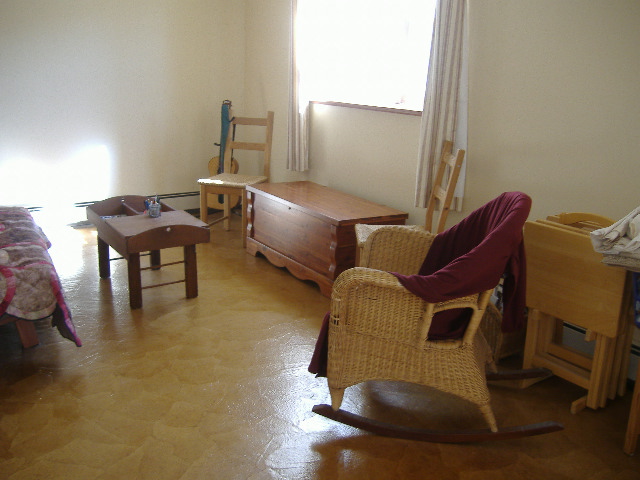 This curbside find ended up following me and Brian from my Princeton apartment to our first apartment in Highland Park and, eventually, to this house, where it settled in the playroom (as we're now calling the big room in the basement, since that's how our cats like to use it). Every so often we thought about replacing it, particularly since a rocker wasn't the ideal type of chair for a room almost entirely surrounded with baseboard heaters, but we never quite got around to it because it wasn't a big priority.
However, once our new kitties took up residence last spring, we noticed that the damaged area of the rocker was gradually expanding. We also started finding fragments of it strewn about the room. And while we weren't that worried about the chair itself being destroyed, given that it was technically trash when I found it, we were a little concerned about the possibility that the cats would ingest parts of it, which we assumed wouldn't be good for them.
So we waited for the first Thursday of the month, which is bulk trash pickup day, and put the chair out at the curb. In fact, we put it out bright and early on Wednesday evening, since we know items that go out for bulk pickup often get snatched up by scavengers before the official trash collectors come for them, and we thought the the chair had a good chance of going to a new home and continuing to live a useful life. And I guess we were right, because when we stepped out to door after dinner to do a little treasure hunting of our own along the curb, the chair was gone.
I would say that's pretty much the ultimate in recycling. The chair came to me off the curb in the first place, got more than ten years of use, and then went back to the curb—and on from there to a new home. So I've now saved this same chair from the landfill not once, but twice. Cradle to cradle is pretty good, but curb to curb—taking something that was waste to begin with, giving it a useful life, and then giving it another useful life after that one is finished—is about as green as it gets.
 It would be the perfect end to this story to say we scavenged a replacement for the chair from one of our neighbors' bulk trash heaps, but sadly, it didn't work out that way. So instead we ended up with a Poang chair from IKEA, which I've always wanted just for the sake of the onomatopoeia (bounce, bounce, poang, poang!). And while our cats have not wasted any time taking possession of the new chair, we think they'll at least find this one a little harder to dismantle.
Sunday, May 31, 2015
Gardening surprises, part 2
As I noted last summer, the life of a gardener is full of surprises—some pleasant, some un. I got one of the pleasant type a week or so ago, while I was hanging out the laundry. Our back yard has a steep slope on the northern side, right next to the clothesline, so I was looking right at it as I hung the clothes, and I noticed a bunch of little, fernlike, bright-green weeds all clustered together near the bottom. My first thought was, "Good grief, is that more dill?" because one of the dill plants in our garden went to seed a couple of years back, and since then, we've been finding tiny dill plants popping up all over the yard. But I'd never seen quite so much of it in one place before.
 There was one easy way to find out, so I nipped a little piece off one of the plants and tasted it. And it wasn't dill; it was an asparagus fern.
At first, I was baffled, because the asparagus in our yard was all planted from crowns (two-year-old root clusters) rather than from seed, and I knew we'd planted those in only two places: the side yard and the big bed in front of the fenced-in garden area. But then I remembered that in both those beds, the allegedly all-male hybrids we'd bought had turned out to include several female plants that produced clusters of berries. And those berries probably looked pretty tasty to the birds that tend to congregate in our yard—particularly in the bushes atop the slope on the north side. So whether they'd picked the berries up and then dropped them, or they'd eaten the berries and they'd passed through, a bunch of them apparently ended up falling right out of those bushes, rolling to the bottom of the slope, and making a home for themselves.
 Unfortunately, their new home was not the ideal place for them from our perspective. It doesn't get nearly as much sun as the two established asparagus beds, and because it's full of grass and other weeds, it would be difficult to find and harvest any mature asparagus stalks that might manage to grow there. So Brian took a crack at digging up some of the baby ferns and transplanting them into the big asparagus bed with our newer asparagus plants (the ones that won't be ready to harvest until next year). Some of the new plants in that bed didn't seem to be doing too well anyway, so we figured eking out the supply with a few extra plants couldn't hurt. It remains to be seen how well the transplants will do in their new home, but at least this way we have a chance of getting some edible asparagus off them.
 Unfortunately, the other surprise in our garden that week was far less agreeable. And to be fair, it wasn't even really that much of a surprise, just a disappointment. You know how last year, I started spraying my rosebush weekly with baking soda spray in an effort to fend off blackspot? And when that didn't work, I switched to a commercial fungicide? And when that still didn't work, I decided that this year I would spray weekly with the fungicide starting in March, as soon as the first leaf buds were visible?
 Yeah, well, that didn't work either. As you can see, despite all my efforts, the dreaded black spots are still showing up on the leaves, and I have no reason to think they won't eventually take over and strip the plant bare, just like they have every other year. In fact, they may even have an easier time this year, because the bush seems to be suffering from some kind of insect infestation as well. So the leaves that aren't gradually turning spotty and yellow and then dropping off are instead just being chewed to pieces right on the stem.
The bottom line is, this is probably going to be the last year for this rosebush. I've decided that if it isn't possible to keep it healthy, I should just take it down and replace it with a new one that's easier to care for. True, the black spot never actually seems to kill the plant, but it does leave it looking bare and ugly for the whole period from August through March, and I've decided I'm not putting up with it anymore.
 The rosebush seems to know somehow that this is its last hurrah, because it's putting on a very impressive display for its grand finale. It almost seems like it's hoping it can still convince me to spare its life by looking so spectacular that I just can't bring myself to remove it. But I'm not fooled. It may look beautiful now, but I know that in a couple of months, while our neighbors' rosebushes are still covered in blossoms, this one will have nothing but a few hips and an ever-dwindling, patchy supply of yellowing leaves. So unless the rosebush actually manages to pull off a miraculous recovery and keep looking good all summer long, I'm not going to be deterred. This pesky plant is going away, and its place will be filled by a nice, easy-care rose like Knock Out, which is resistant to black spot and also a lot more compact than this big sprawling thing.
Normally, I'm all for working with my garden rather than against it, trying to save the plants I have instead of ripping them out and replacing them. But when you've got a plant that just won't cooperate, sometimes you just have to get tough.
 There was one easy way to find out, so I nipped a little piece off one of the plants and tasted it. And it wasn't dill; it was an asparagus fern.
At first, I was baffled, because the asparagus in our yard was all planted from crowns (two-year-old root clusters) rather than from seed, and I knew we'd planted those in only two places: the side yard and the big bed in front of the fenced-in garden area. But then I remembered that in both those beds, the allegedly all-male hybrids we'd bought had turned out to include several female plants that produced clusters of berries. And those berries probably looked pretty tasty to the birds that tend to congregate in our yard—particularly in the bushes atop the slope on the north side. So whether they'd picked the berries up and then dropped them, or they'd eaten the berries and they'd passed through, a bunch of them apparently ended up falling right out of those bushes, rolling to the bottom of the slope, and making a home for themselves.
 Unfortunately, their new home was not the ideal place for them from our perspective. It doesn't get nearly as much sun as the two established asparagus beds, and because it's full of grass and other weeds, it would be difficult to find and harvest any mature asparagus stalks that might manage to grow there. So Brian took a crack at digging up some of the baby ferns and transplanting them into the big asparagus bed with our newer asparagus plants (the ones that won't be ready to harvest until next year). Some of the new plants in that bed didn't seem to be doing too well anyway, so we figured eking out the supply with a few extra plants couldn't hurt. It remains to be seen how well the transplants will do in their new home, but at least this way we have a chance of getting some edible asparagus off them.
 Unfortunately, the other surprise in our garden that week was far less agreeable. And to be fair, it wasn't even really that much of a surprise, just a disappointment. You know how last year, I started spraying my rosebush weekly with baking soda spray in an effort to fend off blackspot? And when that didn't work, I switched to a commercial fungicide? And when that still didn't work, I decided that this year I would spray weekly with the fungicide starting in March, as soon as the first leaf buds were visible?
 Yeah, well, that didn't work either. As you can see, despite all my efforts, the dreaded black spots are still showing up on the leaves, and I have no reason to think they won't eventually take over and strip the plant bare, just like they have every other year. In fact, they may even have an easier time this year, because the bush seems to be suffering from some kind of insect infestation as well. So the leaves that aren't gradually turning spotty and yellow and then dropping off are instead just being chewed to pieces right on the stem.
The bottom line is, this is probably going to be the last year for this rosebush. I've decided that if it isn't possible to keep it healthy, I should just take it down and replace it with a new one that's easier to care for. True, the black spot never actually seems to kill the plant, but it does leave it looking bare and ugly for the whole period from August through March, and I've decided I'm not putting up with it anymore.
 The rosebush seems to know somehow that this is its last hurrah, because it's putting on a very impressive display for its grand finale. It almost seems like it's hoping it can still convince me to spare its life by looking so spectacular that I just can't bring myself to remove it. But I'm not fooled. It may look beautiful now, but I know that in a couple of months, while our neighbors' rosebushes are still covered in blossoms, this one will have nothing but a few hips and an ever-dwindling, patchy supply of yellowing leaves. So unless the rosebush actually manages to pull off a miraculous recovery and keep looking good all summer long, I'm not going to be deterred. This pesky plant is going away, and its place will be filled by a nice, easy-care rose like Knock Out, which is resistant to black spot and also a lot more compact than this big sprawling thing.
Normally, I'm all for working with my garden rather than against it, trying to save the plants I have instead of ripping them out and replacing them. But when you've got a plant that just won't cooperate, sometimes you just have to get tough.
Friday, May 29, 2015
Money Crashers: How to Save Money By Living Green
My third Money Crashers article is my most ecofrugal of all, since it's on the topic of ecofrugality itself: the ways that living a greener life can also save you money. This article touches on lots of different topics I've covered here in the past, from the relative cost-effectiveness of LED and CFL bulbs to the value of solar panels or the benefits of biking to work.
Check it out here: "How To Save Money By Living Green."
Check it out here: "How To Save Money By Living Green."
Wednesday, May 27, 2015
Money Crashers: 8 Ways to Buy Natural Organic Food on a Budget
My second Money Crashers article has just gone live, and it's on a topic I've written about quite a lot here: organic food. Specifically, how to buy it without going broke. Regular readers will recognize some of the topics it covers, such as how to prioritize organic purchases and the great value offered by Aldi's organic brand.
Check out the article here:
8 Ways to Buy Natural Organic Food on a Budget
Check out the article here:
8 Ways to Buy Natural Organic Food on a Budget
Sunday, May 24, 2015
Two easy secondhand clothing hacks
One of the best tools in our entire tightwad toolbox—perhaps even the best—is buying things secondhand.
Clothing is a good example. According to the Bureau of Labor Statistics, the average "consumer unit" (i.e., household) spends $1,604 per year on "apparel and services," with "services" meaning things like dry cleaning, alterations, and repairs. Brian and I, over the last two years, have spent about $350 a year—about 22 percent of the average. Admittedly, our "consumer unit" is a little bit smaller than the average size of 2.5 people, but still, the amount the average household spent per person was around $640, nearly twice what we spent between us. And the main reason our clothing budget is so much lower than the average is that we get most of our clothes secondhand—at thrift shops, at yard sales, or occasionally as hand-me-downs from friends and relatives who no longer want them. Only when we need to replace a worn-out item right away, and we've already exhausted all available secondhand sources, do we buy new.
Some folks, in fact, would argue that we go too far with our secondhand shopping. You see, we occasionally buy shoes secondhand as well when we happen to find a suitable pair—something that many frugal-living experts, including the folks at Money Talks News and Wise Bread, say you should never do. Why not? Wise Bread gives two reasons: first, you might catch athlete's foot or some other sort of fungus, and second, used shoes will be broken in to someone else's feet, so they'll never fit you exactly right—which could unleash a whole host of foot-related medical problems.
Against this argument, there's the opinion of the Grand Panjandrum of frugality, Amy Dacyczyn (all hail the Frugal Zealot!). She writes in The Complete Tightwad Gazette that she consulted two experts to ask whether secondhand shoes are harmful for kids. One doctor argued that secondhand shoes were harmful mainly because "the only way to insure proper fit is with the help of a trained salesperson"—which would make buying new, cheap shoes off the shelf just as unacceptable as buying used ones. The second expert claimed that secondhand shoes are acceptable as long as they fit properly—meaning "there is about a thumb width between the end of the big toe and the end of the shoe," and the little toe isn't jammed up against the side—and they're in good condition, meaning "not badly worn along the outside edge of the heel or sole." As for athlete's foot, she covers that in a separate article. The expert she consulted for that one says it's "theoretically possible" to catch it from used shoes, but the chance is "virtually nil," and you can eliminate it completely by either running the shoes through the washer and dryer or splaying them wide open and letting them dry out thoroughly in the sun.
 So the only real argument against buying shoes secondhand, then, is that the insole may already be broken in to the shape of the previous owner's foot. And, as we've learned, this is a problem you won't necessarily spot with a quick trying-on. At a yard sale last summer, for instance, Brian found a pair of secondhand Skechers sneakers in good condition, with plenty of tread on the sole, and they seemed to fit him just fine when he tried them on. After taking them out for a walk into the city, however, he began to notice that there was an odd sort of ridge on the inside of one of them, which was rubbing uncomfortably against his foot as he walked.
 Now, given that these shoes only cost us a couple of bucks, most folks at this point would probably have just written them off as a bad buy. But it seemed to me that if the only problem with these shoes was the shape of the insole, putting in a new insole would probably take care of it. So on our way back from our walk, we stopped at the local Rite Aid and picked up a pair of plain, non-molded insoles for $2.69. Since the shoes were reasonably roomy, we chose the "double thick" variety to put as much cushioning as possible between his tootsies and the existing insole. And once he got them in place, he suddenly found that the shoes were perfectly comfortable once again. A new pair of shoes in a similar style would have cost him around $60; this pair cost us under $5, including the shoes themselves and the new insoles. So with this little hack, we saved around $55.
 This is just one way we've hacked secondhand clothing to make it fit better. Another example came up just this week, when I found a pair of black lightweight jeans at the thrift shop for $1. They fit reasonably well in the hips and thighs, but they had an awkward gap at the back of the waist—a problem I seem to encounter with most brands of jeans. But since they were wearable, and since I was particularly in need of new jeans, I bought them anyway. Once I got them home, I figured, I could take a look at them and see if I could figure out some way of taking them in.
 When I tried them on at home and fiddled around with them a bit, pinching together the material of the waistband, I found that I didn't need to remove that much material to make them fit properly. In fact, all I really needed to eliminate was about an inch of fabric between the two back belt loops. And I realized that I could do this reasonably well without even getting out my sewing box. I simply took a black plastic twist tie and threaded it through the two belt loops, then pulled them snugly together and twisted the tie to hold them there. And presto, the uncomfortable gap was eliminated. I can simply remove the twist tie before tossing these in the laundry—but even if I forget to do that, it'll probably come through the wash cycle undamaged.
This pair of jeans cost me $1, and a new pair of relaxed fit jeans from L.L. Bean—the only brand I've found that actually fits me more or less properly without alteration—would have cost $40. (No extra cost for tax or shipping, since Bean offers free shipping on all its orders and New Jersey doesn't charge sales tax for clothing.) So this second little hack saved us $39.
So, in just one week, we saved nearly $100 with two little clothing hacks that didn't take more than five minutes to complete. Not bad, eh?
Clothing is a good example. According to the Bureau of Labor Statistics, the average "consumer unit" (i.e., household) spends $1,604 per year on "apparel and services," with "services" meaning things like dry cleaning, alterations, and repairs. Brian and I, over the last two years, have spent about $350 a year—about 22 percent of the average. Admittedly, our "consumer unit" is a little bit smaller than the average size of 2.5 people, but still, the amount the average household spent per person was around $640, nearly twice what we spent between us. And the main reason our clothing budget is so much lower than the average is that we get most of our clothes secondhand—at thrift shops, at yard sales, or occasionally as hand-me-downs from friends and relatives who no longer want them. Only when we need to replace a worn-out item right away, and we've already exhausted all available secondhand sources, do we buy new.
Some folks, in fact, would argue that we go too far with our secondhand shopping. You see, we occasionally buy shoes secondhand as well when we happen to find a suitable pair—something that many frugal-living experts, including the folks at Money Talks News and Wise Bread, say you should never do. Why not? Wise Bread gives two reasons: first, you might catch athlete's foot or some other sort of fungus, and second, used shoes will be broken in to someone else's feet, so they'll never fit you exactly right—which could unleash a whole host of foot-related medical problems.
Against this argument, there's the opinion of the Grand Panjandrum of frugality, Amy Dacyczyn (all hail the Frugal Zealot!). She writes in The Complete Tightwad Gazette that she consulted two experts to ask whether secondhand shoes are harmful for kids. One doctor argued that secondhand shoes were harmful mainly because "the only way to insure proper fit is with the help of a trained salesperson"—which would make buying new, cheap shoes off the shelf just as unacceptable as buying used ones. The second expert claimed that secondhand shoes are acceptable as long as they fit properly—meaning "there is about a thumb width between the end of the big toe and the end of the shoe," and the little toe isn't jammed up against the side—and they're in good condition, meaning "not badly worn along the outside edge of the heel or sole." As for athlete's foot, she covers that in a separate article. The expert she consulted for that one says it's "theoretically possible" to catch it from used shoes, but the chance is "virtually nil," and you can eliminate it completely by either running the shoes through the washer and dryer or splaying them wide open and letting them dry out thoroughly in the sun.
 So the only real argument against buying shoes secondhand, then, is that the insole may already be broken in to the shape of the previous owner's foot. And, as we've learned, this is a problem you won't necessarily spot with a quick trying-on. At a yard sale last summer, for instance, Brian found a pair of secondhand Skechers sneakers in good condition, with plenty of tread on the sole, and they seemed to fit him just fine when he tried them on. After taking them out for a walk into the city, however, he began to notice that there was an odd sort of ridge on the inside of one of them, which was rubbing uncomfortably against his foot as he walked.
 Now, given that these shoes only cost us a couple of bucks, most folks at this point would probably have just written them off as a bad buy. But it seemed to me that if the only problem with these shoes was the shape of the insole, putting in a new insole would probably take care of it. So on our way back from our walk, we stopped at the local Rite Aid and picked up a pair of plain, non-molded insoles for $2.69. Since the shoes were reasonably roomy, we chose the "double thick" variety to put as much cushioning as possible between his tootsies and the existing insole. And once he got them in place, he suddenly found that the shoes were perfectly comfortable once again. A new pair of shoes in a similar style would have cost him around $60; this pair cost us under $5, including the shoes themselves and the new insoles. So with this little hack, we saved around $55.
 This is just one way we've hacked secondhand clothing to make it fit better. Another example came up just this week, when I found a pair of black lightweight jeans at the thrift shop for $1. They fit reasonably well in the hips and thighs, but they had an awkward gap at the back of the waist—a problem I seem to encounter with most brands of jeans. But since they were wearable, and since I was particularly in need of new jeans, I bought them anyway. Once I got them home, I figured, I could take a look at them and see if I could figure out some way of taking them in.
 When I tried them on at home and fiddled around with them a bit, pinching together the material of the waistband, I found that I didn't need to remove that much material to make them fit properly. In fact, all I really needed to eliminate was about an inch of fabric between the two back belt loops. And I realized that I could do this reasonably well without even getting out my sewing box. I simply took a black plastic twist tie and threaded it through the two belt loops, then pulled them snugly together and twisted the tie to hold them there. And presto, the uncomfortable gap was eliminated. I can simply remove the twist tie before tossing these in the laundry—but even if I forget to do that, it'll probably come through the wash cycle undamaged.
This pair of jeans cost me $1, and a new pair of relaxed fit jeans from L.L. Bean—the only brand I've found that actually fits me more or less properly without alteration—would have cost $40. (No extra cost for tax or shipping, since Bean offers free shipping on all its orders and New Jersey doesn't charge sales tax for clothing.) So this second little hack saved us $39.
So, in just one week, we saved nearly $100 with two little clothing hacks that didn't take more than five minutes to complete. Not bad, eh?
Subscribe to:
Posts (Atom)

 Posts
Posts

