Saturday, June 20, 2015

Money Crashers: Composting 101

My second Money Crashers post for this past week is all about composting, a subject I've discussed here many times in the past. I've written about our preference for cold composting, also known as lazy composting, because you basically just throw everything in the bin and leave it there; about the perils of "killer compost," which contains lingering traces of highly persistent herbicides and can therefore kill your plants instead of fertilizing them; and about the various things we put into our compost that might not be obvious. This new article touches on all those topics, but it's mostly a guide to composting for people who are short on one or more resources:
  • time,
  • space, and
  • money.
It covers specific methods that are useful for busy, crowded, or cash-strapped homes, and it also includes some general info about the benefits of composting, how it's done, and how to troubleshoot your compost pile.

So if you're looking for a nice general guide (either for yourself or for a friend who's new to the compost game), or if you've always wanted to try composting but thought it wouldn't work in your situation, this is the article for you: Composting 101: How to Make Compost & Fertilizer at Home.

Money Crashers: Do It Yourself (DIY) or Hire a Contractor?

Published this week on Money Crashers: an article about when to DIY and when to hire a professional for home repairs and renovations. As you all know, I'm generally a fan of DIY, but there are some jobs—like installing a new furnace or rewiring our basement—that I've willingly ceded to the professionals. I've discussed my reasons for doing this two posts on "the DIY question," part 1 and part 2. This new article is basically a much-expanded discussion of the points made in those two posts. Check it out at the Money Crashers site: "Do It Yourself (DIY) or Hire a Contractor for Home Improvement Projects?"

By the way, this is just the first of three new articles of mine to pop up on Money Crashers this week. So I'll make short posts about the other two as well, and tomorrow I'll give you a proper full-length post to let you know how things are starting off with our local produce challenge.

Thursday, June 18, 2015

Savings Challenge, Weeks 11-16

Since I started working for Money Crashers, I haven't had much time during the week to update this blog, and as a result, I've fallen seriously behind with the Bankrate Savings Challenges. The last one I posted was over a month ago, and since then, six new weekly challenges have popped up on the challenge's main page. I don't really have time to post six separate entries to get caught up, and anyway, I doubt I could get a full blog post out of each challenge, since most of them (as usual) aren't really relevant for us. So instead, here's a catchup post, in which I'll run through the six new challenges and what I have to say about them—whether that's taking the challenge in full or just explaining why it doesn't work for us.

Week 11: Bid on hotel rooms to save big

This challenge is all about using Priceline, along with a few other travel sites, to name your own price for a hotel room. Doug Whiteman, the reporter covering this challenge, leads off with the remark, "The idea that some people would spend hundreds of dollars per night on a hotel room has always seemed crazy to me." I'm certainly in agreement with him there, but I'd take it even further: for me, in most cases, it's crazy to stay in hotels at all.

That's because Brian and I don't really like to travel for its own sake. As a rule, we travel for only two reasons: to visit family and friends (in which case we stay with them), or for the occasional work-related trip (in which case it goes on the expense account). The last time we stayed in a hotel, as far as I can recall, was when we went with my parents to visit my sister for Hanukkah in 2012—and on that occasion, they picked up the tab in exchange for having us do the driving. The last time we actually paid to stay at a hotel, as far as I can recall, was on our honeymoon nearly eleven years ago.

Obviously, if you're a person who does like to travel, this strategy won't work for you, and you're better off with Mr. Whiteman's. (My favorite financial writer, Andrew Tobias, also loves it, saying "Many is the time I've stayed in a $300 hotel room for $89.") But skipping hotels completely works fine for us.

Week 12: Conserve gas by carpooling to work

This tip is obviously useless for me, since I work entirely from home (you know, cranking out those articles for Money Crashers) and I don't use a drop of gas walking from my bedroom to the office. Brian doesn't really do it either, because his workplace is only four miles away, and most of his coworkers live farther away than that. Instead, he saves gas in the warmer months (and very occasionally in the wintertime) by riding his bike to work. He finds this method of commuting much more enjoyable than driving, and it helps him maintain his boyish figure (or rather, acquire one, since he's in much better shape now than he was as a boy).

Occasionally, Brian will get a ride home with a coworker (for instance, if he rode his bike to work and then it started raining), or give a ride to one whose car has broken down. But since he doesn't regularly drive to work, forming a regular carpool isn't really an option.

Week 13: Find the best diaper deals

This obviously isn't a useful tip for a couple with no kids, in diapers or out of them. The only time I've bought diapers in the past couple of years was as a Hanukkah present for my sister, and those were not the disposable kind, but eco-friendly cloth diapers from Charlie Banana. These ain't cheap: a pack of 6 costs at least $114, which means enough diapers to get your kid through to potty training will run you upwards of $450. But that's still significantly less than the $1,912 that frugal-living blogger Squawkfox estimates you'd pay for disposable diapers over the same period. Even if you tack on another $375, as Squawkfox does, for the extra laundry costs, you still save more than a grand by using cloth. And that's just with the first kid; those cloth diapers won't wear out in 30 months, so you can go on to use them again with any future kids. And after that, you can sell the cloth diapers on eBay and recover about half of what you spent on them initially. So unless you can get the price of disposable diapers down to about 8 cents apiece, cloth is bound to be cheaper.

Week 14: Eat local, seasonal produce

Ah, now here at last is a challenge that's right up my alley. Indeed, my whole series of Gardeners' Holidays theme is basically a celebration of local, seasonal produce. However, one thing I learned recently makes me hesitate to take on this challenge: food that's locally grown—say, within a 100-mile radius of your home—doesn't always have the lowest carbon footprint. According to this article from the Worldwatch Institute, the transportation of food from farm to table accounts for only 4 percent of its total carbon emissions. So veggies grown in the fertile soil of California, where they need less fertilizer to flourish, may actually have a lower carbon footprint than veggies grown right here in New Jersey.

The article argues that "production practices"—that is, how food is grown—matters a whole lot more than where it's grown. Organic produce, for instance, has a lower carbon footprint because you can cut out all the emissions associated with producing, transporting, and applying chemicals to fields—and it has other environmental benefits too, like reducing water use and preserving biodiversity. But on the other hand, local produce also has some benefits that can't be measured in terms of carbon equivalents. Buying local makes it possible to know the farmers personally, so you actually know a lot more about how their food is produced than you do when you buy at the supermarket. However, this only works if you're actually shopping at the farmers' market and interacting with the growers directly; if you just pick the apples marked "Jersey Fresh" off the supermarket shelf, it doesn't tell you anything except where they come from.

So if I take on this challenge, I think I'll want to take it one step further. Instead of just choosing food that's local and seasonal, I'll want to make sure it's as sustainable as possible. That means all the food I buy during the weeklong challenge should be either
  1. from our own garden,
  2. Certified Organic, and/or
  3. from a farm I know to be sustainable.
This makes the challenge quite a bit tougher, but fortunately, I have an ace up my sleeve. Brian just notified me this morning that one of his coworkers is going to be away this weekend and has offered us her CSA share. So, between the contents of that box, a trip to the all-organic since we'll be picking that box up on Sunday—which, coincidentally, is also my next Gardeners' Holiday—I'll make that the kicking-off point for a week of local, seasonal, sustainable eating. Once I know what's in the box, as well as what's ready for picking in the garden, I can fill in the gaps with seasonal organic produce from the supermarket. So watch for more news about this challenge on Sunday.

Week 15: Shop around for the best insurance rate

Here's another challenge that I've already done. I posted on the results of my insurance checkup two years ago, when I tried to find better rates on my auto and home insurance but ended up deciding it wasn't worth switching both policies to save $140 a year. This past February, however, I tried it again, and this time I found that we could save $227 a year by switching to a new auto insurer. The higher savings, and the fact that we'd only have to transfer one policy, sold Brian on the deal, and we made the switch—with a promise to our old insurer that we'd check back with them next year and see whether they could convince us to switch back. So it'll be at least another 6 months before I'm ready to check insurance rates again.

Week 16: Set up credit card alerts

This week's story really isn't a challenge at all. Instead, it's a little educational article about four ways to use credit card alerts to save money:
  1. Set up payment alerts to let you know when a payment is due, so you never miss a payment and end up owing a late fee. I already receive my bill electronically, so I don't need any additional alerts to remind me to pay it.
  2. Use balance alerts and spending alerts to keep track of how much you're charging, so you don't let your bill get out of hand. I keep track of my spending using a much simpler system: a pencil and a sheet of paper tacked to my bulletin board. So when my monthly credit card bill comes, I already know exactly what's going to be on it—and if there's any transaction I don't remember, I can always double-check it against the sheet.
  3. Use transaction alerts to warn you about any transaction that looks suspicious, so you'll know if someone else is using your card fraudulently. This, I admit, would be a lot more convenient than the system Citibank uses with one of my cards, which is to cut it off with no warning at all if it's used outside of our home territory—as they did once while we were visiting my in-laws in Indianapolis. Apparently the fact that we'd used that same card to buy gas several times on the way to Indianapolis didn't tip them off that we might actually be there. So after that, we had to call up the company and tell them whenever we were going to be traveling. (Now, we just use a different card.) But if had simply alerted us to the fact that someone was using our card in another state, that wouldn't have been so bad. (Unfortunately, I checked and this isn't actually an available alert with any card we use.)
  4. Use alerts to keep track of your rewards, so you know when to cash them in or when to sign up for a new set of spending categories. I already get the alerts to tell me about new spending categories, and I just check the rewards balance whenever I pay the bill, so I don't need to be alerted about it.
And there we are: all up to date. I'll try not to fall this far behind in future, but it may mean making my Bankrate challenge posts little quickies that I can do during the week.

Sunday, June 14, 2015

Money Crashers: Can Money Buy Happiness?

My latest post for Money Crashers is one that I'm rather proud of. It's on the fascinating (at least to me) topic of happiness economics, which I've so far covered only briefly on this blog. I wrote a post three years ago in response to a Washington Post article on the subject, in which I summed up some of the major discoveries made by happiness economists, such as:
  • Higher income only improves day-to-day happiness up to a limit of about $75,000. Beyond that point, day-to-day happiness doesn't increase, but "life satisfaction" does.
  • Buying more stuff doesn't tend to make us happier, because we quickly get used to what we have.
  • Spending on experiences does make us happier, because it ties in with our social needs.
In the new article, I go into all these findings in much more detail, along with a lot of others. And I talk about how happiness economists are applying their findings to the health of whole nations, not just individuals, much like David Cameron did four years ago in seeking to create a National Happiness Index for Great Britain.

Here's the full article: "Can Money Buy Happiness? - Understanding the Economics of Happiness"

Also, let me reassure everyone that I will post a real blog entry soon. I've been posting these links to my Money Crashers pieces to fill in the blog during the week, because my work for Money Crashers is keeping me busy Monday through Friday and I usually only have time to update my own blog on the weekends...but I promise not to neglect it entirely.

Friday, June 12, 2015

Money Crashers: Is a Warehouse Store Membership Worth It?

My latest post at Money Crashers is a detailed look into the pros and cons of shopping at warehouse stores. You all know this is a subject I've felt torn about ever since we visited Costco with my in-laws one Christmas and I got a gander at their prices on organic sugar and Fair Trade coffee beans. Was it worth paying an entry fee of $55 a year just to gain access to these bargains? Would we spend enough at the store to make the cost worthwhile—and would the array of cheap luxuries tempt us to spend more than we would at our usual grocery haunts?

For us, I've concluded, the answer is probably no, especially since I've determined that (a) Costco's house brand coffee is undrinkable, and (b) all the items that are supposed to be such unbeatable bargains at Costco are as cheap or cheaper elsewhere. But what's true for us isn't necessarily true for anyone else, so my new article goes into the pros and cons of warehouse stores and the various factors that might make a membership a good deal for you. And I also talk about how to get the most value out of your membership if you do decide to join. Check it out here: Is a Warehouse Store (Costco, Sam's Club, BJ's) Membership Worth It?

Tuesday, June 9, 2015

Money Crashers: 5 Best Types of Natural Cat Litter

Money Crashers has just printed my article on natural cat litter. As my regular readers will know, Brian and I have been through several different brands of this stuff. We were loyal users of the wheat-based Swheat Scoop for years, but were disappointed when it suddenly seemed to lose its clumping power, so we switched to the corn-based World's Best despite its higher cost. However, we quickly became disenchanted with the new brand because, despite its super clumping, it really fell down on odor control. So we went back to wheat, this time opting for the cheaper Exquisicat brand. Then, last August, I noted in passing that we'd switched again, but I never got around to posting about the reason for it and how the new litter was performing.

So if you've just been dying of curiosity, you can get the whole story, along with lots more information about natural cat litter, in the new article. It has the scoop (ha ha) on the five main types of natural litter—wheat, corn, pine, walnut, and paper—based on our experiences and what other reviewers have to say. Check it out here: 5 Best Types of Natural Cat Litter.

Monday, June 8, 2015

Curb to curb

Anyone who reads this blog regularly has probably already heard the phrase "cradle to cradle," or C2C for short. In a nutshell, it's the idea that when you design any new product, you should think about its entire life cycle, including how all the materials that go into it will eventually become part of new products. Composting is an example of a cradle-to-cradle process; we harvest vegetables from our garden, eat them, put the waste parts into the compost bin, where they break down into compost that will eventually go onto our garden to grow more vegetables. It's not a perfect closed system, of course, because the digested remains of the veggies go into our town's sewage system rather than our compost bin (some people have systems that can handle human waste, but we're not that advanced) and some of the compost that goes in our garden comes from the store, but still, every bit of the vegetables we grow goes to some useful purpose.

Last weekend, however, I thought of an even more efficient variant on this idea: "curb to curb."

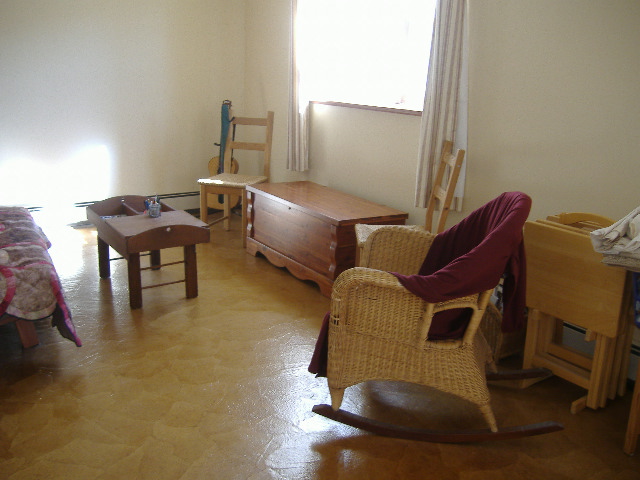
A little background: back when I lived in Princeton, about, oh, 12 or 15 years ago, my apartment was furnished with a mixture of odds and ends: hand-me-downs from friends and family, yard-sale finds, a few cheap new items from IKEA, and a couple of pieces that were scavenged off the curb. Among these was an old wicker rocking chair. One of its arms had obviously sustained some damage, most likely at the paws of a cat or cats, and one of its rockers wasn't very well secured - so either the chair was off its rocker, or I was off mine for picking it up off the curb in the first place. But I just disguised the damaged arm with a throw and positioned it in a spot where the rocker couldn't easily come loose, and with the random hodge-podge of furnishings I had in my apartment, it fit in just fine.

This curbside find ended up following me and Brian from my Princeton apartment to our first apartment in Highland Park and, eventually, to this house, where it settled in the playroom (as we're now calling the big room in the basement, since that's how our cats like to use it). Every so often we thought about replacing it, particularly since a rocker wasn't the ideal type of chair for a room almost entirely surrounded with baseboard heaters, but we never quite got around to it because it wasn't a big priority.

However, once our new kitties took up residence last spring, we noticed that the damaged area of the rocker was gradually expanding. We also started finding fragments of it strewn about the room. And while we weren't that worried about the chair itself being destroyed, given that it was technically trash when I found it, we were a little concerned about the possibility that the cats would ingest parts of it, which we assumed wouldn't be good for them.

So we waited for the first Thursday of the month, which is bulk trash pickup day, and put the chair out at the curb. In fact, we put it out bright and early on Wednesday evening, since we know items that go out for bulk pickup often get snatched up by scavengers before the official trash collectors come for them, and we thought the the chair had a good chance of going to a new home and continuing to live a useful life. And I guess we were right, because when we stepped out to door after dinner to do a little treasure hunting of our own along the curb, the chair was gone.

I would say that's pretty much the ultimate in recycling. The chair came to me off the curb in the first place, got more than ten years of use, and then went back to the curb—and on from there to a new home. So I've now saved this same chair from the landfill not once, but twice. Cradle to cradle is pretty good, but curb to curb—taking something that was waste to begin with, giving it a useful life, and then giving it another useful life after that one is finished—is about as green as it gets.

It would be the perfect end to this story to say we scavenged a replacement for the chair from one of our neighbors' bulk trash heaps, but sadly, it didn't work out that way. So instead we ended up with a Poang chair from IKEA, which I've always wanted just for the sake of the onomatopoeia (bounce, bounce, poang, poang!). And while our cats have not wasted any time taking possession of the new chair, we think they'll at least find this one a little harder to dismantle.