Saturday, August 15, 2015

The fruits of our labors, part 2

This spring, our two-year old plum trees bloomed for the first time. We kept an eager eye on them throughout the spring and summer, watching the tiny balls in the middle of each blossom slowly grow to about an inch and a half in diameter. We kept thinking this couldn't be their final size, because the plums you see in the store tend to be at least two inches across, but apparently ours are either a smaller variety or just smaller because the trees are younger, because once they reached an inch to an inch and a half across, they gradually started to change color. Unfortunately, they also gradually started to drop off the trees before they'd fully ripened. I don't think we got a single plum off the Mount Royal tree, and we managed to harvest only one rosy-hued Opal plum before losing the rest.

So what you see here in this bowl is pretty much our entire plum harvest: about seven Golden Gage plums, each barely bigger than a large cherry. However, small as they were, they were still very tasty. Brian, not normally a great lover of plums, bit into the first one he picked and commented, "Oh, wow," so then I had to try one, and I found it sweet and juicy with just a hint of tartness. But sadly, each one was little more than a mouthful, so they were gone all too soon. We managed to harvest one more, and we had three others still on the tree waiting to ripen—but apparently, in the last two days, they went from being too green to pick to falling off and rotting on the ground. So that's the end of our plums for this year. Still, for a first harvest, it wasn't too bad, and we can hope that as the trees grow bigger, they'll yield more—and possibly larger—edible fruits.

Fortunately, our other fruit-bearing plants have been much more productive. We've already harvested eight cups of cherries, and that was only from four of our five bushes; the little Jan bush in the middle of the row was later to ripen than the others, so its fruit was still green two weeks ago. But it's now ripening nicely and should be ready to pick in the next week, so we probably can probably get another cup or so there. And as you can see above, the raspberries have started to produce as well. True to the pattern they established in their first year, they've been giving us about a handful at a time for the past few weeks, and by yesterday, we were finding so many ripe ones that we couldn't hold them all in our hands and had to use my hat as a receptacle. (I thought A Hat Full of Raspberries sounded like a Newberry-award-winning children's book, but Brian believed it would be more appropriate to use Raspberry Sun Hat as the name of an alternative band, along the lines of Strawberry Alarm Clock.)

As you may or may not be able to judge from the size of the hat, we got a good half-pint of raspberries from just this one picking. As it happened, we'd just returned from a trip to the local farmers' market at the time, and Brian noted that a comparable volume of organic blackberries would have cost us five bucks—so the raspberries are definitely earning their keep. And moreover, there's lots more where those came from; there are lots more berries on the canes, ranging from barely big enough to see to almost ripe enough to pick. So by September, we should be bringing in a truly bountiful crop—possibly even enough to "put up" some preserves for the winter.

All in all, I think our fruit crops are justifying the effort we put into planting them over that one long, dirty, chilly March weekend two years ago. The raspberry canes are yielding a good yearly crop already, and the cherry bushes, while still small, are producing enough for a few good desserts each year. And the plums, even if they're not very productive yet, at least offer a promise of tasty fruit for the future. Plus, at the rate they're growing, they may even be able to provide some nice summertime shade in a few years.

Friday, August 14, 2015

Money Crashers: Community Cafes – What They Do and Where to Find One

When I first discovered our local community cafe, A Better World Cafe, back in January 2010, I'd never seen anything like it before. Indeed, back at the time, community cafes were still a pretty new idea, and A Better World was only the fifth of its kind in the country. Yet the idea seemed so appealing in so many ways—healthy, sustainably produced food, in whatever portion you prefer, at whatever price you can afford—that I couldn't understand why it wasn't more popular. Shouldn't there be places like this all over the country?

Well, now there are—at least 40 of them, with more in the works. And as the community cafe movement goes mainstream, some big names are starting to hop on the bandwagon. Jon Bon Jovi has opened his own community restaurant, JBJ Soul Kitchen, in Red Bank, with plans for a second one in Toms River. And Panera Bread, the popular restaurant chain, is now running four Panera Cares cafes, in Clayton, Missouri; Dearborn, Michigan; Portland, Oregon; and Boston, Mass. These look and feel just like a regular Panera, right down to the free wi-fi, but operate on the community cafe model.

My latest post for Money Crashers explores the community cafe movement: how it started, how it works, and its various benefits, from fighting hunger to supporting local farmers. Read more about this uniquely ecofrugal type of eatery in the full article: Community Cafes – What They Do and Where to Find One.

Tuesday, August 11, 2015

Money Crashers: How to Save Money at Work

I've been working from home as a freelancer for about 11 years now, and I'll admit, it's been a mixed blessing. I love having complete control over my own schedule, but what I don't have so much control over is how much work I actually get, and how much money I can make doing it. Glancing over my records for the ten years for which I have complete records, it looks like on average, I've made about $5,000 less per year as a freelancer than I did when I was working 9 to 5.

This isn't quite as bad as it sounds, though, because my expenses are also lower now that I don't work in an office. For instance, when I lived in Princeton and commuted to work on the Dinky, I used to spend about $800 a year on train fare and another $400 to buy my breakfast each morning at the nearby Wawa. That's over a grand per year I no longer have to spend because my office is now in my home.

Actually, as workers go, I was getting off pretty lightly. Most workers commute by car, and when you factor in all the costs—gas, tolls, wear and tear on the vehicle—that adds up to thousands of dollars a year, not hundreds. The 8 or 9 bucks a week I used to spend on my weekday breakfasts is dwarfed by the $37 a week the typical American worker spends on lunches. Also, since my workplace had a casual dress code, I didn't have to spend extra money on a working wardrobe. And the biggest work-related expense of all, child care, didn't affect me since I was single and childless. A less fortunate nine-to-fiver, one who has to pay all these expenses in order to keep working, could be losing as much as $25,000 out of her paycheck by the time she's hauled that bacon home.

For her sake, I've devoted my latest Money Crashers post to ways to save money on the hidden costs of holding down a job. I deal with ways to save on child care, commuting (whether by car, train, bus, bike, or foot), a professional wardrobe, and workday lunches. Because working for a living is hard enough without having to pay for the privilege.

Here's the full article: How to Save Money at Work on 4 Major Job-Related Expenses

Sunday, August 9, 2015

Pecking Problem

Our tomato crop is being ravaged by an unlikely pest: birds.

Normally, I think of birds as being allies in the war against pests, because they eat all kinds of insects and other critters that attack our plants. But lately, we've started discovering tomatoes with big holes in them, as if something had taken a bite out of them, and since we know the groundhogs are fenced out, it seems birds are the most likely culprit. The tomato shown in the picture here is one of the less damaged ones; the more severely damaged ones are practically torn in two, and Brian doesn't even bother trying to bring them into the house.

Based on what I've read on gardening forums like this one, it appears the birds are attacking our tomatoes not for food, but for water. The most commonly proposed solution is to provide some sort of birdbath or bird waterer, so they have another water source handy and don't need to peck at the tomatoes. I looked for ways to mock up a DIY birdbath and found a slideshow on Bob Vila's site that offers a lot of interesting ideas, but basically, it appears that all you really need is some sort of shallow tray to hold the water and some sort of stand to put it on. Since Brian and I had just recently replaced our cat's water dispenser with a bigger one that the kitties can't push around as easily, we decided to fill up the the old one and set it atop an inverted 5-gallon bucket (the same kind we use for our tree waterers). We figured if this worked, we could always replace it with something nicer-looking later. We could have set this up next to the clothesline, where our birdfeeder is now, but Brian thought it would be best to put it as close to the garden as possible, so the birds could see an alternative source of water right next to the tomatoes. So he set the whole thing up in the little back lane behind the fenced-in garden area where our hardy kiwi vines are planted.

So is it working? Well, it's sort of hard to tell. Since we set it up, there have been fewer tomatoes pecked apart, but we've also been getting fewer tomatoes altogether. Also, the weather hasn't been as hot this week as it was a couple of weeks ago, which means the birds may just not be as thirsty. And lastly, Brian has been trying to safeguard the tomatoes against bird damage by picking them earlier, at "first blush" (when they're just getting rosy), rather than letting them ripen fully on the vine. This is the other major tip recommended on the GardenWeb forum for dealing with bird damage, and one gardener says it's a good idea for other reasons too; it protects the fruit from other pests, such as stink bugs, and prevents splitting, which can occur after a heavy rainfall. According to this gardener, "You lose a lot and gain nothing by leaving the fruit on the stem until it is fully red."

That was news to me, since all the articles I'd seen about buying tomatoes urged shoppers to make sure the ones they bought were "fully vine ripened" and not let the store foist tomatoes on them that had been picked while still green and ripened in some warehouse, or in the truck en route to the store. However, when I Googled "should I let my tomatoes ripen on the vine," the articles I found generally seemed to agree that what's wrong with supermarket tomatoes is that they're inferior varieties bred for endurance rather than flavor, and a decent homegrown tomato will taste good whenever you pick it. This garden blogger, for instance, says she has always picked her tomatoes at first blush and gotten a much bigger crop than her neighbors who insisted on letting theirs ripen fully—and when they tasted some of hers, they were sold.

I know from personal experience that it's possible to pick tomatoes when they're still completely green, before the frost gets them, and ripen them in boxes indoors, but I also know that the tomatoes you get this way don't ripen as reliably, or taste as good, as the ones picked at the height of summer. But if these sources are to be believed, a tomato that has started to turn red—even just a tiny bit—can be trusted to ripen fully on its own and will taste just as good as if it had ripened on the vine. (Tomatoes that are completely green, on the other hand, will never ripen and will just rot in the box—so if you pick fully green tomatoes before the frost, you should find some way of using them in their green state.)

Indeed, according to this article from the National Gardening Association, shelf-ripened tomatoes may actually look better, too, since tomatoes don't turn red at temperatures above 86°F. So if you want a nice, full red color, you're actually better off letting them ripen indoors where it's slightly cooler. In fact, considering that our house occasionally does get above 86°F on the main level, we might be better off leaving them downstairs to ripen.

So the plan for now is to keep picking our tomatoes early, which should help not only with the bird problem but also with cracking and possibly ward off other pests. As for the birdbath, we may as well leave it; even if it's not helping, at least it's probably not doing any harm, and offering the birds a drink will encourage them to hang around our yard and keep eating smaller pests.

Sunday, August 2, 2015

Savings Challenge, Weeks 21-22: Basic Needs

There seems to be something wrong with the main webpage for the Bankrate Savings Challenge. When I view it in either Chrome or Firefox, I can't click on the links for the individual weekly challenges. I finally got it to work in Safari, so now I can view the last two challenges and post my responses. If you're also having difficulty viewing the page, try clicking on the links below to go directly to each week's challenge.

Week 21: Try Meal Replacements

This isn't so much a challenge as a hypothetical question: could you save money by replacing some or all of your meals with a liquid meal replacement called Soylent? Unlike liquid "supplements" like Ensure or Slim-Fast, this fairly new produce is classified as a food by the FDA and is guaranteed to provide all the nutrients your body needs.

Claes Bell, the Bankrate reporter who was brave enough to try this stuff for an entire week, reacted to it pretty much like Paul Hogan's character in the movie Crocodile Dundee: "You can live on it, but it tastes like sh--." He says the flavor and texture are "reminiscent of Ovaltine, but flavored with Splenda and sidewalk chalk instead of chocolate," and when he consumes it, "my stomach realizes it's been filled with some kind of nutrients, but it also knows the substance it's been asked to accept isn't food, per se." After a day or two on it, he says, he began to feel a sense of dread every time he started to feel hungry and realized that the only way to get rid of that hunger was to force down more of this vile stuff. He concludes that eating this stuff for the rest of his life would probably be better than an immediate, painless death, but "I'd have to think about it."

The worst part of all, however, was that when he did the math, he found that a diet of Soylent actually costs more than real food. A month's supply of Soylent for one person costs $255 a month; his family of four, by contrast, spends $600 a month on meals, including "the bill for our organic produce buying club, trips to Publix and an occasional meal out." Even if you assume he personally consumes 1/3 of this food rather than just 1/4, his share is still only $200—about 20 percent less than the stuff he found barely preferable to starvation. And since Brian and I spend only $300 a month on food (at home and at restaurants) for the two of us, it clearly wouldn't save us anything, either.

Bell points out that compared to other convenience foods, such as fast-food meals and frozen dinners, Soylent actually is somewhat cheaper. So for people who are always in a rush, keeping a stock of this stuff on hand for those times when there's no time to cook might be a money-saver. However, some of the items on his list—such as frozen meals from Lean Cuisine and Marie Callender's—cost only slightly more than the Soylent, and presumably they taste a lot better. And since you can usually get these frozen dinners for less than their full price by combining sales and coupons, it's unlikely the Soylent would really save you anything at all. Moreover, there are other convenience foods, like canned soup or macaroni and cheese, that cost significantly less per serving than Soylent does, and while you wouldn't want to eat these at every meal, at least eating them occasionally isn't an ordeal.

So frankly, I don't think it's even worth trying this challenge. Even if I succeeded in choking this stuff down, it wouldn't save me any money, so what's the point?

Week 22: Get Rid of Your Security System

Since I don't have a home security system and never have had one, this looks like another one of those challenges that couldn't possibly be a money-saver for me. But as it turns out, the Bankrate reporter who did the investigation, Laura Dunn, is in the same boat. So she opted instead to find out "what alternatives exist for keeping my home safe without adding a new category to my monthly budget."

A real home security system, Dunn found, would cost about $350 a year. That price includes a home alarm system, a security camera, and batteries for the camera. Getting a dog for protection—say, a nice Labrador retriever—would add another $750 a year, and the dog would also require a lot more "maintenance" than the alarm system. Of course, a dog also provides more intangible benefits, like companionship, but if security is your concern, this is an expensive way to get it.

Dunn also talked to a police captain about what she could do to keep her home safer without investing in this kind of pricey system. He recommended a few low-cost strategies to make her house look less "inviting" to thieves, including:
  • trimming shrubbery to get rid of hiding spots;
  • getting better lighting;
  • being on good terms with neighbors, so they'll keep an eye on your place; and
  • investing in a fake security camera (provided it looks convincing enough to fool a thief during a quick drive-by) and a fake "Beware of Dog" sign (without the dog to back it up).
Dunn found she could get herself a fake camera, with batteries, and a plastic "Beware of Dog" sign for about $40 total on Amazon.com, saving about $300 over the cost of a real alarm system in the first year alone. In theory, I could do the same, but to be honest, I've never seen the need. Our street is pretty busy and pretty well lit, even at night; I don't see any way a burglar could approach our house from the street without being spotted. And even if they did break in, we really don't have much of anything that's worth stealing: no jewelry, no fancy electronics, and a couple of computers that most people would consider obsolete. The biggest risk is that a burglar would leave a door open and let the cats out.

So, once again, I don't think it's worth investing any money at all in improved security. However, if getting rid of those huge overgrown shrubs in front of our house will make us safer, I'm happy to do that, since (a) it's free and (b) I've been wanting to get rid of them for years as it is.

Saturday, August 1, 2015

Gardeners' Holidays 2015: Cherry Fest

This year, the Gardeners' Holiday we normally celebrate as Squashmas is going to be a bit different. It's not that we don't have plenty of zucchini this year; we've actually got four large zukes in the fridge right now. We managed this year to partly fend off the attacks of squash vine borers by covering the base of the stems with dirt, as recommended by a friend of ours who is a Master Gardener in Mercer County. This ploy saved only one of the two plants, but that's still a better success rate than we've had with any previous technique, such as wrapping the plant stem in aluminum foil (the little buggers just try a different stem) or putting out yellow cups to trap the adults (we didn't catch a single one).

So one of the plants is still producing, and even though the other one still succumbed, we managed to get quite a few squash off it before it bit the dust. So we are rolling in squash right now. In fact, last week Brian picked one that was so big he couldn't squeeze it into the veggie drawer; he ended up baking three loaves of zucchini bread, and even then he had a chunk bigger than his fist left over to throw into a couscous salad. And while the surviving plant is still suffering somewhat from powdery mildew (along with all our winter squash and cucumbers), we seem to be keeping it at bay by spraying the plants weekly with a milk and water solution, as recommended by radio-garden-show host Mike McGrath.

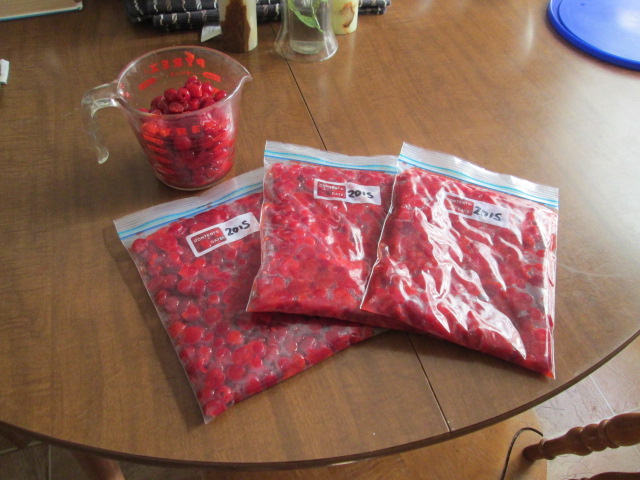
However, the success of the zucchini this year has been completely overshadowed by the advent of a new crop: our first big batch of bush cherries. Since we first planted our Meader bush cherries in 2013, we've managed to harvest only a few handfuls of fruit off them. We got about a cup of cherries that first year, enough to make a tiny cherry tart purely as a proof of concept, and nothing at all last year. But this summer, all five bushes started producing cherries in abundance. In fact, since the bushes themselves still aren't very big, a couple of them were completely bowed down by the weight of their own fruit.

We weren't quite sure how to decide when the cherries were ready to pick. A week ago, they were mostly red, but not quite red all over, and they still didn't come off the branches that easily. And when we tasted them, they were extremely sour—not just tart as you expect a tart cherry to be, but powerfully, mouth-puckeringly sour. So we decided to give them another week. Then on Wednesday, Brian declared that he'd tasted one and it seemed close to normal tart-cherry tartness, and he had also noticed that a few of them were starting to drop off the branches. So we decided it was better to harvest them right away, even if they weren't totally ripe yet, than risk losing the entire crop. We spent a good hour or two sitting on the ground (since the bushes are so tiny) pulling cherries off by the handful, and by the end, we'd filled two plastic colanders with our booty. Brian weighed the contents and found we had 4 pounds, 10 ounces, prior to pitting.

Brian did the pitting on Friday, using the drinking straw method shown here, while I read Anthony Trollope to him. We don't own a cherry pitter, and it probably wouldn't do us any good if we did, since our bush cherries are quite a bit smaller than most tree cherries and would probably slip right through the hole meant for ejecting the pit. The straw method is a bit time-consuming, but Brian found the work relaxing. He actually discovered that it's slightly faster if you push the straw through the cherry from the side, rather than from the stem end as shown in the video. That way the straw catches the pit sideways on, so you don't get the pit stuck in the straw and have to pause to eject it.

When the whole process was done, we ended up with a total of two quarts of pitted cherries. Brian measured out three two-cup portions into one-quart freezer bags and froze them, and the other two cups got turned into a dessert concoction Brian dreamed up. I'd been thinking the cherries would go nicely with a sort of eggy batter, so Brian melded together the recipes for a traditional cherry cobbler and the Giant Mushroom Popover out of The Clueless Vegetarian. This appears to be somewhat similar to the type of fruit dessert called a "buckle," except that with those you put the batter in first, and it "buckles" under the weight of the fruit. This version takes a shortcut by putting the fruit on the bottom to start with.

So, on the theory that bouncing is the opposite of buckling, I'm going to call it:
Brian's Cherry Bounce 
1. Combine 2 cups tart cherries, 1/2 cup sugar, 1/2 Tbsp. cornstarch, and 1/4 tsp. vanilla. Pour into the bottom of a small baking pan. (Note: this came out a little on the tart side; if your cherries are as sour as ours, you probably need a bit more sugar.)
2. Beat 1 egg with 1/2 cup milk, 1/2 cup flour, 1/2 Tbsp. sugar, 1/4 tsp salt, and 1 Tbsp. melted butter. Pour over top of the cherries.
3. Bake at 400°F for 25 minutes.
And we did get in a little celebration of zucchini season, as well; the Cherry Bounce is following up a main course of Brian's Skillet Kugel, modified with the addition of a grated medium zucchini. Surprisingly, the potato-zucchini-leek mixture held together quite well, and the taste was hardly affected. Add one more way to dispose of excess zucchini to the old bag of tricks.

Friday, July 31, 2015

Money Crashers: How to Deal With Funeral Costs

Money-saving sites and newsletters, such as Money Crashers, are always stuffed with tips for saving on weddings, but you almost never see any for funerals. In fact, the very idea seems almost shocking. People seem to feel as if when a loved one has just died, it's heartless even to be thinking about money. But unfortunately, not thinking about it has a serious cost—about $11,000 for a typical funeral in the US. (And that's just for the service, not including any gathering you might have afterward at home.)

I don't know about you, but when I go, I don't want $11,000 of the money I've left to my heirs being spent just to put what's left of me into the ground. Yes, I want the people who remember me to gather together and share those memories, but that doesn't cost anything. It's the fancy caskets and tombstones that cost the big bucks. At least there's some sense in paying for a nice tombstone if you're going to be looking at it every time you visit the grave, but why spend thousands on a coffin that's just going to get covered up with dirt?

For anyone else who would rather, when the time comes, have a funeral that's truly meaningful than one that's impressive, I've covered this topic in detail in my latest Money Crashers post. I talk about your rights when dealing with funeral homes (and your almost total lack of any when dealing with cemeteries), how to compare prices, the value of pre-planning (so you can do your thinking about money at a time when you're not completely overwhelmed by grief), and some money-saving alternatives like cremation, direct burial, and donating your remains to medical science. I also discuss the home funeral, which is far more traditional than the "traditional" funeral of today: the body is simply "laid out" at home for visitors, and the family stays with the deceased until the end. (I noted in my original draft that many people who have done this say that tending personally to the bodies of their beloved dead gives them a greater sense of closure, but the editor cut this out for some reason.)

The writing in parts of this may seem overly formal and unlike my usual style; that, too, was the editor's decision. But there's useful information in it, all the same. Here's the full article: How to Deal With Funeral Costs – Planning Guide & Checklist