Sunday, May 13, 2018

Household Hacks: Summer wardrobe edition

Summer is icumen in, it would appear. In the past week or so, we've had a couple of days that got up close to 90 degrees, and I started pulling some of my summer garments out of storage. Unfortunately, in the process, I discovered that a couple of them were worn out, which threw me face to face with that age-old ecofrugal dilemma: repair or replace?

The first problem popped up on the first day I ventured out in sandals. My current summertime solution to the shoe conundrum is a pair of sturdy Columbia sandals in a "big kids" size 5. Because boys' and girls' shoes are both the same size and width, this shoe fits just fine on my wider foot; it's a bit long, perhaps, but the adjustable straps allow me to keep it snug. And as a bonus, kids' shoes are usually a bit cheaper than those designed for adults, so I was able to pick these up for only $30 or so at Famous Footwear.

After being worn nearly every day for the better part of two summers, the soles of these sandals were seriously worn down. In the middle of the ball of the foot, especially, there was a spot where the rubber was nearly worn through. I'd noticed last summer that they were starting to wear and tried to patch them with Sugru (the stuff we used to repair our old toilet brush), but it didn't stay put. So when I first put them on this summer and found I could nearly feel the pavement through them, I thought they were probably done for. Given that I'd worn them regularly through two summers, you could hardly say I hadn't gotten my money's worth out of them, but I was still disgruntled at the thought of having to shop for a new pair. I'd originally bought these at Famous Footwear, but the selection there is ever-changing, and I couldn't be sure of finding them.

So I decided to have one more go at patching them, this time using a product that's more or less designed for the purpose: Shoe Goo. Unfortunately, I didn't think to take a "before" picture of them, but even in this "after" picture of the repair job, you can see the wavy texture of the worn patches. What's not clear from the picture is how well they'll hold up. I've used Shoe Goo on worn shoes before and managed to get another couple of months of wear that way, but it eventually gets dirty and peels off. So it's not clear whether this fix will be enough to keep this pair of shoes going through the summer, but at least it will save me from having to hunt for new ones in a hurry.


I also ran into difficulties the first really warm night of the year, when I switched to my summer sleeping attire—an old tank top and a pair of men's boxers. I've had these for a few years now, and the waistband elastic, as you can see here, is almost completely kaput.


What I'd normally do in this situation is add a drawstring, as I did with these shorts three years ago. However, the way this waistband is designed makes that technique impractical. It's all one solid piece of elastic, so there's nothing to slip the drawstring through.

Now, these are actually cheap enough that buying a new pair would be no big deal. But the idea of tossing out the old ones just irked me. The fabric was all still perfectly good; it was only the elastic that was worn. It seemed like throwing them away just for that would be a blot on my ecofrugal escutcheon.

So I did a little experimenting and eventually found that if I could just wrap them a little tighter in the front and secure them somehow, I should be able to get them to stay put. So I folded over a big flap of fabric in the front, stitched it together, and attached a button...


...and cut a small buttonhole through the waistband opposite.


The finished result isn't exactly elegant, but it should be enough to keep them from falling off, which is all that really matters for night wear.


So with those two quick fixes, I should be more or less set for summertime. I don't know how well either of them will hold up, but even if I end up having to buy new sandals or sleep shorts before the summer is out, at least I'll know I didn't give up without a fight.

Friday, May 11, 2018

Money Crashers: 17 Reasons Why You Should Get Out of Debt

The only debt Brian and I have ever had—not counting credit cards that get paid off every month—is our mortgage. And pretty much the whole time we had that, we were obsessed with paying it off. We made extra payments as often as possible, and I (in my usual hyper-organizational mode) entered all those payments on a spreadsheet to keep track of our remaining principal, our growing equity, and the time left until it was paid. We didn't have a "mortgage-burning party" to celebrate like some people do, but we certainly felt happier and freer without it.

Now, many financial advisors would say this wasn't really the best move on our part. After all, they'd argue, by throwing all our spare cash at our mortgage, we were only getting a 4.5% return on our investment (or 6% before we refinanced); most likely we could have done better than that by investing in stocks. Now, I would argue that a guaranteed 4.5% return is nothing to sneeze at, but even granted that we could have done better in the stock market, I think paying off the mortgage was still the right choice for us. We're both incredibly uncomfortable with the idea of being in debt, and we were never going to feel entirely secure until that debt was gone.

I realize, of course, that most people don't feel this way. But I'd like to argue that even for those who don't, devoting your extra money to paying off debt has more benefits than you may realize. Aside from the obvious financial perks—more cash to spend or invest, more security—it has documented benefits for your mental and even your physical health. And it has the potential to make your relationships with other people—especially people who share that debt—stronger as well.

Learn about the 17 reasons to get rid of debt in my latest Money Crashers article:

Monday, May 7, 2018

Are Millennials the ecofrugal generation?

Sometimes I ask myself if I'm a Millennial trapped in the body of a Gen-Xer.

This first occurred to me last year when I came across an article in Advertising Age about Millennials' shopping habits. Unfortunately, the article is no longer available to non-subscribers, but the gist of it was that Millennials are less likely to be brand loyal than previous generations. They care less about the name on the package and more about the price and the quality of the item. The Brandless online store, which I wrote about back in September, seeks to appeal to this group with healthy, high-quality products at reasonable prices.

Now, I'm a good ten years older than the oldest Millennials, but this sounded like a pretty good description of the way I've been shopping all my life. Many of the products at the Brandless site, too, seemed calculated to appeal to ecofrugal shoppers like me: organic peanut butter, Fair Trade coffee, "tree-free" bath tissue, and cruelty-free skin care products with no parabens or phthalates. I started wondering: are Millennials actually a whole generation of ecofrugal shoppers?

Other stories I've read seemed to shore up this suspicion. CNBC, for instance, reported that Millennials are wary of debt—one in three say it's their greatest fear—and tend to eschew credit cards. USA Today notes that Millennials save a greater percentage of their incomes than previous generations (though they save less in dollar terms because their earnings are lower). And the Organic Trade Association reports that Millennials, especially those who have kids, are "big buyers of organic."

Then, a couple of weeks ago, I heard a segment on Young House Love Has a Podcast that made me start to question this view. This podcast, by the way, is the current endeavor of John and Sherry Petersik, the creators of the Young House Love blog I celebrated in my 2013 Thrift Week series. In 2014, they decided to stop updating the blog on a regular basis, and I spent a while hunting for a substitute without success—but a couple of years later, they popped back up again with a new weekly podcast, which I now listen to in the shower every Monday.

Anyway, John and Sherry themselves are right on the cusp of the Millennial generation—they sometimes refer to themselves as part of the "Oregon Trail generation"—and in their latest episode, they were discussing some of the ways in which they do and don't correspond to others in their demographic. For example, other Millennials supposedly dislike using top sheets on their beds; they think it's a lot easier to make the bed if you have only a duvet and a fitted sheet. Their view, which I agree with, is that making up the bed with a top sheet is a lot less work than wrestling the duvet out of and back into its cover every couple of weeks so you can wash it. However, they are in agreement with their fellow Millennials about not using bar soap because it's too germy, or fabric softener because they think it's unnecessary, or paper napkins because, hey, paper towels are pretty much the same thing, so why buy two separate products? In fact, they say, they've gone one better and done away with tissues as well, because toilet paper off the roll—especially if you buy the nice soft kind—works just as well.

From an ecofrugal perspective, I agree with some of these choices but profoundly disagree with others. For instance, I completely agree that there's no need whatsoever for fabric softener. Clothes feel plenty soft enough if you wash them with just water and a little soap, so there's no reason to apply extra chemicals to them. (I don't even bother with dryer sheets, even when I actually put things in the dryer rather than hanging them on the line; if there's any static buildup, I find I can dispel it by giving the things a good brisk shake before putting them away.)

But bar soap, to my thinking, is clearly a more ecofrugal choice than liquid soap; all the waste it generates is a small plastic wrapper, or even a paper one that can be composted, rather than a whole plastic bottle and pump assembly. (The plastic bottles may be recyclable, but the pumps never are.) Plus, according to Grist Magazine's "Ask Umbra" column, bar soap uses a lot less energy to produce and to ship, and we use less of it, making it greener all around. And why worry about getting a few germs on your hands if you're about to wash them right off?

Likewise, I was entirely in agreement with the Millennials about not using paper napkins—until I heard that they were replacing them, not with washable cloth napkins, but with paper towels. We don't even have paper towels in our house, because there's nothing they can clean that can't be cleaned just as well with cloth rags, which are both reusable and free. I would have thought this idea would appeal to thrifty Millennials—but perhaps, given their reaction to bar soap, they'd find the idea of reusing a rag too icky. And they'd no doubt be horrified to hear that the reason we don't have tissues in our house is not because we find it easier to use toilet paper, but because we actually blow our noses on—ewwwww!—reusable cloth handkerchiefs. (Though I wonder whether these same people are actually all that diligent about discarding their disposable tissues immediately after use and then washing their hands immediately, every time. If they're not, I'm prepared to bet that my sturdy cloth hanky does a better job of containing germs than a wussy paper tissue that gets soaked through after one good sneeze.)

So now, frankly, I'm not sure what to think. It appears Millennials are more ecofrugal than older folks in some ways, like eating organic and being price-conscious rather than brand-conscious. But they're just the reverse in some other ways, like eating out more and choosing more heavily packaged products.

I guess the bottom line is that the Millennial generation probably isn't going to remake the world on more sustainable lines, all on their own. But on the other hand, at least some of their habits suggest that folks this age are likely to be receptive to the concept of ecofrugality. They care about cost, and they care about environmental benefits—at least as long as they can get them without sacrificing convenience. So maybe, what blogs like mine need to do is focus on green products and services that can deliver all that in one package. That way, we can attract the attention of more Millennials and, in the process, expose them to the broader message of ecofrugality. If we can get them on board with that, they might eventually be willing to change some of their less ecofrugal habits, swapping out some of those disposable soap pump bottles for bars. Or maybe they'll come up with some entirely new form of soap that no one has thought of yet—one that's cheap, eco-friendly, and easier to use. That would be a win for everyone.

Thursday, May 3, 2018

Money Crashers: Cooking for College Students

When I went off to college lo these many years ago, one of the things I took with me was a little "hot pot." This mini kettle allowed me to enjoy General Foods' instant mocha (which I practically lived on at the time) and, in a pinch, ramen noodles, at any hour of the day or night. I didn't aspire to any more elaborate cooking than this, since I had a meal plan that provided me with 20 square meals a week (including brunch on Sunday).

However, the students of today might not be so cavalier about it. The price of a college meal plan, like everything else connected with higher education, has shot up since my school days and now works out to around $18.75 per day. By contrast, the average American spends only $7.80 per day on food—about 42 percent as much.

Ergo, students can save a lot of money by doing some or all of their own cooking. In an apartment or a dorm with a communal kitchen, that's easy—all you need is a cookbook and a few basic tools. But even if you're living in a dorm room, it's possible to make a surprising number of dishes with just a microwave, a mini fridge, and maybe a couple of other tools like a toaster oven or coffee maker.

My latest Money Crashers article delves into the fine art of dorm cooking. I address such topics as communal-kitchen etiquette, tools and techniques for dorm-room cooking, grocery shopping on a student budget, and recipes you can make in the dorm for every meal of the day.

Now, I realize I probably don't have that many college students reading this blog (do I? If you're out there, give a shout in the comments). But these recipes can actually be handy for anyone who's living in a small space, shopping on a tight budget, or trying to prepare meals on a busy schedule. And who doesn't fall into at least one of these categories?

Sunday, April 29, 2018

Environmentalists are not hypocrites

The other day, I read an article in the Christian Science Monitor that really ticked me off. Provocatively titled "Are environmentalists hypocrites?", it points out that wealthy people and wealthy nations are more likely to profess concern about the environment and favor laws to protect it—but they also consume more, thereby causing more damage to the environment. So basically, the argument goes, anyone who claims to be an environmentalist is too busy focusing on the mote in their neighbor's eye to deal with the log in their own.

Now, the article goes on to point out that it's really a misconception that poorer folks, and poorer nations, aren't concerned about the environment. They spend less energy focusing on environmental issues, sure, but they spend less energy on all types of political issues, because they're spending a lot more on just trying to survive. It notes that people in India and Latin America are more worried about global warming than people in "developed nations"—which makes sense, since they'll suffer much more as a result of rising sea levels. Likewise, in the United States, lower-income voters are most concerned about issues like water—which also makes sense, because guess where the water supply is most likely to be unsafe?

But nonetheless, the central "conundrum" remains: rich environmentalists cause more environmental problems than non-environmentalists. Except...do we, really?

Consider the opening paragraph of the article:
A common charge against environmentalists is that they’re hypocrites. They tell us to reduce our carbon emissions, the typical argument goes, yet they fly planes all over the world. They condemn Big Macs, yet they buy raspberries imported from a different hemisphere. They sneer at our plastic shopping bags, yet every year they buy a new iPhone.
Well, maybe I'm not exactly a typical environmentalist, but the last time I took an airplane anywhere was to my grandmother's funeral in Florida seven years ago. I don't buy imported raspberries; I grow my own, which is considerably cheaper as well as more eco-friendly. And as a late adopter, I've never even owned an iPhone—or any smartphone at all. And I make all these choices, at least in part, because I'm an environmentalist, and I want to live my live in a way that causes as little harm as possible.

I think the biggest problem with this "environmentalists damage the environment" problem is that it's comparing apples to imported bananas. It's true, as I determined back in 2011, that I have a bigger ecological footprint than a fictional character living in Botswana, but that's not because her lifestyle is more eco-friendly than mine; it's because the Ecological Footprint Calculator also factors in "societal impacts," such as roads and public services. Compared to other Americans, my footprint is considerably smaller than average. The recently retooled calculator puts my personal footprint at 1.6 Earths, while the average American's is a whopping 5 Earths. (In fact, according to the calculator, I'm even doing better now than the average person in South Africa or Brazil.)

So yes, Americans are more likely to be environmentalists than, say, Brazilians. And yes, Americans also consume more, on average, than Brazilians do. But it's a logical fallacy to conclude from this that environmentalists consume more than non-environmentalists. American environmentalists consume less than Americans who aren't environmentalists, and Brazilians who aren't environmentalists consume more than Brazilians who are (and, if the Footprint Calculator is to be believed, more than some Americans who are, as well). Compared to their peers, environmentalists consume less—even if they're richer.

It may seem like I'm undercutting the whole concept of ecofrugality with this argument, since the whole point of it is that if you consume less to save money, you will automatically live a greener life (and vice versa). Surely this implies that poor people are greener by default.

But here's the thing: there's no rule that, as you make more money, you must consume more. You can have plenty of money in the bank and still wear thrift-shop clothes, walk or bike to work, and eat low on the food chain. Plus, you can afford to make the few green choices that actually do cost you more money, like eating organic, as well as the ones that cost you money up front but save money in the long run, like using LED bulbs. And this, at least in my experience, is exactly what environmentalists typically do as their wealth increases.

In fact, because ecofrugality cuts both ways, there's a case to be made that being an environmentalist can actually make you wealthy. Think about it: if you care about the environment, you'll choose to consume less in a variety of ways (drive less, eat less meat, use less electricity, etc.). Because you're consuming less, you'll also save money. And the more money you save, the richer you'll become.

Maybe for Earth Day 2019, we should forget all about focusing on a specific issue, like plastic use or renewable energy. If we really want to get as many people involved as possible, our theme should be, "Save the Earth and get rich!"

Saturday, April 28, 2018

Money Crashers: Two new articles

Just a quick update here to let you know about my two latest articles on Money Crashers. Neither of them has a lot to do with ecofrugality, but they might be useful for some of you.

The first deals with the topic of online romance scams. Researching this article came as a shock to me: I knew there were some scummy guys out there (most of the criminals are guys) using dating sites to get money out of women (most of the victims are women), but I had no idea of the scope of the problem. There are guys in Nigeria who have dozens of women on the hook at once and live like kings on the money they squeeze out of them. In 2016, Americans lost over $230 million to these scams—and that's just the ones that were actually reported. A lot of victims are too embarrassed and emotionally devastated to report the crime.

The money isn't even the worst part; it's the emotional harm these scams do. When the victims finally learn that what they thought was true love was just a money-making scheme, their lives fall apart. Some of them refuse to believe the person they loved isn't real and start stalking the guys whose images were stolen for the profile. Others become depressed to the point of suicide. Some are so desperate to believe their love was real that they actually stay involved with the scammers, sometimes even aiding them in committing other crimes.

So basically, this is a big deal, and anyone who ever dates online needs to know about it. My article covers how online romance scams work, their many dangers, how to identify a scam, and what to do if you've been a victim.

How to Avoid and Protect Yourself From Online Dating & Romance Scams

My other new article is about personal loans. I've already written about payday loans and their dangers, but this is about longer-term personal loans you can get from a bank. I explain how personal loans differ from other forms of credit, discuss why you might use one and where to get one, outline their pros and cons, and discuss some alternatives for raising cash. Then I conclude by talking about how to get a good deal on a personal loan if you decide to use one.

Sunday, April 22, 2018

The last (single-use) straw?

Since Earth Day fell on a Sunday this year, we were able to celebrate it by going to our town's annual Earth Day event, always held on the nearest Sunday at the environmental center. The theme this year was water, so in addition to the usual stuff—music, food, booths providing information about beekeeping and bike lanes and native plants—there were all kinds of displays about water conservation and pollution, especially from "microplastics." And one particular form of plastic waste a lot of them seemed to have their eye on was a ubiquitous item that, unlike many single-use plastic items, can't be recycled: drinking straws.

One enthusiastic volunteer buttonholed me and loaded me up with three separate fliers and a paper drinking straw, which she described as "much better" than a plastic straw. Now, I happened to know that paper was once the standard material for drinking straws, but I'd never actually encountered one before; when I asked the volunteer where you could buy them, she didn't know. Another booth was passing out leaflets with statistics about plastic use and suggestions for eliminating plastic waste from your daily life, and alongside the usual recommendations you see all the time (tote bags, mesh produce bags, reusable water bottles) it suggested "metal straws/reusable straws" as an alternative to single-use plastic straws. Once again, I asked the kid at the booth where it was possible to find these, and he suggested Target—which came as a surprise to me, since I don't think of that as a store that's high on sustainability.

But when I got home, I searched the Target site for "reusable straws," and I did indeed find a couple of of products. These Bubba Plastic Reusable Straws ($4 for a set of 5) are made of durable silicone and have a wider diameter (like the ones you get with a cup of bubble tea) to make them easier to clean. The similar Silikids straws ($6 for a pack of 6) have similar construction, but come in varied lengths to accommodate cups of different sizes. (Incidentally, I also found some of the paper straws here and discovered why they're no longer popular: they're much, much more expensive than the plastic ones. Paper straws cost around $3 for a pack of 20, while plastic ones were only $1 for a pack of 100.)

So, as an ecofrugal person who enjoys an occasional Frappuccino, I should definitely go out and invest in a set of these reusable silicone straws, right? Well, maybe, but there are a couple of things that give me pause. For one thing, although I have certainly used my share of plastic drinking straws in my time, I've never actually bought any. They always come into my possession when I buy a cold drink while out and about, and there's no way to drink it without a straw. So what I invariably do is take a straw, then take it home, rinse it thoroughly (holding it directly under the faucet so the water flows straight through it), and reuse it. In the top section of one of our kitchen drawers, we have a whole assortment of drinking straws in various sizes and colors: green ones from Starbucks, orange-and-red striped ones from Dunkin Donuts, translucent ones from Quik Check, and a few big fat ones from places that sell bubble tea. Whenever I need a straw at home, I just grab one of these, and when I'm done with it I attempt to rinse it and reuse it yet again. I can get at least a few uses out of each one before it becomes too battered to clean properly.

Thus, keeping a set of reusable straws in a drawer at home wouldn't actually do very much to reduce my disposable-straw use. For them to do me any good, I'd actually have to carry one around in my purse, so that I'd have it with me whenever I happened to get the urge to stop somewhere for a cold drink. But that raises a new set of questions:
  • How would I carry it in my purse? If I leave it floating around loose in there, it won't be very clean when I want to use it. Would it fit in the little the pocket designed to hold pens? Or could I wrap it up in something?
  • Would these wider straws fit through the plastic lids on a standard disposable drink cup? If not, they'd be impractical for use with the iced drinks at Dunkin Donuts (though they'd still fit through the wider, domed lid of a Frappiccino).
  • Conversely, would they be wide enough to accommodate the tapioca "bubbles" in a cup of bubble tea? (At least one reviewer at Target says the quarter-inch Bubba straws are not.)
  • Could I get the used straws home to clean them without making a mess? It works okay with the narrower plastic straws, but would the wider openings on these silicone ones be more inclined to drip?
  • Finally, what would I do with my current collection of plastic straws? Just throw them out? Or save them in case we ever need one to fix a leaking toilet chain?  
This final question made it clear that, even if I do eventually decide to invest in a reusable straw, it clearly makes sense to use up my assortment of plastic ones first. There's nothing ecofrugal about throwing them away and buying something new to take their place. So the most logical thing to do in the short term, I concluded, would be to take one of these old plastic ones and stash that in my purse, ready to use if I need it. As a bonus, doing this will help me figure out the best possible way to tote around a drinking straw, so if I finally run through my collection of old straws and need to buy one, I'll already know the best way to carry it.

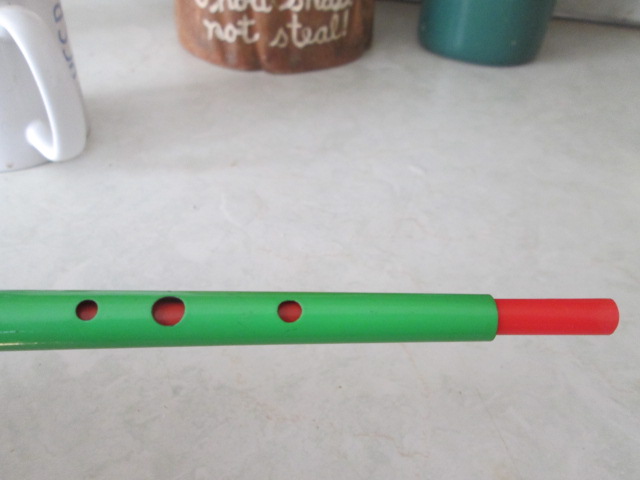
When I tried this, I found that a regular-length drinking straw is, in fact, too long to fit in my purse's pen pocket, so for now I've improvised a case for it from—I kid you not—a pennywhistle. The whistle fits neatly in the bottom of the purse, and it will protect the straw from getting crushed. It takes a bit of shaking to get the straw loose from the whistle, but it can be done. Now I just have to remember, next time I stop for a drink, that it's there.

Of course, this solution won't work if I eventually get one of the silicone straws, since the whistle is too narrow to hold those. But at least it will serve as a proof of concept.