
I'm about to confess something that's probably pretty shocking for a personal finance writer: I don't have a household budget. In fact, I've never had one.
Now, this is not to say that I don't keep track of my household spending. I do, and pretty rigorously at that. This started way back when Brian and I were courting, when we began keeping track of the amount each of us spent traveling to visit the other and splitting the cost; later, when we set up housekeeping together, we started tracking how much each of us spent on joint household expenses and balancing out the difference at the the end of each month. By the time we got married and combined finances, I had decided that having this record of how we spent our money was useful, so I just kept doing it, only with a single column for our expenses instead of two. And eventually, I decided to start recording all these expenses in a spreadsheet, so that I could keep track of how much we spent in each category and tamp it down if it started getting too high. So I am very much aware of where our money goes.
What I've never done is to set any strict, specific limits on how we could spend it. That is, my spreadsheet tells us that last month we spent $202 on food, but it doesn't say that we're only allowed to spend $202 (or $250, or $300) on food this month. I just keep track of the numbers and note when they move up or down by any significant amount, in which case I (a) look for ways to cut back if necessary, and (b) usually, write a post here about the reason.
Now, according to the mainstream finance community, this failure to maintain a personal budget should mean that all our attempts to save money and meet financial goals are doomed from the start. The vast majority of articles on how to save (including one I wrote myself two years ago) lead off with, "Make a budget," and many of them (though not mine) warn that without one, it's basically impossible to control your spending. The clear assumption is that if you don't set firm limits on your spending in specific areas, you'll automatically run through all your money, leaving nothing for savings, and never get any nearer to your financial goals.
However, I happen to think that our own experience shows this isn't true, at least not for everyone. After all, in all the years Brian and I have lived together without a budget, we've managed to not only buy a house but pay it off, and are now aiming for financial independence and possible early retirement some time in the next five years. So clearly, the lack of a budget has not, in itself, been enough to derail our efforts to save.
Nor are we alone in this. Several other successful individuals—including an investment guru who achieved financial independence at age 37, a finance blogger who accumulated $256,000 in retirement savings by the age of 28, and Amy Dacyczyn of "Tightwad Gazette" fame (all hail the Frugal Zealot!)—all say they have never had formal budgets, and some of them go so far as to say budgets don't work.
Personally, I think that's a bit of an overstatement. Budgets clearly do work for some people, but that doesn't mean that they're an absolute necessity for everyone. In my latest Money Crashers article, I've outlined some of the reasons budgets don't work for everybody and described four alternatives—including our own tracking method—that can work without all the restrictions, or all the paperwork, of a formal budget.
Now, if you already have a budget and you're happy with it, great—you don't need to read this article. But if you don't have a budget, or if you keep trying to make one and can never stick to it, this piece could be just what you need to get your finances on track. And if your finances, like ours, are already on track despite the lack of a budget, yet you still feel obscurely guilty for not having one, this article can help you put those concerns to rest.
Friday, February 8, 2019


Saturday, February 2, 2019
Gardeners' Holidays: Renewal
I'm starting to think I should change the name of the first Gardeners' Holiday of the year to Polar Vortex Day. This is the second year in a row we've suffered subzero temperatures around the end of February and only just managed to emerge from our cocoon to get the plum trees pruned.
But that would be focusing on the negative, and Gardeners' Holidays are supposed to highlight the positive. This first holiday, in particular, is not about the bitterness of the winter cold, but about the idea that we're finally starting to emerge from the cold and start pushing our way toward spring. Despite the frigid weather of the past week, the first faint signs of new life are there if you look: tiny buds on the branches of the plum trees and, on the rosebush, even hints of tender leaves ready to uncurl. Winter isn't over, not by a long shot, but we've made it to the middle of the cold season and we're now on our way out.
 So as cold as it is right now, and as far as it may feel from planting weather, it's still the start of a new gardening season, and we need to start putting our garden in order for it. To that end, we've started our first seeds of the year, the parsley, in some tubes full of baked garden soil (which Brian dug up a few weeks ago and baked in the oven last weekend to kill germs - running the vent fan on high all the while to get rid of the awful smell that accompanies this process) topped with a layer of commercial seed-starting mix. (The upright cartons you can see in the background are filled with plain soil in which he's attempting to start some pawpaw seeds, in the hope that he can grow one or two of these curious native fruit trees in the rear corner of our yard. He's promised me that the full-grown trees won't shade the garden significantly, and also that he won't expect me to eat any of the fruit.)
 And this afternoon, once it got warm enough to venture outdoors, we went out and pruned our plum trees in the hope of combating the brown rot that's been destroying most of our crop. We didn't have to take off as much this year as we did last year, but we still ended up lopping off several largish branches and a whole mess of little twigs to eliminate all the points of overlap between branches—both on the same tree and between the Opal and Mount Royal trees. I tried to get some shots of the actual pruning, but a picture of a single branch being cut doesn't really convey what a long, fiddly process it was, with Brian wielding the clippers and me walking around the trees to identify spots that needed clipping, armed with a long pruned-off stick as a pointer so I could reach the high-up branches. But I did manage to get a picture of the carnage afterward—or perhaps, since it's wood and not flesh, I should say "lignage."
 We're not relying on pruning alone to protect the plums from damage, however. The anti-fungal spray we tried last year didn't do much, possibly because Brian had nothing more effective to apply it with than a squirt bottle, so this year we've decided to pull out some bigger guns. We went to the Belle Mead Co-Op about a month ago and bought a bottle of a spray called Serenade, which I'd seen listed in the Fedco Seeds catalogue and which got high marks from users online. It's in a concentrated form, so this 1-quart bottle, which cost us $19, should make about 16 gallons of spray. We also spent about $10 for a sprayer that can be hooked up directly to the garden hose, allowing us (well, Brian really, since he's taller) to dispense it more effectively over the entire tree. The third product you see in the picture is Tree Tanglefoot, which we're planning to deploy once the plums start developing in hopes that it will deter the squirrels from climbing the trees and pilfering them all. Even if it only cuts down on their depredations and doesn't stop them, we can hope to get some plums that way, which is more than we got last year.
I have one more task to do to get ready for this upcoming gardening season: plotting out the beds to decide where each crop will go. This process should be a little easier than it's been in the past, because I've come up with a new system of rotating and flipping entire beds instead of trying to move around individual crops. So, for instance, if last year the tomatoes were in the left rear bed with the basil, marigolds, other herbs, and one pepper plant, then all those crops will still be together this year in the left front bed. However, I will also flip the bed along the y-axis so that the pepper is at the opposite end from where it was last year, so I'm not growing pepper plants in exactly the same spot two years in a row. (Ideally, I wouldn't grow them in the same spot more than once in four years, but this is the best I can do with my limited garden space.) So laying that out shouldn't take more than a few minutes.
And once that's done, all we have to do is sit back and wait for the weather to warm up—as we can trust it will—so we can start planting.
Saturday, January 26, 2019
Recipe of the Month: Eggplant-Green Bean Curry
After wrapping up Thrift Week this Wednesday, I had a look at the calendar and realized that I would only have one more weekend to squeeze in my Recipe of the Month for January. So, with the clock ticking, I turned to Brian for help. We happened to have some Chinese eggplant in the veggie bin, so he started thinking about what he could do with it that would be different enough from any of our previous dishes to be definitely considered a new recipe. Realizing that we also had several cans of coconut milk in the pantry (for a while we were picking up a can every time we went to Trader Joe's, not remembering that we already had some), he decided to do a search on "eggplant coconut milk," and the first hit was a recipe for Seared Eggplant and Coconut Milk Curry on Food and Wine. And since we just happened to have all the other ingredients on hand—and he also happens to really like coconut milk curry—he looked no further.
However, he did make a few modifications to the recipe as written. First, he scaled it up by about 50 percent so that he could use a whole can of coconut milk rather than the cup the recipe called for (which would have left him with an awkward half-cup or so to use up somehow). Then, since he thought the meal could use a green vegetable, he decided to add around 6 ounces of green beans along with the eggplant. (He'd used this veggie combo in other dishes, so he knew they would go well together, and it seemed like less work than cooking the beans separately.)
Finally, rather than pan-searing the veggies as the recipe instructed, he decided to roast them under the broiler. He'd used this technique before, and he knew that it would cook the eggplant through without making it mushy, and it wouldn't require as much oil. His procedure goes like this:
 So he did all this in place of Step 1 in the recipe, and then for Step 2, he cooked the onion, garlic, and ginger in the pan by themselves. Then he added the coconut milk and other ingredients, stirred in the roasted veggies, and heated it through. He served it over rice as the recipe suggested, but left out the cilantro garnish because it's the middle of the friggin' winter (and I don't care much for cilantro anyway).
This came out tasting pretty much like you'd expect, based on the ingredients. It was much more like a Thai curry than an Indian one, but fairly mild (since he did not include the optional Thai chili, which we didn't happen to have). Both of us liked it, but Brian was much more enthusiastic about it than I was. I finished one bowlful with pleasure, but didn't care for more, while he went eagerly back for seconds and was happy to eat the leftovers for lunch the next day. (Not all the leftovers, mind you—the original recipe was supposed to be enough for four, so Brian's scaled-up version could probably feed six, leaving us with at least two more servings in the fridge for future lunches.)
As for the key question, would we make this dish again, I personally could go either way. I wouldn't be in any hurry to make it again, but I would quite willingly eat it again if it were put in front of me. But considering how much Brian liked it, and how cheap Chinese eggplants often are at the H-Mart, I think it's a safe bet to say this will probably become a regular part of our dinner repertoire.
However, he did make a few modifications to the recipe as written. First, he scaled it up by about 50 percent so that he could use a whole can of coconut milk rather than the cup the recipe called for (which would have left him with an awkward half-cup or so to use up somehow). Then, since he thought the meal could use a green vegetable, he decided to add around 6 ounces of green beans along with the eggplant. (He'd used this veggie combo in other dishes, so he knew they would go well together, and it seemed like less work than cooking the beans separately.)
Finally, rather than pan-searing the veggies as the recipe instructed, he decided to roast them under the broiler. He'd used this technique before, and he knew that it would cook the eggplant through without making it mushy, and it wouldn't require as much oil. His procedure goes like this:
- Spread the veggies on a pan and toss them with a tablespoon or so of olive oil, just enough to coat them.
- Put them under the broiler for about ten minutes, moving the pan around the oven a couple of times during the process to make sure all parts of it get heated thoroughly.
- Take out the pan, flip the veggies with a spatula, and return it to the broiler for another five minutes.
 So he did all this in place of Step 1 in the recipe, and then for Step 2, he cooked the onion, garlic, and ginger in the pan by themselves. Then he added the coconut milk and other ingredients, stirred in the roasted veggies, and heated it through. He served it over rice as the recipe suggested, but left out the cilantro garnish because it's the middle of the friggin' winter (and I don't care much for cilantro anyway).
This came out tasting pretty much like you'd expect, based on the ingredients. It was much more like a Thai curry than an Indian one, but fairly mild (since he did not include the optional Thai chili, which we didn't happen to have). Both of us liked it, but Brian was much more enthusiastic about it than I was. I finished one bowlful with pleasure, but didn't care for more, while he went eagerly back for seconds and was happy to eat the leftovers for lunch the next day. (Not all the leftovers, mind you—the original recipe was supposed to be enough for four, so Brian's scaled-up version could probably feed six, leaving us with at least two more servings in the fridge for future lunches.)
As for the key question, would we make this dish again, I personally could go either way. I wouldn't be in any hurry to make it again, but I would quite willingly eat it again if it were put in front of me. But considering how much Brian liked it, and how cheap Chinese eggplants often are at the H-Mart, I think it's a safe bet to say this will probably become a regular part of our dinner repertoire.
Friday, January 25, 2019
Money Crashers: The Pantry Challenge
As Marie Kondo's new show about the joy of tidying up your home attracts more and more buzz, I thought it might be time to say a few words about an often-overlooked part of the home: the pantry. By this I mean not just a single closet devoted to food storage, but all the places in the home where food is kept, including the cupboards, freezer, and fridge.
Many of us have stuff lurking in these spaces that we don't even know is there. Four bags of lentil flour (hey, it was on sale). A half-empty sleeve of saltines. Jars of jam we're sure we never bought. We don't know what to do with this stuff, so usually it just makes its way to the back of the shelf and gets buried there. If we ever go to the effort of unearthing it, we figure the only thing to do is take a leaf out of Marie's book, thank it for its service, and toss it.
But Jessica Fisher, of the cooking site Good Cheap Eats, has a radical alternative idea: Eat it.
Fisher's "pantry challenge" is a simple idea: For anywhere from one week to one month, eat only what's in your pantry. Aside from a small allowance each week for fresh produce or milk, you don't buy any groceries. Instead, you actually figure out ways to use all that lentil flour and jam stores in the back of your pantry. The only things you're allowed to throw away are things that have actually gone bad. Everything else—everything—gets used up. When the challenge is over, you'll be able to see the back of your fridge again, and you'll have plenty of money in your wallet to restock it. And in the process, you'll learn about what you like (hey, turns out that lentil flour is actually pretty useful!) and what you don't (blech, plum jam is just not your thing), so you'll know what to restock it with.
In my latest Money Crashers article, I discuss all the ins and outs of the pantry challenge: its various benefits, how to carry it out, and what recipes can be most useful for using up all those bits and scraps you haven't been thinking of as food. You can read all about it here: The Pantry Challenge – What It Is & How to Save Money With It.
Of course, I realize there are probably a lot of furloughed government workers out there who are doing this right now out of sheer necessity. For them, checking out the recipes and tips in my article, and on Fisher's site, could be a way to stretch their pantry stores a little farther before having to resort to the food bank. And for everyone else who's lucky enough to still have a job that pays, it's a way to clean out the pantry for the new year and save a little cash at the same time.
Wednesday, January 23, 2019
Thrift Week 2019, Day 7: Shopping bags
The one disposable item that seems to have the biggest target painted on its back these days is the plastic shopping bag. (Especially if it's a shopping bag from Target.) All across America, cities and towns are either putting a tax on plastic bags to discourage their use or banning them altogether. And it's easy to see why plastic bags make such a good villain: they're probably the most clear-cut example of stupid plastic there is. Think about it: you buy something, carry it home in a bag, and put the bag straight in the trash. It has served a purpose for perhaps five minutes, and it will sit in a landfill for centuries—if it doesn't instead get washed down a gutter and end up in the ocean, bleaching a coral reef or clogging up a fish's guts.
Unfortunately, most of the alternatives to plastic bags have problems of their own. Consider:
 Fortunately, I have a reusable bag that solves all these problems: my ChicoBag folding tote. It's made of recycled plastic, the material the UK EPA deemed most eco-friendly, and even more important, it folds up into its own built-in pocket, creating a tiny parcel small enough to fit in one hand. It lives in my purse, and if I ever decide on the spur of the moment to swing by the grocery store or the farmers' market while I'm out on my walk, I can just whip out my little bag and deploy it. Then as soon as I get home and take the groceries out, I immediately fold it back into its pocket and stuff it back in the purse, so I can never forget about it. (Forget American Express—this is the plastic not to leave home without.) I even keep my store loyalty cards clipped to it, so I don't need to fumble with a separate item.
Now, this bag isn't perfect. After ten years or so, it's showing signs of wear; I've already had to darn a small hole in the front of it, and I'm not sure how much longer it will hold up. And it's a bit on the flimsy side; it can hold a head of broccoli just fine, but I don't know if I'd trust it with a gallon of milk. However, the newer ChicoBag models seem to be made of tougher stuff; the Micro Skydiver purports to be "micro-ripstop fabric" that can hold up to 25 pounds. Plus it folds into an even smaller package than mine. The one downside is the $20 price tag, but if it gets as much use as mine has, it's probably a good investment. But if you want a cheaper alternative, IKEA has one for two bucks—not quite as compact or sturdy, but still portable.
 Ah, you may be asking, but what if you go to the store and decide to buy some produce from the bins? You have to take a plastic bag for that, don't you? Well, not usually. When we make a grocery run in the car, we always have with us our large reusable shopping bag (also from IKEA) and a set of three mesh produce bags, received as a Christmas gift six years ago. So the only time we need to take a plastic bag for produce is if (1) we buy more than three separate produce items that require bags, or (2) we decide to stop into the store while we're on foot, so all we have is the ChicoBag. (If I know ahead of time that I'm planning to visit the farmers' market while out on my walk, I can stuff a couple of reused plastic bags in my purse.)
Although plastic bags are free at most grocery stores, our reusable bags still save us a bit of money. True, some of the stores I blogged about saving money at with bring-your-own-bag discounts back in 2011 have since discontinued them. But we still get 10 cents off per container at the Whole Earth Center, and we still avoid paying for bags at Aldi—and if Highland Park's proposed plastic bag ban goes into law, we could eventually be saving 10 cents a pop at our local Stop & Shop. So the estimate I made at the time that these bags save us $25 a year isn't too far off the mark. But even if these bags didn't save us a penny, they'd still spare us from having to bring a worthless piece of plastic into our house every time we shop—and you can't put a price on that.
Unfortunately, most of the alternatives to plastic bags have problems of their own. Consider:
- Paper bags have some advantages over plastic. They decompose faster than plastic, making them less of a hazard in the oceans, and they're also easier to recycle. But, as this 2014 article from EcoMyths explains, they also have a higher carbon footprint and require both more water and more energy to produce. And because they're not as strong as plastic, they're less likely to be reused.
- Reusable bags seem like the obvious green choice, but actually, it depends on the type of bag. Cotton canvas bags require so much water, energy, and harmful chemicals to produce that, according to the UK EPA, they'd need to be reused a whopping 131 times to make their carbon footprint as small as a single-use plastic bag's. Reusable plastic bags, by contrast, only need to be reused 4 to 11 times to make them the greener choice.
- Even if you choose the very greenest type of reusable bag, it doesn't actually prevent waste unless you actually use it. Just last week, I was chatting with someone who is very eco-conscious (in fact, she's the one we got our rain barrel from), and she confessed that she hardly ever brings reusable bags to the store. She always means to, but she just never has them with her when she gets to the store. We said, why not just keep them in the car (a Prius, of course), and she said she does that, but then she takes them inside to unload them and they never make it back to the car.
 Fortunately, I have a reusable bag that solves all these problems: my ChicoBag folding tote. It's made of recycled plastic, the material the UK EPA deemed most eco-friendly, and even more important, it folds up into its own built-in pocket, creating a tiny parcel small enough to fit in one hand. It lives in my purse, and if I ever decide on the spur of the moment to swing by the grocery store or the farmers' market while I'm out on my walk, I can just whip out my little bag and deploy it. Then as soon as I get home and take the groceries out, I immediately fold it back into its pocket and stuff it back in the purse, so I can never forget about it. (Forget American Express—this is the plastic not to leave home without.) I even keep my store loyalty cards clipped to it, so I don't need to fumble with a separate item.
Now, this bag isn't perfect. After ten years or so, it's showing signs of wear; I've already had to darn a small hole in the front of it, and I'm not sure how much longer it will hold up. And it's a bit on the flimsy side; it can hold a head of broccoli just fine, but I don't know if I'd trust it with a gallon of milk. However, the newer ChicoBag models seem to be made of tougher stuff; the Micro Skydiver purports to be "micro-ripstop fabric" that can hold up to 25 pounds. Plus it folds into an even smaller package than mine. The one downside is the $20 price tag, but if it gets as much use as mine has, it's probably a good investment. But if you want a cheaper alternative, IKEA has one for two bucks—not quite as compact or sturdy, but still portable.
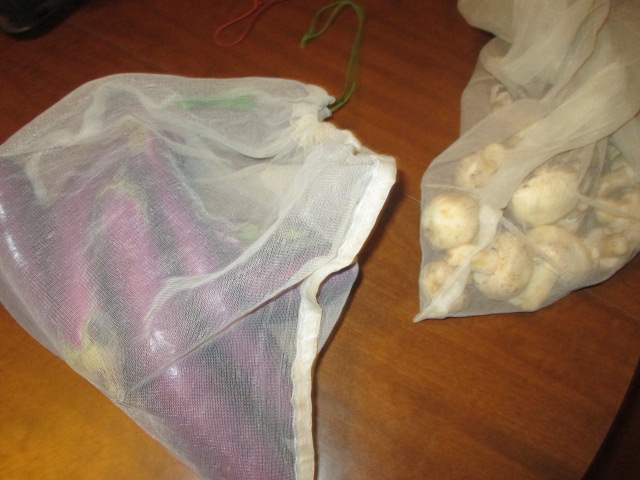 Ah, you may be asking, but what if you go to the store and decide to buy some produce from the bins? You have to take a plastic bag for that, don't you? Well, not usually. When we make a grocery run in the car, we always have with us our large reusable shopping bag (also from IKEA) and a set of three mesh produce bags, received as a Christmas gift six years ago. So the only time we need to take a plastic bag for produce is if (1) we buy more than three separate produce items that require bags, or (2) we decide to stop into the store while we're on foot, so all we have is the ChicoBag. (If I know ahead of time that I'm planning to visit the farmers' market while out on my walk, I can stuff a couple of reused plastic bags in my purse.)
Although plastic bags are free at most grocery stores, our reusable bags still save us a bit of money. True, some of the stores I blogged about saving money at with bring-your-own-bag discounts back in 2011 have since discontinued them. But we still get 10 cents off per container at the Whole Earth Center, and we still avoid paying for bags at Aldi—and if Highland Park's proposed plastic bag ban goes into law, we could eventually be saving 10 cents a pop at our local Stop & Shop. So the estimate I made at the time that these bags save us $25 a year isn't too far off the mark. But even if these bags didn't save us a penny, they'd still spare us from having to bring a worthless piece of plastic into our house every time we shop—and you can't put a price on that.
Tuesday, January 22, 2019
Thrift Week 2019, Day 6: Takeout containers
When I tried to take the Plastic Free July challenge last year, it ended up not going that well. I discovered that a whole lot of the things I buy are packaged in plastic—things I'm not willing to give up, like cherries, Brussels sprouts, tofu, popcorn, and Certified Humane eggs. In some cases, it would have been possible to buy a non-plastic-wrapped alternative, but for significantly more money, and spending extra to avoid such a tiny bit of plastic waste—most of which was going in the recycling bin anyway—just seemed silly.
However, I probably would have done much better if I'd taken the simpler version of the challenge: avoiding plastic "takeaway items," such as plastic bottles, bags, straws, and coffee cups. Because for the most part, I already do this.
I wrote on Day 1 about my reusable water bottles, and back in April I explained about my plan to carry a drinking straw in my purse so I wouldn't need to acquire any new ones. Since I already have a stock of rinsed and reused plastic straws, I plan to work my way through those, getting as much use out of them as I can before discarding them, and only invest in a set of reusable silicone straws when the plastic ones are used up. I even made a little cloth sleeve to carry my straw in so that it wouldn't get dirty. (My post about the straw sleeve turned out to be the most popular one I've had in the past six months, so I guess this is an idea a lot of other people are interested in, too.)
Until recently, one of my weaknesses in the "takeaway" department was those Styrofoam clamshells they give you to package your restaurant leftovers. They're big, wasteful, and non-recyclable, and they don't even store your food all that securely; you have to take care to keep them upright at all times to make sure nothing spills. But the alternatives always seemed to be either letting food go to waste or eating too much so that nothing would be left over, and taking the foam clamshell seemed like the least of those three evils.
It had sometimes occurred to me that we could avoid this problem by just taking some reusable containers with me whenever we went out to eat, so if we had any leftovers, we could pack them up ourselves. The problem was that going out to eat was often an impromptu decision for us, so planning ahead this way wasn't feasible. However, when I signed up for the Plastic Free Challenge, it occurred to me that there was a simple way around this problem: we could just keep some reusable containers in the trunk of the car, so if we ever decided on a whim to go out to eat, we could simply grab these containers for our leftovers as needed.
 We put this plan into action right away. We already had an assortment of plastic containers from various sources (takeout food we've ordered, goodies we've received from friends) that we'd rinsed and stored, rather than tossing them in the bin, thinking they might come in useful some day—so we simply selected a few of different sizes and shapes, tucked them in a bag, and tossed it in the trunk. They never actually got used during
our Plastic Free July, but we've used them several times since then and
found they work just fine. In fact, we used them just this weekend after my parents took me out to dinner for my birthday, and as you can see, they stored our vegetable curry, mango tofu, and mixed seafood quite comfortably.
That leaves me with only one problem in the takeout food department: coffee. Yes, I know that the baristas at Starbucks will serve up your cafe mocha in your own reusable mug if you ask them to, and they'll even take a dime off the price for it—but the problem is that like restaurant meals, coffee tends to be an impulse purchase for me. And unlike a restaurant meal, it's one I'm at least as likely to make while I'm out and about on foot, so keeping a mug in the trunk of the car wouldn't help me most of the time. And stowing one in my purse isn't really an option; although it's on the large side as purses go, it's not really big enough to accommodate a 12-ounce mug as part of my everyday carry.
However, I think I've found a possible solution: a collapsible, silicone cup like this one. If it really folds up small enough to fit into a pocket, then I'm sure I could manage to fit it into my purse. I'm just waiting until this week is out to make sure no one already got me one for my birthday, and then I'm going for it.
With this addition, my reusable takeaway container collection will be complete. I'll never again need to take home a disposable clamshell, coffee cup, or straw. Admittedly, these things are all free, so my collection isn't actually saving me anything—but then, on the other hand, with the possible exception of the coffee cup, it won't have cost me anything either. So it's worth it just for the warm and fuzzy benefit of knowing I'll be cutting down the amount of plastic waste in the world, even if it's only by a teeny smidgen.
Monday, January 21, 2019
Thrift Week 2019, Day 5: Lady stuff
Warning to male readers: If you're at all squeamish about menstruation, you might not want to read today's entry. I'm going to be talking about periods, feminine products, the waste they produce, and how to avoid it—and while I will try not to get too explicit, I won't be able to steer clear of the lady parts altogether.
[Pause]
Okay, now that we've cleared all the fragile males out of the room, let's talk seriously for a minute about the cost of the average monthly period, and the waste associated with it. I did a little research on this for an as-yet-unpublished article on Money Crashers, and I found a piece in the Washington Post about a California assemblywoman named Cristina Garcia pushing to make feminine hygiene products tax-free across the state. Her office did some research and found that the average woman in California spent $7 a month on disposable sanitary pads and tampons. Multiply that by 40 years of fertility, and it adds up to $3,360 we're doling out to Aunt Flo.
And that doesn't even touch on the environmental costs. All those pads and tampons are ending up in landfills (except in the few areas where trash is incinerated), along with the individual wrappers and boxes they're packaged in. Let's start by assuming that $7 a month figure works out to one box of pads per month (which is about the price I found for a box of U by Kotex at Target). A three-pack of this same brand on Amazon has a shipping weight of 2.3 pounds, so if we round down to allow for the weight of the shipping envelope, that works out to to about 12 ounces per box. So over the course of your fertile years, that adds up to 360 pounds of waste going into the landfill.
Now, more power to Assemblywoman Garcia for trying to get the tax removed on these products, but I might quibble with her argument that they're a "basic necessity." Because most of the time, at least, you don't really need disposable products to cope with your period. Our great-grandmothers managed with reusable cloth rags, and there's no reason we can't do the same.
 Matter of fact, it's easier for us, because there are now reusable cloth pads specifically designed for the purpose. I bought my first set of cotton Glad Rags nearly 25 years ago, and while they've finally started to show signs of wear, they're still usable. The assortment you see here—six cloth pads, each with one or two liners—is all I need to get through my period every month. I just change out the pad each day—twice if it's a heavy day—and soak it in the sink before tossing it into the wash. They get laundered and go up on the line with all my regular clothes (probably to the consternation of the neighbors, if they've ever noticed).
These six pads, plus the carrying bag, cost me somewhere around $50. The amount they add to each month's laundry probably works out to maybe one extra load of laundry per year at most, for an annual maintenance cost of 40 cents. So over the past 25 years, these pads have cost me maybe $60 to own and have taken the place of over a thousand dollars' worth of disposable sanitary napkins. (Well, maybe I should say they've almost taken the place of disposable pads, since I still keep a few on hand. They're easier to use when traveling or to store in my purse for emergencies. But I haven't actually bought any in years.)
Now, I realize some ladies probably have to deal with heavier flow than I do, so they'd need a larger assortment of cloth pads to get through the month. But these women have all the more reason to choose cloth over paper; since they're spending more each month now, they stand to save more. Double the initial investment and laundry costs, and you're looking at $120 for 25 years' worth of protection, as opposed to over $2,000 for disposable pads. (Actually, if you were to buy new Glad Rags today, the cost would be a little more than that. Their sampler kit of three day pads, three liners, an overnight pad, and a carry bag costs $95, and a woman with heavy periods would probably need two of them. But other brands are much cheaper, such as these Teamoy cloth pads that costs only $26 for ten pads of varying sizes, plus a "wet bag" for stowing away soiled pads in case you have to change pads while you're at work. The clean ones can simply be folded in on themselves for carrying—no bag needed.)
Cloth pads, like the disposable kind, can't be worn while swimming. This isn't really an issue for me; I just have a box of disposable tampons for those extremely rare occasions when I want to go swimming during my period. (I've had the same box for ages, and there's basically no chance I'll use it up before I hit menopause.) But for women who want to be able to swim at any time, there's also a reusable tampon alternative: the menstrual cup. You can wear one of these for up to 12 hours, then wash it and reinsert it. At the end of your cycle, clean it thoroughly and put it away until next month.
The best-known of these is the DivaCup, which is made of silicone. It's not as cost-effective as cloth pads, since it costs around $40 and only lasts about a year, but it's still less than half the price of disposable pads. A latex cup, such as The Keeper, can last up to 10 years, potentially replacing $840 worth of pads for $35.
Bottom line: between cloth pads and menstrual cups, there's no reason for any woman to keep forking over $7 a month to the giant companies that control the feminine product business. Women of the world unite! You have nothing to lose but 360 pounds of garbage!
Subscribe to:
Posts (Atom)

 Posts

