Sunday, December 12, 2021

Holiday decor disappointment

My simple DIY holiday decorations keep getting harder and harder to create. For years, I did just fine with just one strand of outdoor lights, some festive ribbons, and some evergreen trimmings that I picked up for free from the local Christmas tree vendors in Sears' parking lot. I'd generally tip them a buck or two, but with all the rest of the decorations reused from year to year, it was still very cheap. And since I was only putting to use what would otherwise go to waste, it was very eco-friendly as well.

Two years ago, this got more difficult. Sears had gone into bankruptcy, and the Christmas tree vendors had stopped setting up shop there. And when I searched online to see where the nearest tree vendor was, it was about a twenty-minute drive away in an area we never visit for any other reason (and would particularly avoid visiting at Christmas time). Plus there was no guarantee they'd even have evergreen trimmings available when we got there. So I scaled down my decorations a bit and made do with what I was able to trim off the one evergreen tree in our yard and the bushes that overhung our driveway from the neighbor's yard.

But this year, that option too became unavailable. Our neighbor cut down all the bushes in his yard, and the one tree in our yard couldn't possibly yield enough greenery to make any sort of show. So at this point, we could think of three options:

  • Make the trek up to the nearest tree vendor, with no guarantee of finding anything;
  • Shell out for pricey greenery from a local store; or
  • Don't put up decorations.

The first two options didn't seem very ecofrugal, but the last was just too depressing, particularly after a year with so little cheer in it. So I did a little research and found that I could get a 20-foot rope of pine garland at the local supermarket for 12 bucks — not as cheap as the greenery I used to pick up from the tree vendors, but still reasonably affordable. And I thought maybe the pine garland would justify its price by being easier to work with than the individual branches that had to be carefully trimmed and fitted and bound to the railings piece by piece.

This turned out not to be the case. The long, heavy rope of pine garland was actually more unwieldy than the branches; I had to use one hand to hold the end on the railing and one to tie the ribbon on while trying to pin the rest of the bundle in place so it didn't drag the piece I was working with off the railing. Also, 20 feet proved not quite long enough to go all the way up one railing, over the door, and down the other railing, so I had to hack off two lengths for the two railings — which was a lot harder than it sounds, because the pieces of pine were attached together with sturdy wire that I had to cut through,
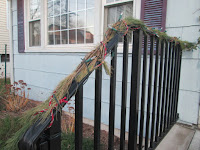
But the biggest problem with the pine garland is that it just doesn't look as good as the ad hoc arrangements I used to make with miscellaneous evergreens. Because I was trying to work with a pre-made rope, I couldn't arrange the individual branches to cover over bare spots, so I was left with stretches of exposed wood with no greenery. Also, because I was trying to run the garland up one railing and down the other, the pine needles are all pointing in opposite directions on the two sides. And worst of all, the pine dries out a lot faster than the assorted branches of yew, spruce, cypress, and whatnot that I used to work with. It's only been up there for two weeks, and already it's starting to look brown and drab — not cheery and festive at all.

All in all, I can't really consider the $12 I spent on this pine garland to be money well spent. I'm not prepared to tear it all down, but I'm certainly not inclined to shell out another $12 for the same thing next year.

Fortunately, there may be other alternatives. For one, I discovered this year that there were Christmas tree vendors setting up shop at our local farmers' market, starting the Friday after Thanksgiving. They didn't seem to have a pile of discarded trimmings anywhere, but I could try going up to them next year and asking if they have any they'd like to get rid of. The downside of this plan is that, first, they might say no; and second, the farmers' market doesn't open until 11am on Friday, so if we tried to make it there the Friday after Thanksgiving we wouldn't be able to join the rest of the family in Hopewell until noon at least. We'd either lose out on a couple of hours of Thanksgiving fun or have to wait another week to get our decorations up.

But there is another possibility. My parents live on a half-acre lot with a whole bunch of spruce trees on it, and we could probably glean more than enough greenery from them to decorate our house without doing the trees any damage. And since we're always there for Thanksgiving weekend anyway, all we'd have to do is bring our clippers with us, and maybe some sort of bag to store the branches in.

If we could manage this, it would bring our holiday decorations back to their original ecofrugal roots. We'd be using only local, sustainably harvested evergreens, and paying nothing at all for them. And with our new battery-powered LED lights (running off rechargeable batteries) both outdoors and indoors, they'd be even more festive and easier to set up. The best of all ecofrugal worlds.

Sunday, December 5, 2021

Not-so-Green Mountain Energy

For as long as I can remember, I've been buying my electricity through a third-party supplier. Obviously, this doesn't mean that I have a direct line from my home to this company and they're feeding in only the particular stream of electrons that they generate; rather, it means that I pay a fee for that provider to feed a certain amount of power into our local electric grid. On my electric bill, there are two separate charges: one to the third-party supplier for generating the power, and one to my local utility, PSE&G, for delivering it via the grid.

Unlike most people, I don't do this to save money. I do it because it's the easiest way to power my home with renewable energy. (We've considered installing solar panels, but at first we hesitated due to the price, and eventually we learned that we don't qualify for solar because our power usage is too small.) 

For many years, I used a supplier I chose through the NJ Clean Power Choice program. Then, a few years back, the state of New Jersey canceled that program and required anyone who wanted to switch providers to do it through NJ Powerswitch instead. This was much more complicated, because there were a lot of providers to choose from and no indication as to which ones used renewable energy, but eventually I managed to find a supplier called Ambit Energy that offered plan with 100 percent renewable-generated electricity for only about a penny more per kilowatt-hour than we'd have paid through PSE&G.

But last year, I received a notice from Ambit informing me that they would be switching me over to their new regional power plan. They included an environmental disclosure showing what energy sources went into producing the power for this plan — and lo and behold, it was mostly fossil fuels. It actually had a larger carbon footprint than the power sold directly by PSE&G, which is mainly nuclear.

So I went back to the drawing board again and found a new power supplier: Green Mountain Energy, which I'd used before in the old Clean Power Choice days. It offered a plan with 100 percent wind energy for just a little more than we'd been paying with Ambit. So, problem solved.

Or rather, so I thought. Because last month, I received an Environmental Information Disclosure (EID) from Green Mountain, informing me that their power mix was more than half fossil fuels: 22 percent coal and 38 percent natural gas. Less than 5 percent of it came from renewable sources.

Hoping this was a mistake, I called up Green Mountain Energy to ask for an explanation. The person I got didn't seem to know what was going on and put me on hold several times, but eventually she came back with an explanation: that EID didn't apply to me, because the plan I was on included the purchase of RECs, or Renewable Energy Certificates. These are tools a power provider can use to buy its energy from a green energy supplier — which is exactly what I thought I was doing directly by using Green Mountain. But it turned out Green Mountain was not itself generating power from wind, as it had specifically claimed; it was merely paying some other provider (not necessarily in New Jersey) to do so.

When I expressed some frustration over this, the person on the phone tried to explain to me that, well, look, RECs are the only way you actually can buy renewable energy, because it's all going into the same grid. When I replied that yes, I knew what RECs were, but I thought I was buying my clean energy directly from the supplier, and not from a middleman who was paying money to the supplier, she had to admit that, well, no, that was not the case.

So for the third time, I had to go through the incredibly cumbersome process of trying to compare power suppliers on the NJ Powerswitch site, clicking through to each supplier's website and hunting until I found information about both its rates and its energy sources. It took me about an hour of work to figure out that the best available price for a plan with 100 percent renewable energy was 13.24 cents per kWh from North American Power — just a fraction of a cent more than we'd been paying with Green Mountain. 

But when I clicked on "more details," I found this little tidbit of info:

NAP purchases and retires renewable energy certificates (“RECs”) to match the applicable percent of your electricity usage, above and beyond any state renewable portfolio standard requirements. Your energy consumption for this product is offset by RECs from eligible sources including, but not limited to a mix of hydro and wind.

In other words, if we switched to NAP, we'd be getting essentially the same deal we were getting from Green Mountain. Rather than paying the supplier to put green energy into the grid directly, we'd be paying a broker to buy RECs from other renewable energy suppliers. So logically, it made no sense to switch. If we simply stuck with Green Mountain, we'd be doing the environment exactly as much good as we would with NAP, and we'd pay a little less per kWh.

But I decided to switch anyway, and for one very simple reason: NAP told us the truth about what they were doing. They disclosed right up front that they were not generating clean power themselves, but paying someone else to do it. Green Mountain, by contrast, gave us a contract promising that our energy would come from 100 percent renewable sources, then sent us an EID saying that, well, actually, it came mostly from fossil fuels, and only after I called them up and spent half an hour on hold admitted that they were just buying green energy from someone else.

Maybe it's irrational to be willing to pay an extra three-quarters of a cent per kWh to a company just for being honest with us upfront. But it's a kind of irrational I can live with.

Wednesday, December 1, 2021

Money Crashers: Two new articles

Two more of my articles popped up on Money Crashers today. The first is about how to decide when it's time to ditch your old car in favor of a new (or at least newer) one. I outline the factors to consider, from car payments and fuel costs through safety and gas mileage, and how to decide what's right for you.

Keep Driving an Old Car or Buy New – What’s Better?

The second is a head-to-head comparison of the features of Walmart+ and Amazon Prime. I don't actually subscribe to either myself, but I compare them point for point — cost, delivery options, other shopping perks, and entertainment — to demonstrate which (if either) could be a better value for you.

Walmart+ vs. Amazon Prime – Which Is Better?

Monday, November 29, 2021

Money Crashers: 2 new articles

A quick post to let you know about two new articles of mine that have popped up on Money Crashers in the past week:

9 Best Books to Read Before Buying a Home


From the author who brought you "7 Best Personal Finance Books to Read of All Time," a new piece on the best books about home buying. These volumes cover every aspect of your biggest purchase ever, including real estate agents, mortgages, inspections, title insurance, negotiation, and closing costs. It's everything you've ever wanted to know about home buying but were afraid to ask.


How to Get the Best Price on a Rental Car – 10 Simple Steps


The second  article is a companion to my earlier piece on avoiding rental car fees. This one focuses not on the fees, but on the base price you pay for a rental car. It lets you in on the secrets to getting the lowest possible price, from avoiding upselling to taking advantage of discounts.

Sunday, November 28, 2021

Recipe of the Month: Butternut Squash Soup with Apple and Leek

Whew! Over this past weekend, I have probably eaten more meat than I did during the rest of the year combined. My folks always get a free-range turkey for Thanksgiving, mostly to accommodate me, and from Thursday through Saturday I consumed parts of it for at least four meals: Thanksgiving dinner itself, then turkey sandwiches for lunch on Friday and Saturday, and Thanksgiving leftovers for Saturday dinner. Of course, I wouldn't have eaten so much turkey if I didn't enjoy it, but still, it was kind of a relief to get back to my more normal plant-based diet tonight with a new vegan recipe. And, of course, it also allowed me to slip in this month's Vegan Recipe of the Month just under the wire.

This recipe, or at least the inspiration for it, came out of the Fix-It and Forget-It Vegetarian Cookbook, which I picked up cheap a few years ago. I forget just where it came from; maybe it was the library book sale, or maybe it was part of our regular December trip to Half Price Books. But whatever its source, it went onto our cookbook shelf and basically just sat there. Whenever I was looking for a recipe, I skipped right over it and went straight to the more familiar cookbooks we've worked with before. As far as I can recall, we've never actually made anything at all from it. 

This month, I got to thinking it was a bit silly to have this cookbook taking up space on our shelf if we weren't going to use it, so I decided to take it out and put it to the test. I paged through it and found that most of the recipes in it wouldn't be all that useful for us, as they have a fairly heavy emphasis on dairy, which we've largely given up. But I happened to hit on one recipe for Acorn Squash Soup with Apples and Leeks that I thought could be converted to vegan without too much difficulty. The only dairy ingredient in it was a half-cup of half-and-half, and I believed a substitution of canned coconut milk would fit in perfectly well with the rest of the ingredients (acorn squash, vegetable broth, apple, leeks, and a touch of ground nutmeg).

We also replaced the acorn squash in the recipe with butternut squash, which tastes much the same and which we always have on hand. As I noted last month, last year's crop lasted us over a year, because we always grow a lot of it and we have a limited number of recipes that call for it. We seldom make our beloved butternut squash lasagna anymore because it requires so much dairy, and so far, we haven't dared to risk making it with our new vegan mozzarella and almond milk for fear of mucking up the texture. So that leaves only a handful butternut dishes we make recipe: butternut squash souffle, black bean and butternut quinoa bowl, butternut squash pizza with sage, and roasted fall veggies with eggs. So I figured this new soup recipe, if we liked it, could provide an opportunity to expand our repertoire.

Making the soup was pretty easy. The recipe calls for baking the squash in the oven for half an hour, but Brian skipped that and used the microwave method we follow when making souffle or lasagna: zap the entire squash in the microwave for about 20 minutes, let it cool, and peel and mash it. He did that ahead of time in the afternoon, and come dinnertime, all he had to do was stir the soft squash into a big pot with a chopped apple (skin and all), a sliced leek, and three cups of veggie broth. Then all it needed was 15 minutes of simmering, a half-cup of coconut milk, a quick blending in the pot with our stick blender, and a sprinkle of nutmeg before serving.

And the result was...interesting. It's quite unlike most of our other soup recipes, because the butternut squash and apple together give it a distinctly sweet flavor, while the leeks and vegetable broth (from our favorite Penzey's vegetable stock) provide a savory background. It's sweet, tart, salty, and savory, all at once. And as I suspected, the coconut milk blends in quite unobtrusively with the other ingredients. Eked out by Brian's half-wholemeal biscuits, it made a perfectly enjoyable meal, but I wouldn't say I prefer it to any of the other butternut recipes we make regularly. So I don't know if it will earn a place in our regular rotation.

As for the Fix-It and Forget-It Vegetarian Cookbook, I'm not prepared to keep it solely on the strength of one recipe that we thought was fairly good. But based on the quality of this one dish, I'm prepared to spend a little more time delving into its pages and see if there are any more hidden gems to be unearthed.

Sunday, November 21, 2021

DIY almond milk from scratch

Two weeks ago, I blogged here about how I'd discovered a new, simple method for making your own almond milk at home by blending almond butter in water (with a little salt and sugar). We tried this with some commercial almond butter from Costco, and the result wasn't bad, but it didn't work well for cocoa; the toasted-almond flavor was so strong that it completely drowned out the flavor of the cocoa powder. But I wondered if it might be possible to produce a homemade almond milk with a milder flavor, more similar to the commercial stuff, by making our own almond butter from blanched rather than roasted almonds.

I can now say definitively that the answer is yes. But it's still not perfect, and it's a bit of a hassle.

Making this completely-from-scratch almond milk last weekend was a multi-stage process:

  1. First, Brian blanched the almonds using the process outlined by Alpha Foodie. The blog claims this process only takes five minutes, but it takes rather longer if you're processing a cup of almonds at once. As the recipe notes, peeling them is quite easy: just pinch them and they shoot right out of their skins (and go skidding across the table if you're not careful). But you can only do that to one almond at a time, so it takes a good while to get through a cupful.
  2. Then, he ground the almonds into butter using Alice Waters' recipe. Here's where he encountered his second snag: The almonds wouldn't grind easily. He tried it in both the Magic Bullet and the food processor, and in both cases, the motor started to burn. He ended up having to add roughly a quarter-cup of canola oil to the almonds just to reduce them to a paste, and he would have added more if he hadn't been afraid of mucking up the texture. Maybe our little food processor doesn't qualify as the "sturdy" model that Waters recommends.
  3. He took a tablespoon of this blanched-almond butter and blended it up with two cups of filtered water, a teaspoon and a half of sugar, and an eighth-teaspoon of salt. That's roughly equivalent to the pinch of salt and single date recommended in the Nest and Glow recipe.

As you can see here, the resulting almond milk had a much lighter color than the stuff made from commercial almond butter. It had a much lighter flavor, too, very close to the almond milk we buy in cartons at the store. The big difference between this and the commercial product was texture. 

Brian ground the almond butter as finely as he could and then blended it very thoroughly with the water, but it still didn't blend completely. There were tiny solid particles suspended in the liquid, which precipitated out when it sat overnight. Getting them back into suspension wasn't a big problem; I just gave the bottle a good shake, the same way I do with the carton of commercial almond milk. But the little flecks of almond in my breakfast cocoa gave it a rather chewier texture than I'm used to.

Mind you, this was only our first attempt, and it's possible we might be able to get the almond milk a little smoother with a little tweaking. Maybe processing the almonds in our big blender on the "grind" setting would work better than using our little Magic Bullet or our little food chopper. Or maybe we could simply strain the almond milk after blending it. But that would also add a fourth step to the process, making it more work than before.

So we're going to need to fiddle with this recipe a bit more before we decide if it can really take the place of our packaged almond milk from Lidl. It comes down to two questions: (1) can we come up with a method that produces a reasonably smooth homemade almond milk, and (2) if we do, is the process simple enough to make it worth the effort. We've still got most of our initial batch of homemade almond butter to work with, so we'll definitely be making at least a few more batches, and perhaps by the time we're done we'll have come up with a method that's workable.

If we do, we'll have the ultimate ecofrugal plant-based milk: half the price of dairy milk, with practically no packaging. But even if we don't, it's good to know that we always have this DIY almond milk as a backup. Now if we're snowed up for days at a time and can't make it to the store, we can always produce a tolerable version of almond milk from ingredients we always have on hand — just so long as the power stays on, that is.

Saturday, November 20, 2021

Money Crashers: secondhand shopping and free e-books

Money Crashers has popped up two new articles of mine, both on topics close to my heart.

The first is about secondhand shopping. Since I always prefer to buy secondhand when I can, I felt particularly well qualified to cover this topic. The article compares the various types of venues that sell secondhand goods, from thrift shops to eBay to yard sales, and offers strategies for getting the most for your money. Much of it will be familiar to regular readers of this blog, but here it's all conveniently organized in one place.

Second-Hand Shopping: How to Save at Thrift Stores and Consignment Shops

And the second is about another favorite subject, books. Specifically, it's about e-books and about how and where you can get them for cheap or free. The article runs through all the best sites for finding digital reading material at little to no cost, from digital libraries to the collection of free Kindle books on Amazon. (Okay, a lot of them aren't very good, but they'll do to pass the time in a waiting room.)

10 Best E-Book Download Sites to Find Free or Cheap Books Online