
In my last post, which introduced my article on things you should never buy online, I talked about my disappointing experiences shopping online—particularly for shoes. After ordering the same pair shoes from Zappos last month in three different sizes, then being forced to ship them all back because not one pair fit comfortably, I concluded that I simply shouldn't buy any more shoes without being able to try them on.
Well, as it turns out, that resolution didn't last long. Because, as I discovered last night, shopping for shoes in a store has can be even more problematic than buying online—especially for someone with weird feet like mine.
After my disappointing experience with Zappos, I decided I should give up on shoes with any kind of built-in arch support, since it always seems to hit me in the wrong part of the foot. So instead, I decided to try the nearby Skechers outlet, knowing that Skechers makes many shoes with a memory foam insole that conforms to your particular foot. I tried on every single pair of flats in the store, and I didn't find any that was a perfect fit, but I found one pair in a size 7 regular that I thought would be acceptable. Until I got it home, that is, and started wearing it around the house. After an hour of just sitting still with the shoes on my feet—not even walking around much—they were starting to cut off my circulation. And since they were also so long that my heels came close to slipping out of the shoes when I walked, I knew sizing up wasn't an option. So, back those went to the store.
Then, last night, I gave DSL a try. This experience was even worse: there wasn't a single pair of shoes in the store in a wide width. I tried simply sizing up to a 7 regular, but in every single case, the size 7 - and sometimes even the 7 1/2 - was too tight across the top, yet too long at the same time. There were one or two pairs I could get my feet into, but none that felt comfortable.
So I came home and fell back on Plan B: I ordered a pair of shoes from Minnetonka Moccasin. These aren't vegan, but they're made from moosehide, which comes from (presumably) free-range moose, so it fits within my ethical limitations. And on every other requirement, they appear to tick all the boxes: they're available in a 6 1/2 wide, they look reasonable, and the overwhelming majority of reviews describe them as both incredibly comfortable and incredibly durable. They're a little pricey at $70, but if I can get five or more years of wear out of them, they'll still be a great value. And if they don't fit, I can send them back and exchange them for a different size, free of charge, until I find a pair that does. If I try on all the sizes and nothing fits, well, I'll have to eat the $7 return shipping, but I'd rather take that risk than waste another evening in a shoe store trying on pair after pair to no avail.
So it appears that, at least where shoes are concerned, sometimes online shopping is the best option after all. And that makes this story a good way to introduce my latest Money Crashers piece, which is all about the things you should always buy online. Once again, shoes aren't on that list (for someone with normal feet, shopping in a store for those is probably easier), but clothes are—or at least, "clothing basics" where fit isn't crucial—along with seven other items that are nearly always cheaper and more convenient to order over the Web from the comfort of your home.
Find out what they are here: 8 Things You Should Always Buy Online
Thursday, March 29, 2018


Wednesday, March 28, 2018
Money Crashers: 8 Things You Should Never Buy Online
I have a love-hate relationship with online shopping. I love the fact that it's possible to find almost anything online, and often at a much better price than I'd be likely to pay for it in a store. And I love the ease of being able to search and compare products and prices. in the space of a few minutes from the comfort of my own home, rather than dashing from store to store. (Case in point: we recently decided we could use some wet-erase markers to use with our homemade RPG battle mat, since the dry-erase markers tend to get smudged during use (or if a cat decides to sit on the map). We looked at every store we could think of and found only one set at Staples for $12, which we weren't sure was worth it. Then I went online and found a set on eBay for $6, shipping included.)
What I hate about it is how often that one perfect thing I found online after a fruitless search in the stores turns out, when it finally arrives, to be not so perfect. Then I have to go to the trouble (and sometimes expense) of shipping it back, and the search starts up all over again. This seems most likely to happen with shoes, as I was recently reminded when I ordered the same pair in three different sizes from Zappos, figuring at least one of them was bound to fit, and ended up having to return all three because the arch support his my foot in the wrong place. At least the return shipping was free.
So I've pretty much come to the conclusion that shoes are one product I simply shouldn't try to buy online (unless it's a brand and style I've bought before that I know for sure will fit). And it occurred to me that probably there were several other products that fit into the same category—products that, for one reason or another, it simply isn't worth shopping for online, no matter how good the prices look.
In my latest Money Crashers article, I've done my best to identify those products. I went through a bunch of lists compiled by experts of products you shouldn't buy online and came up with a set of eight that there was widespread agreement on. Shoes, interestingly, do not make the list (the experts were split on those), but there are several others that you might expect (e.g., mattresses) and some that are a bit more surprising (e.g., makeup).
Find out what they are here: 8 Things You Should Never Buy Online. And keep an eye out for my companion piece, which should be published soon, on the eight items you should always buy online.
Tuesday, March 27, 2018
Money Crashers: 5 Benefits of Baking Your Own Bread at Home and How to Get Started
It's been five years now since our bread machine died and Brian decided, rather than replace it, to start baking all our bread by hand. Over the course of those five years, I've asked him from time to time if he would like to have a bread maker again, and his answer has always been no. I've also mentioned other bread-making methods to him, such as the no-knead method featured in Artisan Bread in Five Minutes a Day and its sequels, but he was never interested. He really enjoys the whole process of baking bread by hand, getting his fists into the dough, and he would actually miss it if it were no longer part of his routine. He's willing to make the minor concession of baking two loaves at a time, so he only has to do it every two weeks instead of every week, but that's as far as he'll go.
However, I realize this isn't a decision everyone would want to make. Some people would love to have fresh bread every week, especially at a third of the price they'd pay for a fancy loaf from the bakery, but they just have things they'd rather do with their time than knead bread dough.
My latest Money Crashers article is for them. In it, I discuss all the advantages home-baked bread has over the store-bought stuff—including price, flavor, nutrition, and the chance to customize recipes to fit your taste—and then explain how it's possible to get these benefits without having to set aside three hours every week for baking. I explore methods such as batch baking, using a machine, baking in your slow cooker, and using the no-knead method, discussing how each one compares to store-bought bread in time, cost, and taste.
To learn more about baking your own bread on a busy schedule, check out the article:
5 Benefits of Baking Your Own Bread at Home and How to Get Started
5 Benefits of Baking Your Own Bread at Home and How to Get Started
Saturday, March 24, 2018
Gardeners' Holidays 2018: First Sowing
It appears to have become a tradition around here to celebrate the official first day of spring with a snowstorm. In 2015, I stubbornly went out and sowed my snap peas in a light snowfall that later accumulated to about four inches; in 2016, I did the same with only a paltry inch of snow in the forecast; and last year I had to give in and postpone the planting because there was already a couple of inches on the ground. And this year, our spring Gardeners' Holiday had to be postponed on account of this:

While that's a lot of snow for what's supposed to be springtime, it could have been a lot worse. The forecast was originally calling for eight to eleven inches of heavy snow that could take out trees and power lines; instead we got about seven inches of fairly light, fluffy snow that was fairly easy to shovel. It was already starting to melt the day after it fell, and by the weekend, nearly all of it was gone.
That freed us up to plant our peas today, right on schedule. But before we could put them into the ground, we had to prep the beds, which were full of a lot of weeds and debris left over from last year's crops.

We cleared all that out as best we could, then I worked on clearing away the worst of the weeds from the path area while Brian opened up our new compost bin and extracted several buckets full of nice, dark compost.

After dumping those out onto the beds and raking it out smooth, we were ready to start planting the peas. Fortunately the bed we're putting them in this year is the left front one, which gets more early sun than the others, so the dirt in it was fully thawed. Rather than fuss around digging a trench, Brian just out all the peas in a neat little row, two inches apart, and then pushed them down into the dirt up to the depth of his first knuckle.

Before these plants grow tall enough to latch onto the trellis, we'll need to make some repairs to the bottom part of it. Apparently we didn't leave quite enough extra at the bottom when we attached the netting after rebuilding the garden beds last year, so some of the strings have worked themselves loose (as you can sort of see in the photo). But these peas will take a while to come up, so we have plenty of time to deal with it.
And now that this chore is all taken care of, we can go out for a little walk and enjoy the spring weather...before it snows again tomorrow.
Monday, March 19, 2018
Money Crashers: Avoid Frugal Fatigue with Cheap Luxuries
I've always made a point of stressing, on this site and off it, that frugality isn't the same thing as deprivation. Ideally, in fact, living a frugal life means you have more money and time to spend on the things that really matter to you. As I put it in this 2010 entry, "we really can have our cake and eat it too, as long as we're willing to bake it ourselves."
The problem is that a lot of people don't really know how to cut back without going to extremes. They'll try to trim their budgets down to the absolute bare bones, and then after a few weeks of feeling deprived, they snap and go on a spending binge. Then follows self-recrimination, a vow to turn over a new leaf, another period of self-denial...and the cycle repeats itself.
The best way to avoid this problem—sometimes known as "frugal fatigue"—is to make sure you allow yourself to indulge a little while you're saving money. There are plenty of treats that you can enjoy for very little money or even no money at all, such as fluffy TV shows, hand-picked flowers, homemade coffee treats, cozy bedding, library books, online puzzles, and other forms of cheap entertainment. Little luxuries like these make a frugal lifestyle a joyful and abundant one.
This is the theme of my latest Money Crashers article. I outline the causes and symptoms of frugal fatigue and then offer a list of cheap luxuries that can alleviate it, such as fresh flowers, fancy toiletries, home-cooked gourmet meals, and even the extra-plushy toilet paper. I give prices for each item on the list and discuss ways of lowering the cost still more, so you can stretch your "mad money" as far as possible.
Read all about these luxuries that won't break the bank here:
Sunday, March 18, 2018
Recipe of the Month: Celery Root and Potato Puree
Our Recipe of the Month for March involves a vegetable we've never tried before: celery root, otherwise known as celeriac. Despite the name, celery root isn't simply the root part of a normal celery plant; it's a related plant grown mainly for its edible roots. These roots smell and taste quite similar to stalk celery, but like most root vegetables, celeriac keeps much better in cold storage than green celery. It's also rich in vitamins B6, C, and K, as well as phosphorus, and it has a not unreasonable amount of fiber and protein.
Despite these benefits, however, Brian and I never had a really good reason to try it until we picked up the most recent issue of Stop & Shop's Savory magazine. In a section on recipes for Passover, there was one for Garlicky Celery Root and Potato Puree, touted as a "creamy side dish [that] goes well with any meal." This versatile dish looked like it might make a good addition to our veggie repertoire, so we decided to stop by the Whole Earth Center and pick up the necessary ingredients. In addition to the celeriac, we'd need some gold potatoes, which are a better variety for boiling than the white or russet potatoes we usually buy.
These ingredients proved to be quite a bit pricier than we'd expected. Even though we were only making a half recipe, we still needed a pound of celery root, which was priced at $2.99 a pound. (We actually bought slightly less than a pound because it was sold in fist-sized knobs, and two of these knobs weighed in at 0.84 pounds. At that price, we didn't think it was worth buying a third one.) We also needed a pound of the Yukon Gold potatoes, which were much pricier than our usual variety at $1.69 a pound. Perhaps we could have paid less per pound by buying a larger bag somewhere else, but we would still have paid more in total, and we would have had to figure out what to do with all those extra potatoes. So the ingredients we bought specifically for this recipe came to $4.20, not counting the olive oil and garlic we already had at home. At that price, this was going to have to be one hell of a side dish to justify the cost.
 Making the puree wasn't difficult. Instead of boiling the celery root and potatoes on the stove as the recipe specified, Brian cooked them together in the pressure cooker on his usual potato setting, which worked just fine. Then he browned the garlic in the skillet (using just a bit more than the recipe called for, as is his wont), added the cooked veggies, and mashed it all up together. The resulting mixture had a distinctly different texture from regular mashed potatoes, noticeably thinner and less starchy, but still reasonable to serve in the same position on the plate. Since the dish was new to us, we decided to serve it up as part of a simple meal of baked whiting (seasoned with lemon pepper) and green beans, and let the new recipe be the star of the meal.
The mashed mixture of potatoes and celeriac was definitely more interesting than regular mashed potatoes, though the celery flavor wasn't nearly as strong as we'd expected based on the smell of the celery roots. Perhaps cooking it mellowed the flavor, or perhaps the taste just isn't very strong to begin with, but it was merely a faint hint of celery's usual sharpness in the background, playing off the creamy mildness of the gold potatoes and the mellow flavor of the cooked garlic. It was tasty enough to bring us both back for seconds, but, to be honest, not so amazingly tasty that we thought we'd be eager to make it again. It's not that much work to make, but it's still more work than a plain baked potato, which is almost as good and a hell of a lot cheaper. Maybe not quite as healthy, but there are other veggies you can add to the meal that would be just as healthy without the added expense.
So I'd have to say this Garlicky Celery Root and Potato Puree is interesting mainly as a curiosity. It was definitely worth trying once, but it's not something I feel any need to include in our collection of staple dishes. Maybe if we could find both celery root and gold potatoes a lot cheaper, this lighter and lower-carb variant on mashed potatoes would be worth making more often, but at the prices we pay around here, it's not a good investment.
Despite these benefits, however, Brian and I never had a really good reason to try it until we picked up the most recent issue of Stop & Shop's Savory magazine. In a section on recipes for Passover, there was one for Garlicky Celery Root and Potato Puree, touted as a "creamy side dish [that] goes well with any meal." This versatile dish looked like it might make a good addition to our veggie repertoire, so we decided to stop by the Whole Earth Center and pick up the necessary ingredients. In addition to the celeriac, we'd need some gold potatoes, which are a better variety for boiling than the white or russet potatoes we usually buy.
These ingredients proved to be quite a bit pricier than we'd expected. Even though we were only making a half recipe, we still needed a pound of celery root, which was priced at $2.99 a pound. (We actually bought slightly less than a pound because it was sold in fist-sized knobs, and two of these knobs weighed in at 0.84 pounds. At that price, we didn't think it was worth buying a third one.) We also needed a pound of the Yukon Gold potatoes, which were much pricier than our usual variety at $1.69 a pound. Perhaps we could have paid less per pound by buying a larger bag somewhere else, but we would still have paid more in total, and we would have had to figure out what to do with all those extra potatoes. So the ingredients we bought specifically for this recipe came to $4.20, not counting the olive oil and garlic we already had at home. At that price, this was going to have to be one hell of a side dish to justify the cost.
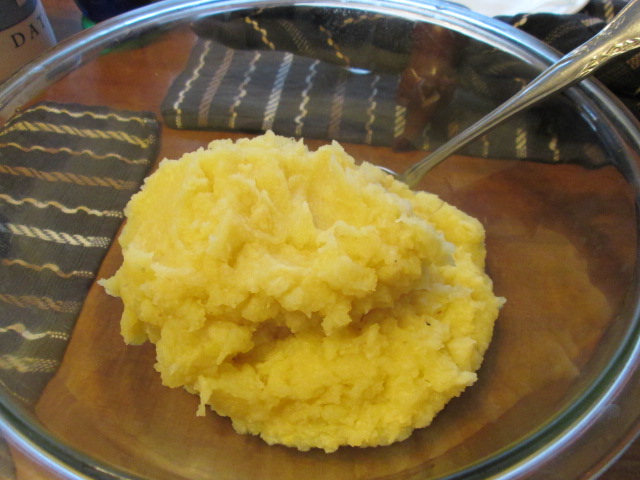 Making the puree wasn't difficult. Instead of boiling the celery root and potatoes on the stove as the recipe specified, Brian cooked them together in the pressure cooker on his usual potato setting, which worked just fine. Then he browned the garlic in the skillet (using just a bit more than the recipe called for, as is his wont), added the cooked veggies, and mashed it all up together. The resulting mixture had a distinctly different texture from regular mashed potatoes, noticeably thinner and less starchy, but still reasonable to serve in the same position on the plate. Since the dish was new to us, we decided to serve it up as part of a simple meal of baked whiting (seasoned with lemon pepper) and green beans, and let the new recipe be the star of the meal.
The mashed mixture of potatoes and celeriac was definitely more interesting than regular mashed potatoes, though the celery flavor wasn't nearly as strong as we'd expected based on the smell of the celery roots. Perhaps cooking it mellowed the flavor, or perhaps the taste just isn't very strong to begin with, but it was merely a faint hint of celery's usual sharpness in the background, playing off the creamy mildness of the gold potatoes and the mellow flavor of the cooked garlic. It was tasty enough to bring us both back for seconds, but, to be honest, not so amazingly tasty that we thought we'd be eager to make it again. It's not that much work to make, but it's still more work than a plain baked potato, which is almost as good and a hell of a lot cheaper. Maybe not quite as healthy, but there are other veggies you can add to the meal that would be just as healthy without the added expense.
So I'd have to say this Garlicky Celery Root and Potato Puree is interesting mainly as a curiosity. It was definitely worth trying once, but it's not something I feel any need to include in our collection of staple dishes. Maybe if we could find both celery root and gold potatoes a lot cheaper, this lighter and lower-carb variant on mashed potatoes would be worth making more often, but at the prices we pay around here, it's not a good investment.
Sunday, March 11, 2018
To almond milk or not to almond milk
Recently, our local Stop & Shop gave us a coupon for a free bottle of So Delicious organic almond milk. We chose the vanilla flavor, which Brian has been enjoying on his breakfast cereal, saying it tastes like candy. (Ironically, this particular brand of almond milk actually has less sugar in it than regular milk contains naturally, but the vanilla makes it taste sweeter.)
This got me wondering, as I occasionally have before, whether we should consider switching from regular milk to almond milk. It's been a couple of decades now since I gave up most meats on account of objections to factory farming (outlined in more detail in my "How to Become a Vegetarian" article), and I know that most of those same objections apply to dairy milk as well. The cows don't live a normal cow life; they're kept indoors most of the time and fed on grain, which isn't their natural diet. That, in turn, causes them to produce a lot more methane, making dairy farming one of the most carbon-intensive industries in the country. It also consumes a lot of water, and while milking one cow over its lifetime is a more efficient use of resources than butchering it and eating it all at once, it's still a much less efficient way to convert land to food than growing grain. So if I really wanted to be intellectually consistent, I really ought to give up milk and cheese as well as meat.
However, there are a few details that always give me pause. The first is the cost: at most stores in our area, a half-gallon of soy or almond milk costs around $3, roughly the same as a whole gallon of nonfat dairy milk. I've looked into recipes for homemade almond milk to see whether it's any cheaper, but it appears to be exactly the opposite. This recipe from Kitchn calls for a ratio of one cup of almonds to two cups of water; according to this analysis from Huffington Post, that works out to just under six ounces of almonds to produce about 14 ounces of almond milk. The best price we've ever found for almonds is around $5 a pound, so that works out to $8.57 for half a gallon of almond milk—and it's considerably more work than buying it in a carton.
However, even at $3 for half a gallon, almond milk is still cheaper than organic dairy milk, which typically costs at least $4 for the same volume. So if I were ever to decide that I just couldn't sleep at night while drinking regular milk any more, switching to almond milk, or another plant-based milk, would definitely be the cheaper alternative. What's less clear, though, is this thorny question: Is almond milk really better for the environment?
At first glance, it seems like this should be an easy call. After all, we already know how inefficient and destructive raising animals for meat is; making a milk substitute out of plants should obviously be greener. Yet if you really delve into the question, it's by no means clear that this is the case. I was doing some investigating of the topic this morning, and after spending a good half-hour or more looking through Google results (at least the ones that looked reliable), I emerged more confused than ever. Here's what I found:
Unfortunately, finding a clear comparison between these different plant-based milks proved even more complicated than nailing down the figures on dairy versus almond milk. Umbra of Grist magazine, normally very detailed in her research, ducks the issue, saying "it stands to reason" that a plant-based milk would be better for the planet than cow's milk (though not actually showing this to be the case) but saying it's practically impossible to compare the different types directly. She concludes that all commercial plant milks have their problems and urges readers to try making their own—which, as we've already seen, is quite a bit more costly than buying the stuff.
Well and Good is a little more helpful, listing various factors that affect the sustainability of nut milks and arguing that milk from peas "might" be the best option. They're higher in protein than nuts and much less water-intensive to grow, and because they're a nitrogen-fixing crop, they actually improve soil quality rather than using up tons of carbon-intensive fertilizer. It is a highly processed foodstuff—much more so than almond milk, according to the Washington Post—but at least all the stuff going into it is pretty earth-friendly.
Of course, these the same benefits also apply to soybeans, which were once the most popular source for plant-based milk. The Culture-ist recommends soy milk as the best of the plant-based milks, saying it's "comparable to cow’s milk" in protein and fat content (though lacking in calcium) and uses less than 30 percent as much water to produce. Unfortunately, soy milk has one big drawback, at least in my opinion: it tastes gross. The one time I experimented with soy milk, I quickly switched back to cow's milk because I couldn't stomach the stuff.
So maybe it's time to give pea protein milk a try. Organic Life notes that it offers 8 to 10 grams of protein per cup and has a "mildly nutty and sweet" flavor, as opposed to the "beany" taste I found so off-putting in soy milk. Unfortunately, the stuff ain't cheap: Target lists a 48-ounce carton of Ripple at $3.99, which works out to a whopping $10.64 per gallon—way more than almond milk and even higher than organic cow's milk. But perhaps Stop & Shop will come through with another coupon, and we'll get a chance to see how we like it at a more reasonable price.
This got me wondering, as I occasionally have before, whether we should consider switching from regular milk to almond milk. It's been a couple of decades now since I gave up most meats on account of objections to factory farming (outlined in more detail in my "How to Become a Vegetarian" article), and I know that most of those same objections apply to dairy milk as well. The cows don't live a normal cow life; they're kept indoors most of the time and fed on grain, which isn't their natural diet. That, in turn, causes them to produce a lot more methane, making dairy farming one of the most carbon-intensive industries in the country. It also consumes a lot of water, and while milking one cow over its lifetime is a more efficient use of resources than butchering it and eating it all at once, it's still a much less efficient way to convert land to food than growing grain. So if I really wanted to be intellectually consistent, I really ought to give up milk and cheese as well as meat.
However, there are a few details that always give me pause. The first is the cost: at most stores in our area, a half-gallon of soy or almond milk costs around $3, roughly the same as a whole gallon of nonfat dairy milk. I've looked into recipes for homemade almond milk to see whether it's any cheaper, but it appears to be exactly the opposite. This recipe from Kitchn calls for a ratio of one cup of almonds to two cups of water; according to this analysis from Huffington Post, that works out to just under six ounces of almonds to produce about 14 ounces of almond milk. The best price we've ever found for almonds is around $5 a pound, so that works out to $8.57 for half a gallon of almond milk—and it's considerably more work than buying it in a carton.
However, even at $3 for half a gallon, almond milk is still cheaper than organic dairy milk, which typically costs at least $4 for the same volume. So if I were ever to decide that I just couldn't sleep at night while drinking regular milk any more, switching to almond milk, or another plant-based milk, would definitely be the cheaper alternative. What's less clear, though, is this thorny question: Is almond milk really better for the environment?
At first glance, it seems like this should be an easy call. After all, we already know how inefficient and destructive raising animals for meat is; making a milk substitute out of plants should obviously be greener. Yet if you really delve into the question, it's by no means clear that this is the case. I was doing some investigating of the topic this morning, and after spending a good half-hour or more looking through Google results (at least the ones that looked reliable), I emerged more confused than ever. Here's what I found:
- A 2016 life-cycle analysis of almond milk and dairy milk by UCLA undergraduates finds that almond milk has a much lower carbon footprint than cow's milk: about 0.36 kg of CO2 equivalent per liter, as opposed to 1.67 kg. However, its water use is much higher. It takes 77 gallons of water to produce a liter of dairy milk, but more than 1,611 gallons to produce a liter of almond milk.
- However, One Green Planet vehemently disputes these figures. It claims that it takes only 30 gallons of water to produce one gallon of dairy milk—but a gallon of almond milk uses only 23 gallons. (Its source for these figures is a 2014 article in Mother Jones, which in turn cites a variety of academic and government sources dated between 2005 and 2012.)
- The Guardian, a British news source that's normally very thorough in its fact-checking, takes a position that appears to be in between these two extremes—but it's a little hard to interpret. It claims (citing Mother Jones again) that it takes 1.1 gallons of water to grow one almond, but 100 liters of water to produce 100 milliliters of cow's milk. Unfortunately, this isn't exactly an apples-to-apples comparison, since it's not clear how many almonds go into a liter of almond milk. The UCLA paper used the recipe from Kitchn in its calculations, with its ratio of 1 cup almonds to 2 cups water—but based on their nutritional information, it appears that most commercial versions don't use anywhere near this volume of almonds. The Guardian claims that Alpro, one of the most popular brands in Britain, contains only 2% almonds by volume. The blogger at Treading My Own Path crunched the numbers using a less almond-intensive recipe and concluded that it requires 384 liters of water to produce a liter of almond milk, while cow's milk uses roughly 2.5 times as much.
- However, the water required to grow almonds is proportionally more damaging because 80 percent of the world's almonds are grown in California. Tom Philpott of Mother Jones claims that even in the middle of a drought, the state continues to plant thirsty new almond groves to satisfy the ever-growing demand for the white stuff. These trees not only use up scarce water supplies, they're actually draining aquifers so fast that the ground is sinking at a rate of 11 inches per year in one area. This undermines buildings and increases the risk of earthquakes.
- Meanwhile, Hilary Lebow of Alternative Daily comes out strongly in favor of "raw grass-fed milk," arguing that it's not only a "nutritional powerhouse" (packed with such buzzwords as "good bacteria," "digestive enzymes," "conjugated linoleic acid" that's "proven to reduce carcinogenesis," and "beneficial saturated fats, proteins and amino acids") but also completely free of all the environmental problems that plague factory-farmed milk. These eco-conscious dairy farms don't just have a smaller carbon footprint than the big factory farms, Lebow argues, they're "often actually improving the state of the land"—though she provides no evidence to back up this claim.
Unfortunately, finding a clear comparison between these different plant-based milks proved even more complicated than nailing down the figures on dairy versus almond milk. Umbra of Grist magazine, normally very detailed in her research, ducks the issue, saying "it stands to reason" that a plant-based milk would be better for the planet than cow's milk (though not actually showing this to be the case) but saying it's practically impossible to compare the different types directly. She concludes that all commercial plant milks have their problems and urges readers to try making their own—which, as we've already seen, is quite a bit more costly than buying the stuff.
Well and Good is a little more helpful, listing various factors that affect the sustainability of nut milks and arguing that milk from peas "might" be the best option. They're higher in protein than nuts and much less water-intensive to grow, and because they're a nitrogen-fixing crop, they actually improve soil quality rather than using up tons of carbon-intensive fertilizer. It is a highly processed foodstuff—much more so than almond milk, according to the Washington Post—but at least all the stuff going into it is pretty earth-friendly.
Of course, these the same benefits also apply to soybeans, which were once the most popular source for plant-based milk. The Culture-ist recommends soy milk as the best of the plant-based milks, saying it's "comparable to cow’s milk" in protein and fat content (though lacking in calcium) and uses less than 30 percent as much water to produce. Unfortunately, soy milk has one big drawback, at least in my opinion: it tastes gross. The one time I experimented with soy milk, I quickly switched back to cow's milk because I couldn't stomach the stuff.
So maybe it's time to give pea protein milk a try. Organic Life notes that it offers 8 to 10 grams of protein per cup and has a "mildly nutty and sweet" flavor, as opposed to the "beany" taste I found so off-putting in soy milk. Unfortunately, the stuff ain't cheap: Target lists a 48-ounce carton of Ripple at $3.99, which works out to a whopping $10.64 per gallon—way more than almond milk and even higher than organic cow's milk. But perhaps Stop & Shop will come through with another coupon, and we'll get a chance to see how we like it at a more reasonable price.
Subscribe to:
Posts (Atom)

 Posts

