Sunday, May 26, 2024

Recipe of the Month: Crispy Citrus Soy Curls (with bonus dessert)

Last week, with Memorial Day approaching, Brian and I were casting about for a Recipe of the Month for May. After taking stock of what we had in the fridge, he did a little hunting online and came across a suitable-looking dish on, of all places, Instagram. The post featured (of course) an exquisitely arranged photo with the title, "Crispy citrus soy curls with soba noodles and roasted brussel sprouts and broccoli." Neither of us actually has an Instagram account, but fortunately he didn't need one to grab the recipe; he just copied all the text out of the post, pasted it into a Google doc, and went from there. 

As usual, Brian made a few minor modifications to the recipe. First, he decided to use only Brussels sprouts rather than a mix of sprouts and broccoli, since we had plenty of them on hand. He also replaced the agave nectar the recipe called for, which we didn't have, with simple syrup. (He thought he might need a substitute for "vegan hoisin sauce" as well, but it turned out the hoisin sauce we had in the fridge was vegan; I guess this qualifier was only added because there are some varieties that aren't.) And finally, he added a little salt and nutritional yeast to the soaking water for the Soy Curls to boost their flavor a bit.

My picture of the finished product isn't as beautiful as the Instagrammer's, but I'd bet it tasted just as good. The fried Soy Curls and roasted Brussels sprouts were nice and crisp, drenched in sticky, sour-sweet sauce rich with the flavors of citrus, garlic, and ginger. And the soba noodles, with their earthy buckwheat flavor and chewy texture, made a more interesting backdrop to the dish than rice. I wouldn't say we like this dish better than our other Soy Curl recipes, but it's nice to have it in our repertoire in case we ever feel like a change of pace.

Here is Brian's version of the recipe:

Crispy Citrus Soy Curls with Roasted Brussels Sprouts and Soba Noodles

Toss 1 lb. halved Brussels sprouts with ½ tsp salt and enough olive or canola oil to coat. Roast at 400 degrees F for 30 minutes (until browned).

Mix ½ tsp. salt and 1 tsp. nutritional yeast in 1 ⅓ cup hot water, then add 4 oz. Soy Curls to soak. When the curls are soft, remove from liquid and squeeze as much liquid out as possible. Sprinkle ½ cup cornstarch on the soy curls and toss to fully coat. Fry curls in oil, stirring constantly, until crisped and browned.

Mix ¾ cup orange juice, 1 Tbsp. lemon juice, 2 Tbsp. tamari, 3 Tbsp. agave or simple syrup, and 2 Tbsp. (vegan) hoisin sauce. In a separate bowl, mix 1 Tbsp. cornstarch in 2 Tbsp. water.

Mince 4 cloves garlic and saute with 1 tsp. (or more) minced or grated ginger root on low heat until softened. Stir in juice mixture and simmer for ~3 minutes. Stir in cornstarch slurry and continue to stir until sauce is thickened and smooth.

Cook 9 oz dry soba noodles until done. Drain and rinse with cold water.

Combine Soy Curls and sauce until curls are well-coated. Serve Soy curls, sprouts, and soba together.

And if you'd like a vegan dessert to go with that, here's a chocolate cookie recipe Brian made up on the spur of the moment for a game party last weekend. They're both vegan and gluten-free, yet surprisingly moist and tender. For a completely improvised recipe, not bad at all.

Brian's Impromptu Double Chocolate Cookies

Combine in mixing bowl:

  • ¼ cup cocoa powder
  • ¼ cup sugar
  • ¼ cup refined coconut oil, melted
  • ¼ cup aquafaba
  • 1 tsp vanilla
  • ¼ tsp. salt
  • ½ tsp. baking powder
  • 1 ¾ cup + 2 Tbsp almond flour
  • ¼ cup chopped walnuts
  • ½ cup vegan chocolate chips

Drop by spoonfuls on baking sheet. Bake at 375 degrees F for 14 minutes.


Saturday, May 18, 2024

Why climate scientists are losing hope—and why they're wrong

A week ago, I was feeling incredibly depressed and pessimistic about climate change. I'd just read a piece in the Guardian in which top climate scientists shared their views about the future, and they were almost uniformly bleak. Nearly all agreed that there was no chance now of limiting warming to 1.5 degrees Celsius, and most thought that realistically, there never had been. Many thought warming would exceed 3 degrees, and one said even that number was "hopeful and conservative." They predicted a "semi-dystopian" future in which large swaths of the globe would become uninhabitable and billions of people would die or be displaced.

For many of these scientists, the most frustrating thing was knowing that this didn't have to happen. They talked about how they'd been sounding the alarm for decades at this point, and still world leaders were dragging their feet. One expressed incredulity that the world was willing to spend trillions to deal with COVID but couldn't muster several billion to address a far more existential threat. One said it was "almost impossible not to feel hopeless and broken"; another was "relieved that I do not have children, knowing what the future holds." A third confessed that she considered giving up her climate work, which seemed to be having no impact at all, and becoming a nightclub singer.

All this had me questioning whether there was even any point in trying to deal with this problem anymore. And then a member of my Citizens' Climate Lobby chapter posted a link to an episode of "The Ezra Klein Show" that offered a completely different perspective. In it, Klein interviews another climate scientist, Hannah Ritchie, who has recently published a book called Not the End of the World: How We Can Be the First Generation to Build a Sustainable Planet. Their discussion brought out several highly convenient truths that don't often get mentioned in the climate discussion:

  • First, it's simply not true that nothing has been done about climate change. She pointed out that before the 2015 Paris Agreement, scientists were predicting "completely catastrophic" levels of global warming—between 4 and 5 degrees Celsius. Today, those estimates have fallen to between 2.5 and 3 degrees. She acknowledges that this is still very, very bad, but it's no longer in world-ending territory. Even though most nations have fallen short of their Paris goals, we've still "chopped off a degree" or more from the worst-case scenario we were looking at less than a decade ago.
  • While it's almost guaranteed that we will breach the 1.5-degree threshold, that doesn't mean it's too late to avert disaster. That's because the impact of global warming —how much rising temperatures affect precipitation, storm strength, and other problems—isn't linear. Going from 1.5 to 2 degrees is much worse than going from 1 to 1.5 degrees. So not only are we not too late, what we do now matters more than ever. Every tenth of a degree that we can shave off our temperature trajectory means a much bigger difference to our future than it did before.
  • One of the biggest problems—switching to clean energy—is already more or less cracked. Not only do we have wind and solar and electric cars, these technologies are now better and cheaper than fuel-burning alternatives—something that wasn't true just five years ago. So it's not true that we've had these solutions for years and haven't deployed them; we've only just now reached the point where we have cost-effective alternatives that can replace fossil fuels without holding back human progress. Now all we have to do is build them.
  • Some people object that we can't simply rely on the clean energy sources we have now, because we don't have enough of the critical minerals required. This too is false, says Ritchie. In the first place, we keep finding new deposits of the minerals we need and new ways to extract them. In the second place, the amount of material needed for each new battery or solar panel keeps dropping as the technology improves. And finally, unlike fossil fuels, these minerals don't get used up. When a solar panel reaches the end of its usable life, we can extract the contents and use them again.
  • Another common objection is that we don't have the space for all the solar farms and wind farms we'd need to power our whole country. But while solar and wind farms do take up more space than fossil fuel plants, the footprint of a fossil fuel plant isn't limited to the plant itself; you also have to consider all the land used for extracting the fuel. Right now, says Ritchie, we're using lots more land for other energy sources than we would need to produce all our power from solar and wind. One mind-blowing statistic: if you took all the land currently being devoted to producing not-that-efficient biofuels and covered it in solar panels, it could power the U.S. three times over.

Ritchie admits that we don't have all the answers yet. We know how to produce low-carbon electricity, but we don't know yet how to produce low-carbon cement, steel, jet fuel, or meat. (She also acknowledges that simply getting everyone to go vegan, as she has done, is a nonstarter. People don't care much about what powers their cars or heats their homes, but they do care a lot about what they eat.) But she stresses that this shouldn't stop us from rolling out the clean technologies we do have as fast as we can. There's no reason we can't tackle the problems we know how to solve and look for new solutions to other problems at the same time.

Klein's conversation with Ritchie covers a lot more than this, from air pollution to nuclear energy to some knotty issues related to meat consumption. (For instance, is it worse to eat beef, which has a much higher carbon footprint, or chicken, which requires killing a lot more animals?) It's worth listening to the whole thing, or reading the transcript if you aren't into podcasts. 

But the main takeaway for me is that we haven't lost the climate battle yet. Yes, things are already bad, and yes, they are going to get worse. But what we do in the next ten years will make a huge difference, for good or bad. And to a large extent, we have our work cut out for us.

Sunday, May 12, 2024

A pin-on pocket

Last year, a much-loved skirt that I'd worn for nearly 20 years finally wore out beyond my ability to repair. The fabric simply wore clean through, and because the skirt had a complicated, multicolor pattern, there was no way I could patch it that wouldn't look stupid. So, reluctantly, I began searching for a replacement. Eventually, I settled on a patchwork wrap skirt from The Little Bazaar, an online retailer that works with "small manufacturers from cottage or very small industry" to produce garments it describes as "ethnic and trendy look, Bohemian and hippie soul." Rather than buy it right away, I added it to my Gift Hero wish list, and sure enough, in January I received it as a birthday present.

In most ways, this new skirt is a pretty good substitute for its predecessor. The color palette isn't identical, so it doesn't work with all the same tops, but it can pair with many others that didn't match the old one. And since it's a wraparound, it will always fit, even if I lose or gain a few pounds. But there's one crucial feature it lacks: pockets.

Now, I don't rely on pockets for every part of my everyday carry. Like most women, I carry a purse that holds most of my stuff: wallet, keys, phone, sunglasses, a mini umbrella, and assorted other sundries such as my collapsible drinking cup and straw. But with all that stuff in the bag, it takes a bit of time to reach in and fish out anything I need. So I like to have at least one pocket in every outfit for things that I might need to grab quickly, such as a handkerchief. And with this skirt, I wouldn't have one. I could add a pocket to the outfit by pairing the skirt with a sweater or jacket, but that wouldn't be practical during the hottest days of summer.

So I started wondering if I could somehow add a pocket to this skirt. I was able to find lots of online tutorials about how to do this, but most of them rely on the same two basic methods, neither of which would really work with this skirt. The first involves opening up the side seam of the skirt to sew in a pocket—not an option, since this wraparound has no side seams. And the second, sewing patch pockets to the front, requires you to have fabric that matches the skirt—also not feasible with this variegated patchwork pattern. I considered trying to sew on a patch pocket in a coordinating solid color, but with my limited sewing skills, I was afraid I might mess up the skirt if I added anything visible to the outside.

My next idea was to construct a set of tie-on pockets. According to clothing historians, pockets that are actually sewn into garments are a relatively recent development: from the 17th through the 19th centuries, pockets were separate garments that could be worn either over or under a person's other clothing. This idea was appealing, since I'd be able to wear the standalone pocket with other clothes as well. But since the skirt itself is a wrap-and-tie style, I feared that having an additional garment tied around my waist over top of it would be awkward. 

What would really be ideal, I thought, was a pocket I could either tuck under the wrapped-over edge of the skirt or pin to the waist tie over top of it. Even with my rudimentary sewing skills, I figured I ought to be able to make something like that with the right materials. But what could I use?

Most of the remnants in the scrap bin were plain, utilitarian fabric, such as old blue jeans, that wouldn't fit with the skirt. But I managed to unearth one piece that looked like it would might work: a shoulder pad salvaged from an old shirt. Not only was it a colorful, patterned fabric in keeping with the skirt, it was already neatly machine-hemmed, so I wouldn't have to worry about my hand-sewn seams looking wonky.

Once I'd found this, converting it into a pocket was pretty straightforward. I used my trusty seam ripper to undo the seam along the straight top edge of the shoulder pad and pulled out the padding. Then I folded over the raw edge of the fabric and stitched it down. I then safety-pinned the resulting half-circle of fabric to the waist tie of the skirt, creating a little pocket at waist level. If I find the pocket works well in this position, I can try stitching it down more permanently. If it doesn't, I can simply unpin it and move it to a new location.

This new, temporary pocket isn't exactly roomy, but it's large enough for a handkerchief or any other small item I might need to slip into it. And it fits in fairly nicely with the "ethnic and trendy look" of the skirt. With its addition, I think this skirt will be as practical as it is charming.

Monday, May 6, 2024

More ecofrugal episodes

Once again, we've been having some ups and downs in our ecofrugal life this week. Rather than recount these ecofrugal episodes in chronological order, I think I'll arrange them from most disappointing to most satisfying. That way I'll be able to end the post on a nice positive note. 

Thus, we'll start at the bottom, with:

Ecofrugal Episode 1: The Earth Fair Washout

I spent most of this afternoon "tabling"—that is, setting up a table and talking to people—for Citizens' Climate Lobby at a street fair in town. Unfortunately, the event was a bit of a washout—literally. The weather was chilly and wet, progressing from clouds and drizzle in the morning to steady, soaking rain in the afternoon. Fortunately we had a canopy to keep us dry while we were actually at the table, but we got pretty wet whenever we ventured away from it. By the time we finished putting away all our gear at the end of the event—including the canopy itself—we were all pretty well soaked.

Furthermore, there were fewer people to talk to than there would usually be, since many people were sensibly staying home and keeping dry. All in all, we had about 30 conversations over the course of four hours—five if you count the time we spent setting up and putting away all our gear—and only a few of those could be considered enthusiastic. It's not a lot to show for the amount of effort we put in. 

On top of that, we had to put up with a lot of other annoyances unrelated to the weather. The organizers of the Earth Fair put our booth into a slot right next to the music stage, so we couldn't converse at normal volumes. The parking lot they told us to use for unloading our gear was completely filled up five minutes before the time they told us to arrive, and we weren't allowed to use the nearby bank parking lot—not even for the few minutes required to unload—because it was reserved for an EV car show. (Fortunately, we'd already unloaded our car by the time they told us this; otherwise we would have had to find a parking spot on the street and then haul all our gear several blocks to the site.) Given how much hassle we went to for such a small benefit, I'm inclined to think it's not even worth signing up for this event next year.

Ecofrugal Episode 2: The Case of the Compacted Soil

Yesterday was our big spring planting day in the garden. We put in seeds for twelve squares of beans, four of cucumbers, six of basil, and two of herbs, and we transplanted eight tomato seedlings and four peppers. This proved to be a much harder job than I expected—literally. I'd expected to just poke some holes in the dirt and put the seeds in, but the soil was so dense and compacted that I could barely get the blade of a trowel into it, much less my fingers. I had to spend several minutes hacking at the soil in each square to break up the clods of clay before I could put the seeds into it.

This is both puzzling and frustrating, because we've had these raised garden beds for about fifteen years at this point, and we've spent that whole time following the advice in all our garden books about building healthy soil. We double-dug the beds when we first built them, turning over all the soil twice to break it up, and we haven't tilled it or walked on it since then. We add compost to it every year during spring planting and mulch the beds with leaves in the winter. And we've never once used any sort of harsh synthetic fertilizer or pesticide. By now, our soil ought to be so rich and soft we could plunge our hands right into it, not packed so hard we can barely dig in it.

Based on all the sources I've consulted, the best explanation I can find is that we're not adding enough organic matter to the beds. Our little home compost bin only provides enough compost to add a thin layer—less than one inch—to each of the beds each year, and we should be piling on at least a couple of inches. Bagged compost isn't an ideal solution either, since we would need to buy several bags and then test every one of them to make sure the contents weren't herbicide-laden "killer compost" that would kill our plants. If any of the bags failed the test, we'd have to buy new ones and test them too, repeating the process until we got only clean results. But that would seriously delay our planting schedule, so to avoid the problem, we'd have to buy a lot more compost than we thought we needed—at least twice as much—in the hope that at least one bag in two would be usable. 

Probably the best solution is to go to the Belle Mead Co-Op every year and load up with half a yard of bulk leaf mold. We haven't been using this stuff regularly because we learned that it's not actually a great source of soil nutrients, but it should be effective as an amendment to loosen up the soil, hold moisture, and attract earthworms. The only problem with this plan is that we can't do this at the same time we buy mulch because there isn't room in our car, or our garden shed, for both at once. So probably we should either buy a load of mulch every spring and a load of leaf mold every fall or vice versa.

Ecofrugal Episode 3: The Case of the Disappearing Eggs

One of the things that made Lidl an instant hit with Brian and me was its prices on Certified Humane (CH) eggs. We used to buy these at H-Mart, where sale prices ranged from $2 to $4 per dozen. But at Lidl, we consistently found them for $2.40 a dozen. Even during the pandemic, when most food prices soared, this price held steady. We did encounter occasional shortages, during which we'd go in and find the CH-egg shelf empty, but we figured these were due to temporary blockages in the supply chain. The eggs were always back a week or so later, so we didn't worry too much about it.

But in the past month or two, Lidl's CH eggs seem to have disappeared entirely. The case where they live is still there, with the price on it marked at $2.40 a dozen, but every time we show up, it's empty. Brian guessed this could mean that the store's delivery cycle has changed, so that the eggs now arrive on Friday morning, and consequently they're always gone when we show up on Thursday evening. (We found a little support for this theory last week, when we showed up a little earlier on Thursday and found exactly one carton of eggs in the case, with one of them smashed. Clearly it hadn't been sitting there all week, so it was most likely the last one left, passed over on account of the damage.) But given how full our schedule is this spring, we haven't found an opportunity to go to Lidl at some other time and check.

For a while, this problem left us stranded without a good source of CH eggs. The $8 per dozen at the farmers' market was much too rich for our blood; we hunted around at other local food stores, but none of them—not even our once-trusty H-Mart—could do much better than $5 per dozen. (Trader Joe's, we discovered, didn't carry them at all; it had only "cage free" eggs, a much wimpier standard.) And then it occurred to us to check the refrigerated case at Rite Aid, which carries a small selection of dairy products. To our astonishment, not only did the store carry CH eggs, they were only $3.20 per dozen—about 35 percent less than their nearest competitor.

We don't know how a drugstore chain, of all places, manages to offer humanely farmed eggs at better prices than any local supermarket. But we're pleased to have a new source of eggs so close to home. We'll still keep checking the Lidl when we visit to see if our cheaper eggs have returned, but we won't need to rearrange our whole shopping schedule in the hopes of catching them there.

Ecofrugal Episode 4: A Reusable Replacement

My favorite way to brew coffee, hands-down, is the Aeropress. It's much faster than a drip machine, uses much less ground coffee to brew the same volume, and produces excellent coffee from fairly cheap beans. It's also much easier to clean than the French press so beloved by coffee snobs. All the grounds get compacted into a dense little puck that you can shoot directly out into the compost bin, so all you have to do is rinse off the plunger. 

The Aeropress has only two downsides. First, it takes a lot of effort to depress the plunger; I often have to put my full weight on it for a minute or so before it finally sinks. And second, it's not completely zero-waste. The paper filters it uses are fairly tiny and cost only a couple of cents each, and they can go straight into the compost bin with the coffee grounds, so the waste it produces is fairly minimal. But still, I have thought from time to time that it would be still more ecofrugal to replace those paper filters with a resusable one.

So, when I noticed that I was running low on paper filters, I decided this was my chance to give it a try. This was an easier decision to make since the paper filters had gone up in price, from $6 for a pack of 350 to between $8 and $10, not counting shipping. By contrast, a set of two reusable metal filters from a site called Mason Jar Lifestyle was only $10 ($14 with shipping). The price was barely any higher, and I'd have two filters to experiment with and see which I preferred. And if it turned out they were both unacceptable, I'd still have time to switch back to the paper ones.

Having now tried both filters, I can say they have both advantages and disadvantages compared to the paper ones. Most obviously, they're more ecofrugal; they produce no waste and should last for years, making them much cheaper on a per-cup basis. They also let more air through than the paper ones, which reduces the amount of muscle needed to depress the plunger. This is particularly noticeable with the perforated metal disk rather than the fine mesh one.

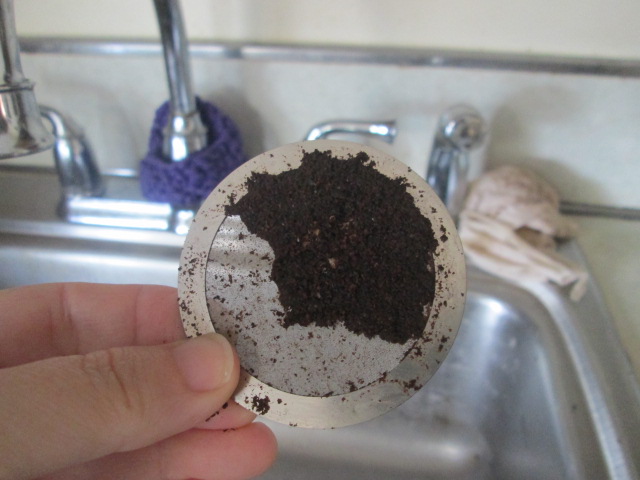
One downside of these metal filters is that they allow more sediment into the coffee than the paper  ones. However, this isn't a huge problem, particularly with the fine-mesh disk. A much bigger drawback is the extra cleanup work. Removing the filter from the press before knocking the grounds out into the bin doesn't sound like that much added hassle, and it wouldn't be if the filter came away cleanly. But no matter how carefully I pry it off (after running cold water over it so it's cool enough to touch), at least half the coffee grounds end up stuck to the filter rather than the press. And unlike the grounds stuck to the plunger itself, they don't come off cleanly. If I simply rinsed them off the filter, I'd be washing several grams of coffee grounds down the drain with every cup of coffee I brew, and I think it wouldn't be long before our plumbing objected to that. I've tried scraping the grounds off the filter onto the plunger before emptying it, but that never works neatly. Some grounds stay stuck to the filter no matter what I do, and some get all over my hands, so they have to be washed too.

I consulted Reddit on this subject and found two suggestions for dealing with this problem. Some users say that sliding the metal filter off sideways rather than lifting it off removes most of the grounds. Others say pulling the plunger back slightly and then inverting the press and letting it rest (without unscrewing the cap first) allows the grounds to drop back onto the plunger and away from the filter, leaving it mostly clean. I'll give both methods a try, and if either one works, then I'll be able to say definitively that the mesh filter is superior to the paper ones. 

[UPDATE, 5/5/24: I have now tried both methods of cleaning the metal filter. Neither one is perfect, but the first is much better than the second. When I invert the plunger and let it rest before removing the cap, the grounds do not fall away from the filter; they remain stuck to it at the top. When I remove the cap, some of the grounds fall off onto the top of the plunger, but at least half remain on the filter:

By contrast, when I rinse the plunger, unscrew the cap, and slide off the filter, it leaves only a thin film of coffee grounds behind. A quick spray with the faucet hose is enough to get them off. And I'm not concerned that the amount of coffee washing down the drain will clog it up.


I've also discovered another advantage of the metal filter: it fits more securely than the paper ones. With those, I always had to take care that the filter was exactly centered in the cap before screwing it on. If it wasn't, it would slip to the side and let some of the grounds through into my cup of coffee. I'd have to strain it a second time before I could drink it. 

So, in addition to saving me money and eliminating waste, this metal mesh filter has eliminated the two biggest problems with my Aeropress: the stuck-plunger problem and the slipping-filter problem. The additional step of rinsing the filter is a small price to pay for that.]

[FURTHER UPDATE, 9/13/24: I've now figured out that the best method of all for cleaning the filter is to combine the two suggestions. After rinsing the press and unscrewing the filter basket, I pull the plunger back slightly so the metal filter is flush with the bottom of the tube before sliding it off. This takes only a few seconds and leaves almost nothing stuck to the filter.]

Ecofrugal Episode 5: A Pressing Concern

A couple of weeks ago, I mentioned that I had ordered us a new (or more accurately, new-to-us) garlic press to replace our old Oxo one that broke. After a little research, we decided to go with the Joseph Joseph Garlic Rocker, which got consistently solid reviews from cooking sites. A new one costs $15 at Amazon, but since we don't do Amazon, we bought a secondhand one from eBay for $14 ($17 with shipping).

It has since arrived, and after testing it out several times, Brian reports that it's better in almost every way than its predecessor. It takes a couple of passes over a garlic clove to mince it as finely as the old one, but on the plus side, it does mince the entire clove rather than extruding part of it and turning the rest into a sort of squashed blob. It's easier to clean than the old press and takes up less room in the drawer. And since it's a solid piece of metal with no moving parts, we can be confident it won't simply fall apart like the previous one.

This espisode makes me inclined to add a seventh principle to my Ecofrugal Manifesto: Buy It to Last. (You could call this a subset of my sixth principle—Mend It, Don't End It—but I think it's different enough to deserve a principle of its own.) If you have to buy something new, buy something that's built to last as long as possible. Look for sturdy materials and construction, check reviews for complaints about durability, and minimize the number of moving parts that can break. And, other things being equal, opt for mechanical rather than electronic controls whenever possible. Electronics of all kinds usually cost more to repair than to replace—if it's possible to replace them at all.

Sunday, April 28, 2024

Gardeners' Holidays 2024: Mulching Day

April and May are insanely busy for us this year. What with our eclipse trip to Indianapolis at the beginning of the month, Passover this week, meetings and other events with Citizens' Climate Lobby, and dance gigs with Millstone River Morris, we don't have a single free weekend on our calendar between Easter and Memorial Day. 

Unfortunately, all this is happening during a busy part of the gardening year. We've managed to keep up with the absolutely essential chores, like planting squares of lettuce and spraying the plum trees. But less urgent jobs, like weeding and mulching, have languished on the to-do list for weeks. As a result, the weeds have been running more or less rampant over all our permanent planting areas—the flower and herb beds, the rhubarb and asparagus patches, and the areas under all our fruit trees and bushes. 

This morning, we finally decided we couldn't afford to put these tasks off any longer. Even if we couldn't do the entire job today, we could at least pick up a load of bulk mulch so we'd be able to get it started. So, right after lunch, we made the trek out to the Belle Mead Co-Op and bought half a yard of mulch, which we loaded into our usual assortment of containers (two trash barrels and a pile of empty birdseed bags). We also bought a package of seed potatoes to plant in our old rain barrel. (We'll probably have to buy soil in bags to plant them in; although the Co-Op also sells bulk topsoil, we can't currently use an entire half-yard of it, and we can't buy less than that.)

Once we got the mulch home, we spent the next couple of hours getting some of it into place. After first clearing away as many weeds as we could with our trusty stirrup hoe, we used up one of the big barrels on the spaces under the plum trees and the other in the asparagus bed. Then we hauled the remaining bags of mulch—which, though lighter than the barrels, were still quite heavy—down to the shed and hauled our panting, sweating selves inside for a couple of much-needed showers.

While putting down the mulch, we had a decent opportunity to observe the various areas of the garden and see how our crops are shaping up for the summer. The answer: It's kind of a mixed bag. The plum trees have finished blossoming and are starting to develop little fruitlings where the blossoms used to be, so there's at least a chance we'll get some plums this summer (though we're not counting on it, since we seem to alternate between bumper crops like last year's and complete duds). The cherry bushes have also shed all their blossoms, but not only is there no fruit to be seen on the branches, there are hardly any leaves. We don't know whether the bushes are just stressed or actually dying, but we're already thinking ahead to what we might replace them with in case they don't recover. (It looks like the best bet for our heavy clay soil might be aronia, also known as chokeberries.)

In the garden itself, our scallions and parsley are looking reasonably healthy, and our arugula and spring lettuce are just starting to come up. However, our snap peas are a big disappointment. We're used to getting only about half as many pea vines as we plant, but this year only 9 of the 32 plants I put in have come up—less than one in three. The seeds were brand new, so the problem wasn't their age, and we soaked them overnight before planting them, so it wasn't lack of water. Based on a guide at Tiny Garden Habit, the likeliest explanation seems to be that birds or other critters have been eating the peas before they can take root. Next year we may have to try covering the seeds with a cage for a couple of weeks, or maybe even starting them indoors. 

Another thing we've had a chance to observe early results on is the leaf cover we put down on the garden paths last winter. As you can see in the picture above, it appears to be somewhat effective, but far from perfect. There are quite a few dandelions and a few stray strands of mugwort poking their heads through the leaves, but the paths aren't completely overrun with them. I guess we'll try adding more leaves to the paths this winter and see if we can eventually build up a thick enough carpet to keep the paths weed-free. Even if it doesn't work, a carpet of leaves with a few weeds poking through is a lot better than a carpet of weeds tangling around our ankles every time we enter the garden.

So, all in all, our garden appears to be off to a bumpy start for this year. It's not clear how much of a harvest we have to look forward to, and it will probably be a while before we're able to harvest anything at all.  But considering how little time we'll have to spend in the garden over the next month, maybe that's just as well.

Sunday, April 21, 2024

What we're doing for Earth Day

This year, Earth Day overlaps with the start of Passover—which means, ironically, that we're going to spend it being a little less ecofrugal than usual. Normally we wouldn't drive anywhere on a Monday; Brian would either bike to work or work from home. But tomorrow, we'll have to drive to get to my parents' house for the Seder, and since my family isn't kosher, that meal will include both meat and dairy (a free-range chicken for dinner and ice cream with fruit compote for dessert). And our menu for the following week will also include more meat and dairy than usual, since many of the Passover-friendly recipes we know include either one or the other. 

Fortunately, Brian and I are making up for that by increasing our efforts in the lead-up to Earth Day itself. Over the past week or so, our earth-friendly activities have included:

  1. Trying a new vegan restaurant. Last weekend, we went to a show with some friends in the nearby town of Metuchen, and they suggested meeting for dinner beforehand. I did a little investigation online to find a vegetarian-friendly restaurant in Metuchen and discovered one called Red's Leaf Cafe where the menu is 100 percent vegan. The place is quite small, with just a handful of tables, but everything we ordered—the shared oyster mushroom appetizer, Brian's sesame seitan, my orange lion's mane mushrooms over coconut rice—was very tasty. Unfortunately, it was also pretty pricey; the bill for our party of four, including tip, came to $160. So I don't think we'll want to visit there on a regular basis, but if we have guests we want to impress, it could be worth another trip.
  2. My monthly Citizens' Climate Lobby (CCL) meeting. Most months, this group holds its monthly meeting on Tuesday night, with only a few people meeting in person and the rest joining via Zoom. This month, for a change, it met at a Unitarian church in Somerville on Saturday afternoon. (Brian helped make my trip up there more eco-friendly by driving me there and spending the time while I was at my meeting running errands in town.) My favorite part of the meeting was watching the monthly presentation from CCL's national organization, which featured an interesting speaker: Ernesto Alcantar of Potential Energy, the self-described "marketing team for planet Earth." His presentation focused on eight principles for having productive conversations about climate with people who don't live in our climate-activist bubble. His tips include "talking like a human" (avoiding jargon like "carbon footprint" and even "greenhouse gas"), avoiding partisanship, and focusing on "humans, not concepts."
  3. More visible mending. After my success fixing the holes in Brian's socks with Scotch darning, I decided to try a new technique called honeycomb darning for reinforcing some worn areas that didn't have holes yet. This method involves putting in a series of blanket stitches running all around the edge of the worn spot, then looping through those stitches to add another row of stitches farther in, and repeating the process until you get to the middle. This video on YouTube does a good job of explaining the process, including what to do with the dangling "tail threads" at the end. One thing it doesn't show is what to do if, like me, you misjudge how much thread you need and end up running out before you've finished the job. I had to guess how to work in a new piece of thread to pick up where the first one ran out. But I later found a second video on the same subject that does show what to do, and its method is pretty much the same as mine, so apparently I guessed right.
  4. Joining a stream cleanup. Several members of our CCL chapter took part in the Raritan Headwaters 34th Annual Stream Cleanup yesterday. (Since this blog is technically social media, I'll throw in the tags @raritanheadwaters and #RHAstreamcleanup here.) The area we were assigned to was Spruce Run Recreation Area in Clinton, which is actually along a reservoir rather than a stream. Our team of seven didn't go into or near the water itself; instead we donned yellow vests and combed the verge along a half-mile stretch of road near the park entrance. By far the most common type of trash we found was cigarette butts—over 150 of them—followed by plastic bottles and wrappers. (Little mini liquor bottles and cigarette butts were particularly likely to be found together.) The most unusual item we found was a piece of hardware that no one in our group, or in the larger group running the event, could identify. It's a...well, some sort of knob bolted to some sort of hinge, sort of? If you can figure out what it's for, please let me know.
  5. Secondhand shopping. The stream cleanup happened to fall on the same day as the town-wide yard sales in Metuchen, so we couldn't spend the entire day strolling around and browsing sales as we normally would. But after coming home and having some lunch, we headed up to Metuchen to get in a couple of hours of yard-saling in the afternoon. Between the huge rummage sale at the First Presbyterian Church and a few other sales we visited in that same neighborhood, we managed to pick up three items of interest—a Fairport Convention CD, a peacock-blue T-shirt for me, and a Ngaio Marsh mystery—for $2.50 total. (Unfortunately, we then spent twice that amount at a local cafe on a cup of coffee for me, since I was practically falling asleep on my feet after our early morning and busy day.) Not a very impressive haul, but I followed up on it just now by ordering us a secondhand garlic press on eBay to replace the one that just fell apart as Brian was cooking dinner. (Since this one has a one-piece "rocker" design, with no moving parts, we know it won't break like its predecessor. And The Spruce Eats says it can mince ginger, too.)

Add all that in to our everyday earth-friendly activities, such as eating meatless meals, hanging our laundry, and Brian's regular bicycle commute, and I'd say we're not doing too badly.

Sunday, April 14, 2024

These darned socks

Brian and I don't tend to spend a lot of money on clothing. Even our "investment pieces," like my fall coat and Brian's one good suit, typically come from thrift shops. But one item we don't cheap out on is winter socks. We both splurge on $22-per-pair Smartwool socks, which keep our feet cozy and warm without itching, and then wear them until they literally fall to pieces. I've always done my best to extend their lifespan by stitching up small holes as they formed, but eventually the holes would get too big to close up this way. At that point, our pricey socks would be fit only for the rag bin.

Once or twice, I attempted to salvage the socks by darning them. The only way I knew of to do this was the traditional weaving technique: make long stitches across the hole horizontally, then follow up with vertical stitches that weave in and out of the horizontal ones. Unfortunately, this never worked very well. If I put the horizontal stitches far apart, the weave was too loose, and if I put them close together, it was too hard to weave in between them. And in either case, it always came out lumpy.

That's why I was intrigued to learn about a visible mending technique called Scotch darning. With this method, you put in only one row of stitches at a time, as if you were knitting rather than weaving. Each row of stitches is secured to the row above it and is secured at either end to the good fabric outside the hole. (It's a bit hard to explain in words, but this YouTube video illustrates it quite clearly.) With this method, there's no worry about how to space the long stitches and no fiddling with weaving in and out between them. And if you make your thread too short and it runs out midway through the process, that's okay; you can just  start a new row and keep going, securing it to the one you just finished.

So I decided to give this method a try with one of Brian's Smartwool socks that had reached the limits of my normal darning abilities. I started out using some fine grey yarn that I'd had sitting around for years, but it kept breaking, so I switched to a heavier blue yarn that I'd received as part of a learn-to-knit kit. (All my attempts to make sense of the instructions in the knitting book had so far come to naught, so I figured there wasn't much sense in saving the yarn for a project I'd probably never manage to complete.)

It was a bit difficult to thread a needle—even my biggest "sailcloth" needle—with this thick yarn, but once I managed that, the actual stitching process went fairly smoothly. I quickly got the hang of the pattern: under the top row, under the bottom row, over the thread, pull it tight, and repeat. As one of the comments on the YouTube video observed, it was almost meditative. After I got the entire hole stitched up, I had Brian try on the sock, and while he could feel the difference between the darned area and the rest of the fabric, he said it wasn't uncomfortable. So I carried on, stitching up holes and worn areas in three more socks.

I ran into only two problems as I worked my way through this lot. First, the yarn kept getting twisted up as I tied it into loops, and I had to stop periodically and let it unwind itself. Second, I had trouble gauging how much yarn I needed to cover a hole completely. On my first attempt, I ran out of yarn and had to sister in a new length of yarn halfway down. The next time, I deliberately cut my yarn much longer than I thought I needed—far longer than the length of my arm, so that I had to stop after every stitch and spend a minute pulling the long strand through with both hands. This proved to be far more than I needed, leaving me with over a foot left over once the hole was completely covered. So I cut it off and used the extra yarn to get started on the next hole, only to find that it was once again too short and I had to re-thread the needle halfway through. I worked my way through four socks without ever really figuring out how much was the right amount.

Although this Scotch darning technique was a smooth enough process once I got going, it wasn't a quick one. I didn't time it, but I'm sure I spent at least an hour and probably over two hours getting through all four socks. It might have gone faster if I'd been using a finer yarn that was easier to get through the needle or if I'd known what amount to use, so that I wouldn't have to keep re-threading it in the middle of a hole. But even if I were doing it perfectly, it would still require a fairly significant investment of time. (Even the experienced sewer in the YouTube video takes nine and a half minutes to stitch up one medium-sized hole.) 

Given the time involved, this probably wouldn't be worth doing for cheap everyday socks. But taking an hour to repair a $22 pair of Smartwool socks is like earning a $22 hourly wage, and that beats New Jersey's minimum wage by nearly $7 an hour. Plus, it keeps them out of the landfill. And there's a certain satisfaction in sticking it to The Man by fixing my own darned socks (ha ha) instead of shelling out for a new pair like a good little consumer.