Sunday, January 26, 2025

What's holding back plant-based protein?

I recently discovered The Tyee, an independent Canadian news site with a leftward bent. Flipping through to see what sorts of stories it covered, I happened on one about a "revolutionary" new plant-based protein made from mycelium, the root-like fibers that connect networks of fungi underground. The company profiled in the piece, Maia Farms, claims it can cultivate and harvest its mycelium protein in just seven days, as compared to 18 months to grow a calf to adult size and slaughter it for beef. Its process produces 84 percent lower carbon emissions per "unit of production" than chicken, which in turn has only about 12% of the carbon footprint of beef. The founder of Maia Farms calls his product "arguably the most efficient form of agriculture that will ever exist" and says it could be a "global solution" to the problem of meeting the protein needs of a growing population. All of which, obviously, sounds fantastic. 

But I was not impressed. Why not? Because I've heard this same story so many times before from so many other producers of plant-based protein—all of which have, so far, completely failed to make a significant dent in humanity's meat consumption. 

In 2023, for instance, the Climate Coach column in the Washington Post ran a story (free gift link for non-subscribers here) about Plantible, a California startup producing a protein called rubisco from fast-growing duckweed. The article touted rubisco as a versatile protein that can easily step in to do the job of eggs, meat, or butter. It also noted how easy the duckweed is to grow, producing "36 metric dry tons per hectare — roughly 10 times more than soy." It sounded like it should be utterly revolutionary. Yet in the 19 months since that article came out, I have not seen Plantible's Rubi Protein, nor any product that contains it, in any store. Obviously, it takes time for a new product to scale up, but based on Plantible's website, I can't find any evidence that its product is available anywhere at all.

If these plant-based proteins are so revolutionary, so efficient, so sustainable, then why aren't they everywhere? The Climate Coach article implies that the main barrier to wider adoption is taste: plant-based proteins, it says, "fall short of the savory appeal of eggs, dairy and meat." But I don't buy that argument. Brian, a longtime fan of beef, says burgers and bratwursts from Impossible are, to him, indistinguishable from the real thing. That is, until you look at the price tag. On Target's website, a bag of six Impossible Burgers (in their new red packaging, designed to appeal more to carnivores) costs $13.59, or $9.06 per pound. A 3-pound bag of store-brand beef burgers costs $13.99, or $4.66 per pound—roughly half as much. At those prices, what reason would anyone who isn't a vegetarian already have to switch?

I can only see two ways that plant-based proteins will ever become more popular than the animal products they're meant to replace. Either they'll have to get a lot cheaper, or the animal-based products will have to get a lot more expensive. And there's some chance that economies of scale will, in fact, drive down the cost of plant proteins. A 2021 analysis from the Good Food Institute (GFI) shows that, while plant-based meats and cheeses were about 40 percent more expensive in 2020 than corresponding animal products, plant-based products in "more developed categories," such as plant milk and butter, had a much smaller price premium of 7 to 11 percent. So maybe, once mycelium and rubisco proteins have been around as long as soy milk, they'll be more affordable. But they won't be doing much to halt the growth of food-driven carbon emissions in the meantime.

But there's also the second possibility: a spike, or even a sustained rise, in the price of animal proteins. We're starting to see it right now with eggs, which have jumped in price to an average of $4 per dozen from $2.50 just a year ago. That inflated price is still considerably cheaper than Just Egg, but it's significantly more than scrambled tofu. One large egg weighs about 2 ounces, so a two-egg scramble would be about 4 ounces' worth and cost 67 cents. Last time we bought tofu, we paid only $1.29 per pound, so a scramble made with 4 ounces of tofu would cost only around 32 cents. Even if you throw in a pinch of turmeric for color and a pinch of black salt (kala namak) to give it an eggy flavor, it won't cost more than about 34 cents—roughly half the price of real eggs.

Honestly, I'm thinking the next time we make a recipe that includes scrambled eggs, like our staple weeknight meal of roasted Brussels sprouts with eggs and potatoes, we should just scramble up a corresponding volume of tofu instead. At both half the price and half the carbon footprint, it's an ecofrugal no-brainer. The only downside is that the leftover tofu in the package won't keep as long as eggs in their individual shells, so we'll need to make sure to use the rest of it up within a few days so it won't go to waste. But with the number of recipes we know that use tofu, that shouldn't be difficult. And it will allow us to save our precious eggs for the jobs that only they can do properly, like holding matzo balls and rice casserole together.

[Edit, 2/26/26: I've just learned why I've heard nothing about Plantible's products in the three years since they were announced. Turns out they've spent all that time waiting for approval from the FDA to use their Rubi Protein in food. Now that they have that approval and a working factory that can make Rubi Protein at scale, we might—maybe, possibly?—see it on shelves in the next year or two. Or three. Or...not.]

Thursday, January 23, 2025

Thrift Week 2025, Day 7: Giving

So far this Thrift Week, I've only looked at the money that the wealthy spend on themselves. But they also spend a non-trivial portion of their income on others. According to the latest Consumer Expenditures Survey, Americans earning over $200,000 per year devote more money to "cash contributions" than those with lower incomes—both in absolute dollar terms and as a percentage of their income. But the gap isn't as big as you might expect. The top income group devotes an average of 3.7% of its budget to charitable donations, as compared to 3.1% for Americans overall. Even the poorest Americans, those earning under $15,000 per year, manage to give away 1.5% of that.

If happiness economists are to be believed, wealthy Americans are making a sound investment when they give to charity, and probably missing a trick by not devoting a bigger share of their spending to this purpose. Multiple studies have shown that spending money on others gives people a bigger happiness boost than spending it on themselves. Wealthy people, who presumably have all the necessities of life already, stand to get more satisfaction out of their money by giving it away than by spending it on luxuries. And for those who aren't rich, giving money away is one of the easiest ways to feel like you are. Just the gesture of giving something, even if it's only a dollar to a sidewalk beggar, reminds you that you're better off than a lot of other people in the world. 

Even if your budget is so tight that you can't manage to squeeze that extra dollar out of it, there are other ways to indulge in what Louisa May Alcott called "the luxury of charity." You can: 

  • Shop through charity portals that donate a small percentage of your purchase.
  • Use a credit card that does the same thing.
  • Raise money for a cause on GoFundMe.
  • Donate food, clothing, or other household goods.
  • Donate your time by volunteering.
  • Donate blood (an especially valuable way to give right now if you live in New Jersey or New York, where blood banks are currently experiencing severe shortages).

Thus, I'm closing out this Thrift Week with a Treat for Today that's a treat both for me and for others: a donation to support SciShow, one of my favorite educational channels on YouTube. Hank Green, one of the channel's hosts (and, in my opinion, a total hottie), recently posted on Bluesky that to make accurate content, they rely on donations from one out of every 10,000 people who watches. So, to reward that special one percent of one percent, they are offering a deal: for a donation of $25, you get a postcard autographed by all the show's hosts containing art, facts, and a QR code linking to "one of four exclusive videos from me discussing my favorite frog facts." And for a donation of $60, you get all four postcards with all four frog videos. Such a deal!

Sure, that $60 is significantly more than I've spent on any of my previous birthday treats. But last year I donated $54 and got only one postcard, and all it had on it was a thank-you message with Hank's signature. So four whole postcards complete with frog videos for a mere $60 seems like a good value to me.

Oh, and I made an appointment to give blood next Tuesday. So even when Thrift Week is over, I can continue to treat myself—both with the warm glow of giving and with free cookies.

Wednesday, January 22, 2025

Thrift Week 2025, Day 6: Fragrance

Back on Day 3, I named Dom Perignon as a classic example of a luxury good, costing about $330 for a 750-mL bottle. But on a milliliter-for-milliliter basis, that stuff doesn't hold a candle to high-end fragrance. A 2023 article in (once again) Town & Country magazine lists a dozen perfumes that cost hundreds or even thousands of dollars per ounce. The most expensive scent on the list, Haute Luxe by Roja Dove, costs $3,500 for a 3.4-ounce (97-mL) bottle. That's $36 per milliliter—82 times as much as France's most iconic bubbly.

According to T&C, these pricey perfumes are "worth every cent." While the editors concede that "your signature scent doesn't need to cost an arm and a leg," they also claim that an "ultra-luxury fragrance" offers benefits a more "attainable" one can't, such as:

  • The "finest ingredients in the world" that went into it.
  • The skills of the "master perfumer" who created it.
  • The design and "natural materials" of the the bottle.
  • A "one-of-a-kind scent" that most people won't have.

All that sounds impressive, but really, a fragrance only has to do one thing: make you smell good. If it doesn't do that, then the luxurious ingredients, the fancy bottle, and the efforts of the master perfumer are simply wasted. And, conversely, if you can get a much cheaper scent that smells just as good to you, then the lack of fancy ingredients and "craftsmanship" matters not one whit. The proof of the perfume is in the sniffing.

So, if you want to "find your signature scent" without spending a bundle on it, where do you look? Well, you could disregard T&C's guide in favor of this one from Cosmopolitan, which recommends the best "affordable fragrances that smell luxe." But its definition of "affordable" is up to $70, which is still a bit much to risk on a scent you don't actually know you'll like. So if you want a chance to try before you buy, you could pick up a few test vials from Microperfumes, which sells tiny samples (just 0.75 mL) of different fragrances for as little as $3 apiece. Or, if you already know what fragrance you like but you don't like the price tag, you can search for a knockoff version at a site like Perfume Parlor. With a quick search there, I found a duplicate of that $36-per-milliliter Haute Luxe that costs only 56 cents per milliliter (with a 2-mL test vial available for just $4). 

Or, if you want a truly "one of a kind scent" that no one else is wearing, you can do what I do and make your own. My signature scent is a blend of three essential oils—sandalwood, vanilla, and cinnamon—mixed with a carrier oil in a little roller bottle. Last summer, the tiny bottles of essential oil that I bought back in 2020 finally started to run low, so I restocked with some bigger bottles from an online supplier: 2 ounces of sandalwood for $4, 1 ounce of vanilla for $6, and half an ounce of cinnamon that looked like an unbeatable value at just $1. Unfortunately, when I cracked it open, I realized why it was so cheap: it had a weird, acrid smell that was nothing at all like cinnamon. Thus, for the past few months, I've been making my perfume with just sandalwood and vanilla—all about those base notes, with no middle or top.

So, as my Treat for Today, I ventured out in the brisk January air to go to the local Rite Aid and drop $9 plus tax on a new bottle of cinnamon essential oil. (As Rite Aid is going through a bankruptcy right now, its shelves are looking a little picked over, but fortunately this particular essential oil is still well stocked.) It's a 1-ounce bottle, so at the rate I use it, I'll still have half of it left when my new bottles of vanilla and sandalwood oil run out. (At that point, I'll have to decide if I want to replace the sandalwood oil, which I've recently learned comes from a rare and over-harvested plant, with something more sustainable—like, ironically, a synthetic fragrance oil.)

Tuesday, January 21, 2025

Thrift Week 2025, Day 5: Beauty

Another way the very rich are different from you and me: They don't age as visibly. Partly, of course, this is because they can afford more nutritious food (see Day 2) and better health care. But also, they can invest in luxury skin care, spa treatments such as facials, "tweakments" such as Botox and fillers, and even plastic surgery. All that stuff decidedly doesn't come cheap. According to Real Self, a site that reviews beauty treatments, you can expect to pay an average of:

  • $35 for a prescription skin-care product containing Retin-A (tretinoin), which can gradually brighten your skin and improve elasticity if you use it regularly for at least 4 to 6 weeks
  • $208 for a HydraFacial, which reduces the appearance of fine lines for 1 to 3 months
  • $535 for a syringe of Botox, which can smooth away wrinkles for 3 to 4 months
  • $1,112 for a "vampire facial," which uses tiny needles to inject your skin with platelet-rich plasma pulled from your own blood, smoothing away skin damage over the course of multiple treatments and lasting 9 to 18 months
  • $3,229 for a "liquid facelift" that combines Botox with dermal fillers, improving wrinkles and moderately lifting sagging skin for up to 2 years
  • $16,690 for a full facelift—the most expensive option, but the only one that will last 10 years or more

None of these, obviously, will fit into a tight budget. Even the $35 topical treatment, with its modest effects, will run you $420 a year if you restock monthly. The rest, if you keep them up regularly, will most likely cost a grand or more per year. 

The most economical approach to beauty, obviously, would be to decide to love yourself wrinkles and all. But I'll admit that's not easy. Throughout my late forties, I found myself growing more and more dissatisfied with the face in the mirror, which didn't look like the way I thought of myself. I kept browsing the list of pricey treatments on Real Self, but I could never convince myself that any of them would be worth the money.

Finally, on my 50th birthday, I decided to spring for something that looked like it could give me just a little bit of a boost. I invested $150 (on sale) in a mini microcurrent device that claimed it could "significantly improve skin firmness & elasticity" in just a few minutes a day. The evidence for the effectiveness of microcurrent wasn't terribly strong, but I'd seen a few studies suggesting it could have at least a small benefit, and even if it didn't help at all, I wouldn't be out as much money as I would for a pricey professional treatment. I did a little research first to make sure that it would work without the expensive serums the company sells to go with it and found that a homemade conductive gel made from aloe vera gel with a bit of ordinary table salt could get the job done.

So did it work? Well, you can judge for yourself. Here's the "before" picture I took of my face in January 2023 (shot in the bathroom mirror because I'm hopeless at selfies):

And here's the one I took in May, after a few months of using the device nearly every day.

It's not a dramatic difference, to be sure, but many of the before-and-afters on Real Self are just as subtle, and for treatments that cost considerably more.

Another beauty booster I considered was collagen supplements. Once again, there were some studies suggesting that taking them regularly could improve skin texture and elasticity. But there were two problems: first, most brands contain bovine collagen, which isn't vegetarian-friendly, and second, even a relatively inexpensive brand like Vital Proteins costs around $1.25 a dose—over $450 a year if you take it daily. (You can get "marine collagen" made from fish instead, which would work with my flexitarian diet, but it's even more expensive.) Searching for a vegan alternative, I happened on some research about the benefits of aloe sterols found in plain old aloe vera gel. I found an aloe vera supplement that cost only pennies a dose and started taking that daily. Once again, the effects are subtle at best, but it certainly isn't doing me any harm, and it could potentially have benefits for my blood sugar as well. So, for such a low cost, I see no real downside to keeping it up.

The latest addition to my low-budget beauty routine is my Treat for Today: a little bottle of plant-derived squalane oil. This stuff is derived from squalene, a natural oil produced by your skin, and Cleveland Clinic reports it's good for hydration and can "slow the signs of aging." This little bottle from The Ordinary cost me only $10, and a little of it goes a long way; just five or six drops is sufficient to moisturize my entire face and neck. I use it in the evening, after using the microcurrent device and before applying my rosacea meds, and I don't need any additional moisturizer on top of that. It hasn't miraculously firmed up my skin, but it does leave it nice and soft, and for less than ten cents a dose, it adds an affordable touch of luxury to my evening routine.

Do I truly have the skin of a rich person? Almost certainly not. But is my budget beauty routine keeping me in pretty good shape for 52? Almost certainly yes. I mean, hey, Cameron Diaz and Jennifer Garner are my age, and they don't look that much better without makeup than I do.

Monday, January 20, 2025

Thrift Week 2025, Day 4: Clothing

When you picture a rich person, how are they dressed? Designer labels from head to toe? According to the Washington Post (gift link), Town & Country magazine, and the Style Theory channel on YouTube, that's a bit wide of the mark. There certainly are well-to-do folks who dress that way, but the really rich tend to go for "quiet luxury." Their clothing doesn't bear any obvious brand labels; in the words of O. Henry, it "properly proclaim[s] its value by substance alone and not by meretricious ornamentation." You'd have to look at it very closely to notice the details that make it so expensive: the luxe fabrics, the impeccable stitching, and crucially, the flawless fit. They often have garments altered, made to measure, or even custom made to fit them exactly.

So how do you get this look for less? The Style Theory video suggests starting with off-the-rack garments from mid-tier brands like Banana Republic or J. Crew, then getting them tailored for "an additional $20 or so" to give you that custom-fit look. But several comments on that video argue for my preferred approach: starting out with thrifted garments. In the first place, secondhand clothes from those same medium-priced brands will cost less than new ones; in the second place, they'll most likely be better made, as all but the highest of high-end clothing lines have cut back on quality in recent years to churn out clothing faster and more cheaply. You can take those secondhand clothes to the tailor and end up with a custom-fitted garment for the same price as you'd have paid for a lower-quality new garment straight off the rack. (This is also a handy strategy for those of us who have trouble getting a decent fit in new clothing. Rather than hunting all over for that elusive pair of pants that fits over the hips without gapping at the waist, we can just buy one that fits in the seat and have it taken in to close the gap.)


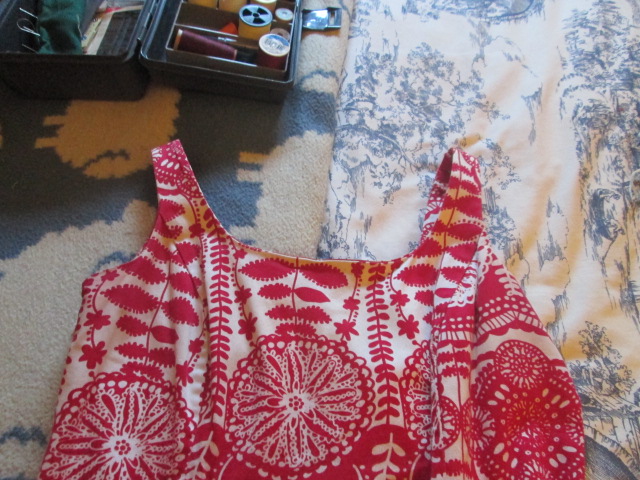
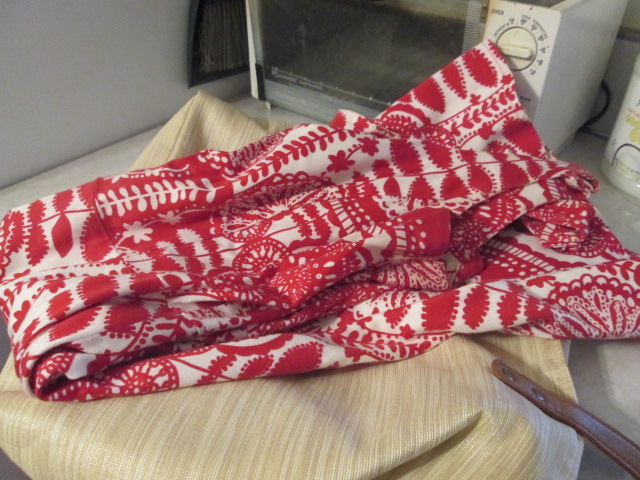
Now, while this thrift-shop-plus-tailoring approach costs a lot less than buying high-end brands to start with, that doesn't mean it's cheap. As I recently discovered, high-quality secondhand garments can actually cost significantly more than new ones from cheaper brands (though they may give you more quality for your dollar). Also, depending on what you want done, tailoring can cost quite a lot more than the $20 benchmark quoted in the Style Theory video. I was originally planning to have my Treat for Today be taking an item to the tailor: a red sundress I'd bought for $19 on eBay that was too big in the shoulders. I'd managed to make it wearable by pinning up the straps and loosely basting them into place, but the excess fabric made an awkward lump that I had to hide under a jacket. I figured for around $30 more, I could have the straps professionally adjusted and get myself a perfectly fitted dress for under $50 total. But when I got the dress to the tailor shop, they informed me that this simple alteration would actually cost $50 all by itself. (I also inquired about the cost of adding pockets to the dress, and that would have raised the price tag to $100.)

At that price, I wasn't sure this alteration would really qualify as an affordable luxury. So, before springing for it, I brought the dress back home and did a little investigation to see how hard it would be to shorten the straps myself. When I found a YouTube video showing a method that didn't require a sewing machine and looked well within my modest abilities as a seamstress, I decided to take the plunge. 

First, I turned the dress inside out, put it on, pinned the straps up to the right length, and stitched them in place. Then, I added an extra step not shown in the video: I turned the dress right side out again and tried it on to make absolutely sure I had the shoulders adjusted correctly. I knew once I took the next step—cutting the fabric—there would be no going back, so I followed the old carpenter's rule: measure twice, cut once.

Then I took the dress back off and, with some trepidation, made the fateful cut. I stitched the fragments of fabric down as shown in the video, then did the same on the other side. And when I turned it back right-side out and put it on again, lo and behold, it fit! With my rudimentary sewing skills, about a quarter's worth of thread, and about half an hour of work, I'd managed to make a perfectly respectable job of an alteration that would have cost $50 to have done professionally. My work may not look quite as neat as the tailor's would have, but you'd have to look quite closely at the straps to notice it, and how likely is anyone to do that?

So this is my actual Treat for Today: an elegant summer dress that fits me perfectly and only cost me $19 plus half an hour of work. In fact, I'm so encouraged by this success that I might just take a crack at adding those pockets myself, too. But that looks like a job that requires the use of the sewing machine, so I'll probably want to practice my machine skills a bit first. (And yes, I realize the dress looks a bit silly worn with a winter hat and long johns, but give me a break, it's January.)

Sunday, January 19, 2025

Thrift Week 2025, Day 3: Drink

It was perhaps a bit misleading for me to call the theme of this year's Thrift Week "Champagne tastes on a beer budget," because actually, I'm not that big a fan of bubbly. I'm happy to drink a toast in it to celebrate someone's wedding or graduation, but it's not a drink I'd choose for myself. I prefer alcoholic beverages (and, for that matter, nonalcoholic ones) with a bit of sweetness to them, like a nice tawny port.

However, a high-end tawny port doesn't exactly come cheap either. Some of the top-rated tawny ports at Vivino sell for over $300 a bottle, rivaling the price of Dom Perignon. So while it's not literally a champagne taste, it's one that could be equally pricey to indulge.

Fortunately, it doesn't have to be. The tawny Brian and I like best, Hardy's Whiskers Blake, sells for as little as $14 a bottle. It's not technically a port since it's not made in Portugal, but as far as I'm concerned, its dark, velvety flavor leaves nothing to be desired. Wine Spectator, which awards it an impressive 94 points out of 100, describes it as "Succulent and smooth...tremendously complex...layered with caramel, walnut, coffee, almond and orange peel flavors, long, elegant and spicy in the mouth." The highest-priced tawny on that same site, a 40-year-old Taylor Fladgate that costs $210, gets only 90 points, so I think we're missing nothing by choosing this bargain bottle.

The only problem with Whiskers Blake is that it's a little hard to find. The only store anywhere near us that carries it is in Somerville, half an hour's drive from here—a bit far to go just for a bottle of wine, particularly in weather like we're having this weekend. So instead, my Treat for Today is a tipple we picked up on our last trip to Trader Joe's: Joe-Joe's Peppermint Wine Cocktail. It's a sweet, creamy drink with a strong peppermint flavor. The bottle cost only $8.99, and a little of it goes a long way. Because it's so strong, I tend to sip it slowly, so I can easily nurse a couple of ounces over the course of an hour or two while curled up on the couch watching Critical Role or Taskmaster. And a dollop added to a cup of hot cocoa, along with a puff of coconut whipped cream, turns an everyday sip into an indulgent treat.

By the way, if your tastes actually do run toward Champagne, don't worry: there are budget-priced picks for you too. Sparkling wines from outside the Champagne region, such as Prosecco, Cava, or Cremant, are much cheaper than the real thing and just as fizzy and fabulous. Check out Gear Patrol and Reverse Wine Snob for recommendations costing as little as $8 a bottle.

Saturday, January 18, 2025

Thrift Week 2025, Day 2: Food

When you ask people to name a luxury good, many of them will probably think of traditional rich-people foods like caviar or lobster. And thirty years ago, this would indeed have been an accurate reflection of a multi-millionaire's diet. According to a 2018 story in Quartz, the 1991 Lifestyles of the Rich and Famous Cookbook featured these two luxury foods right on the cover, alongside such other delicacies as chocolate-dipped strawberries and capital-C Champagne in crystal goblets. But in the years since, the article notes, the lifestyles of the wealthy—including their food choices—have changed dramatically. Today, rich-people food is all about "wellness": cold-pressed juices, organic produce, "fermented lamb and local lichens" served at a high-end restaurant on a remote Scottish island.

Healthy whole foods like these are indeed more expensive than processed foods, especially if you're looking for local and organic produce and the green halo associated with it. (As it turns out, this halo is mostly illusory; local and organic foods have roughly the same carbon footprint as conventionally grown ones. Some reputedly earth-friendly foods, like grass-fed beef, are actually significantly worse than their cheaper equivalents.) But the cost doesn't have to be prohibitive—particularly for those lucky enough to live near a Lidl store. 

Over the course of our two most recent visits to Lidl, we picked up ten pounds of mandarin oranges, a cauliflower, half a pound of Brussels sprouts, three bell peppers, a pound of mushrooms, two eggplants, an avocado, a head of broccoli, a bunch of scallions, a bag of red onions, and an English cucumber, all for a grand total of $25.86. That works out to $12.93 per week—slightly less than the $13.06 per week the average low-income household (under $15,000 per year) spent on fresh fruits and veggies in 2023. (To be fair, we also bought some produce from other stores, but our total food spending was still less than half the limit set by the USDA's Thrifty Food plan.) And if you're looking for more traditional luxury foods, like caviar, Lidl carries those too—at prices that, while a bit steep, won't break the bank.

Which brings me to my Treat for Today: a half-pound of smoked salmon, purchased on our most recent Lidl trip for $8.39. Admittedly, anything that costs $16.78 a pound is still an extravagance, but as extravagances go, it's a pretty affordable one. Served on Brian's home-baked no-knead bread with sliced cucumber, accompanied by a salad of red leaf lettuce with walnuts, dried cranberries, and our favorite honey-garlic balsamic vinaigrette, it's a meal that wouldn't look out of place in the pages of a modern Lifestyles of the Rich and Famous Cookbook. And you don't have to be either rich or famous to enjoy it.